Why Conservation Is Crucial
pp. 5-6 · Read in the full issue
ALTHOUGH Australia attracts its fair share of crit icism, especially when it is spending millions of dollars to celebrate its first 200 years, there is one area in which it can stand as a model for the South Pacific: the conservation of fauna and flora. Not that the coun try’s record is without a significant number of blemishes an estimated 200 species of animals and plants, one per year of European settlement, have become extinct in Australia since 1788 but laudable efforts are being made and tradition notwithstanding, public attitudes have swung firmly in favour of environmental and biological protection. Not only have successive governments sought
to protect Australian wildlife in reserves and national parks and through the control of exports, but they have encouraged conservation in other countries.
One of the most significant initiatives in international fauna and flora protection is CITES the Convention on International Trade in Endangered Species. CITES seeks to control the exploitation of endangered plants and animals through rigorous prosecution of smugglers and through the promotion of alternatives to, for example, the fur of endangered cats or the export of rare orchids. And there is growing evidence that CITES is having an impact in those countries where it has been adopted.
But adoption has not been universal, and for a variety of reasons almost 70 nations have not signed the Conven tion. Among them are Fiji, Kiribati, Marshall Islands, the Federated States of Micronesia, Solomon Islands, Tonga, Tuvalu, Vanuatu and Western Samoa.
In the face of pressing economic and social needs, it is tempting to dismiss conservation as a side issue until one looks at the record in other developing nations. Brazil is destroying its greatest natural resource, the rainforest of the Amazon basin, at a rate of hectares per day for the immediate and long-term benefit of firms based in strong First World nations. Similarly, much of northern Africa’s growing desert (the Sahara is expanding southward at more than 25 kilometres a year) is “fed” by agricultural practices that allow the destruction of habitats and finely evolved natural systems. In the Pacific, the problem is growing too: timber exploitation, mainly in PNG and the Solomons, is endangering whole human communities as well as animal and plant groups. Even coastal fishermen are feeling the effects as the denudation of inland forests brings soil runoff to reefs, killing fish and corals.
A more telling statistic is that the International Union for the Conservation of Nature and Natural Resources’
Red Data Book , which lists animals and plants endan gered, or at risk of extinction, includes 237 animals alone in the Pacific region. No-one knows for sure how many plants are at risk; just as no-one knows for sure what effect the extinction of any one of those animals or plants will have on whole ecosystems, or the potential benefits to hu mans of chemicals extracted from animals (such as ma rine organisms) or plants. Quite apart from potential benefits to humanity, what value can we place on the sur vival of even the lowliest organism for its own sake? We are presumptuous if we decide which plants and animals may live, and which may not: just as we are when we di-
vide societies along racial, religious or ethnic lines.
The Pacific at tracts tourists and scientists because it is perceived as one of the planet’s last un spoiled regions. Un less Pacific peoples realise that their landscapes and their plant and animal communities are non-renewable, non negotiable re sources, their quaint customs and attrac tive artifacts are des tined to become savagely inappro priate reminders of how the inhabitants of paradise gradually sold their way into perdition.
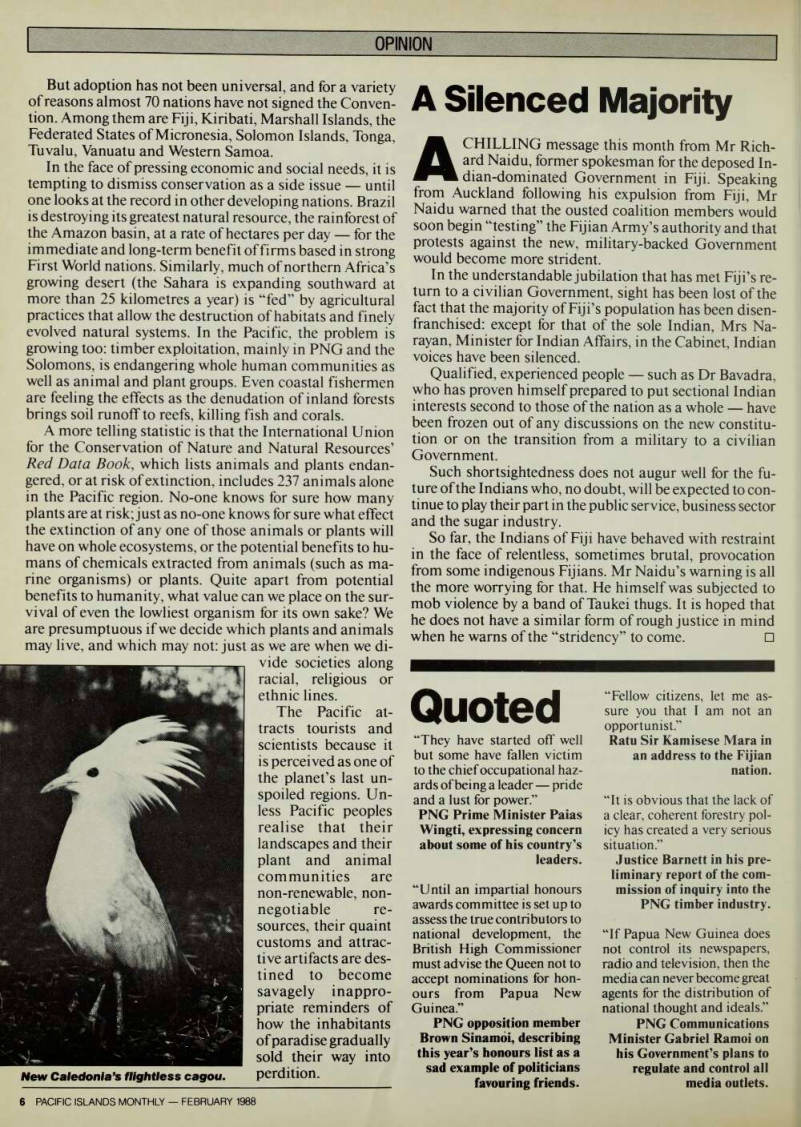
New Caledonia’s flightless cagou.