Thorns Among The Roses
Opinion
The Wingti Government’s excellent record has been tarnished lately by a series of potentially costly misjudgments and ministerial fiascos.
THE GOVERNMENT of Paias Wingti has much of which it can be proud. Its rural development pro gram the Prime Minister’s personal obsession is a highly praiseworthy scheme that, if successful, will make Papua New Guinea more self-sufficient, its citizens more prosperous and self-respecting, as well as enticing people from the relative anonymity and welfare queues of the cities back to the rich traditions of the provinces.
Also to the Government’s credit is its responsible for eign policy. Mr Wingti has made his nation more secure by locking Indonesia and Australia into trade and defence agreements, is establishing a host of new trading partners, and is an influential and eloquent spokesman for Me lanesian interests all over the Pacific.
The Government has benefited, too, by the dedicated
work of Sir Julius Chan in getting the business commu nity on side.
However, the Government’s record is not all rosy. Ma jor debits must be the decision to appoint national MPs to Government agency boards, the forcing of foreign owned coffee exporting companies to sell out by October, and the Government’s seeming inability to do anything about the country’s continuing law and order problems.
The Wingti Administration’s image has not been helped by the series of scandals, gaffes and fiascos that have dogged the steps of the once influential, now dis graced, Ted Diro and the hapless Mr Matiabe.
But the proposal with the potential to do the most tell ing damage to the Government is the controversial bill, announced by Communications Minister Mr Gabriel Ra moi, to control the nation’s media by the establishment of a mass media tribunal. Despite the Government’s high sounding claims that such controls will ensure the pres ervation of national ideals and put the brakes on foreign ownership, the bill reeks of Iron Curtain regulation.
Shackling of the media has no place in this otherwise energetic and free-spirited nation. And the sections of the bill that direct a licensee to publish whatever the minister deems to be of national importance, and that prohibit the publication of material prohibited by the minister, the mass media tribunal or the censor, are shackles of the most blatant kind.
When announcing the proposed legislation, Mr Ramoi said the bill was non-negotiable. Mr Wingti has since said he is seeking consultation with media owners, the churches, the opposition and business, a considerable softening of the original stance. It is hoped that this con sultation will help the Government see the error of its way and scrap this odious legislation.
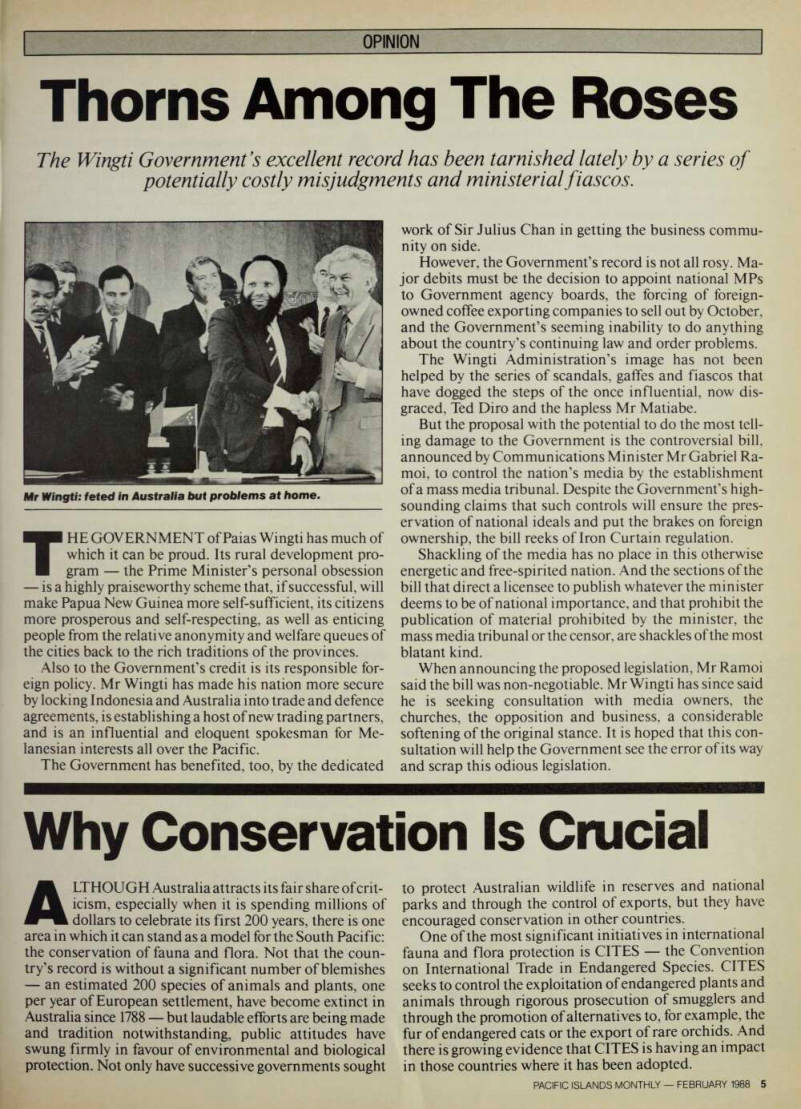
Mr Wingti: feted in Australia but problems at home.