Leaders And Their Legacies
pp. 26-27 · Read in the full issue
By Stuart Inder
WHEN considering the men and women whose deeds have had the greatest influence on the development of today’s South Pacific, whose names should be on the roll-call?
The list would be long and controversial, but in my view there are five who would have to be at the top: Queen Sal ote Tupou 111 of Tonga, Ratu Sir Lala Sukuna and Ratu Sir Kamisese Mara, of Fiji, Albert Henry of the Cook Is lands and Michael Somare of Papua New Guinea.
But first, some definitions: today’s South Pacific is the Pacific of the 15 independent or fully self-governing South Pacific Forum states, including Australia and New Zea land; and the non-Forum French and US Pacific territo ries. We will consider as candidates those people whose influence has been felt some time during the past 50 or so years: the years since about the beginning of World War II have been the crucial ones in the development of the region as it is today.
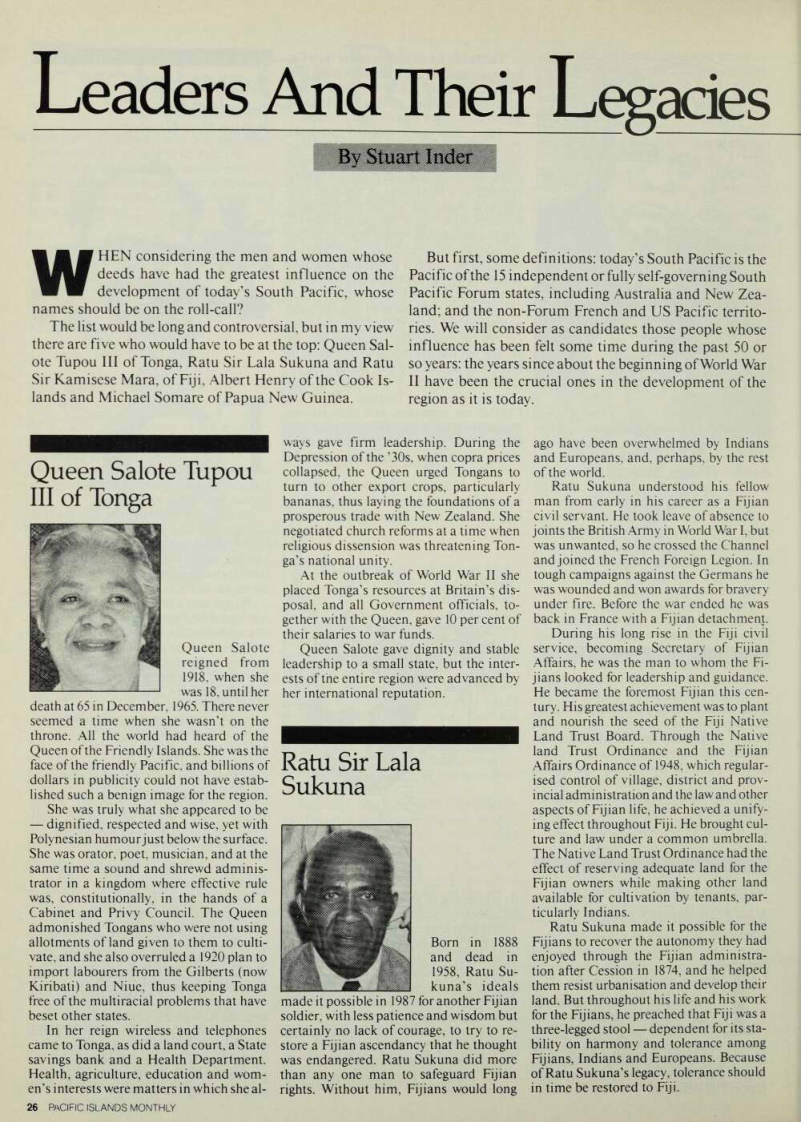
Queen Salote Tupou 111 of Tonga
Queen Salote reigned from 1918, when she was 18, until her
death at 65 in December, 1965. There never seemed a time when she wasn’t on the throne. All the world had heard of the Queen of the Friendly Islands. She was the face of the friendly Pacific, and billions of dollars in publicity could not have estab lished such a benign image for the region.
She was truly what she appeared to be dignified, respected and wise, yet with Polynesian humour just below the surface.
She was orator, poet, musician, and at the same time a sound and shrewd adminis trator in a kingdom where effective rule was, constitutionally, in the hands of a Cabinet and Privy Council. The Queen admonished Tongans who were not using allotments of land given to them to culti vate, and she also overruled a 1920 plan to import labourers from the Gilberts (now Kiribati) and Niue, thus keeping Tonga free of the multiracial problems that have beset other states.
In her reign wireless and telephones came to Tonga, as did a land court, a State savings bank and a Health Department.
Health, agriculture, education and wom en’s interests were matters in which she al
ways gave firm leadership. During the Depression of the ’3os, when copra prices collapsed, the Queen urged Tongans to turn to other export crops, particularly bananas, thus laying the foundations of a prosperous trade with New Zealand. She negotiated church reforms at a time when religious dissension was threatening Ton ga’s national unity.
At the outbreak of World War II she placed Tonga’s resources at Britain’s dis posal, and all Government officials, to gether with the Queen, gave 10 per cent of their salaries to war funds.
Queen Salote gave dignity and stable leadership to a small state, but the inter ests of the entire region were advanced by her international reputation.
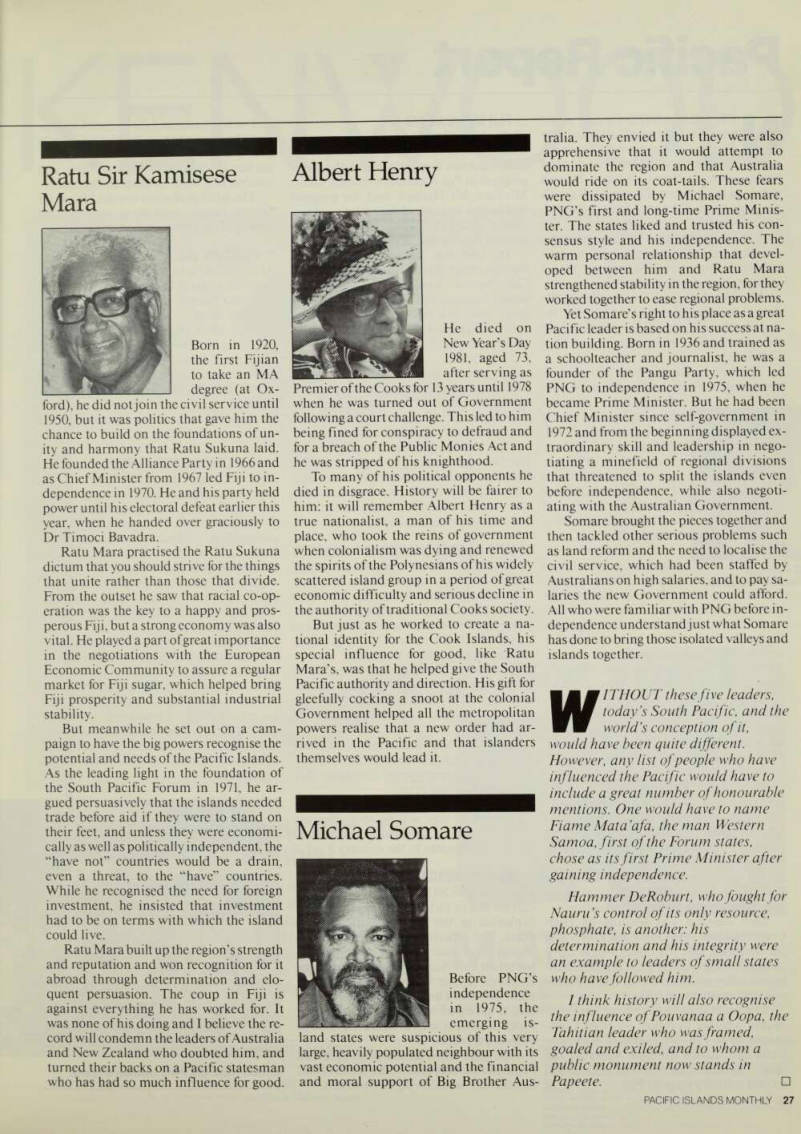
Ratu Sir Lala Sukuna
Born in 1888 and dead in 1958, Ratu Su kuna’s ideals
made it possible in 1987 for another Fijian soldier, with less patience and wisdom but certainly no lack of courage, to try to re store a Fijian ascendancy that he thought was endangered. Ratu Sukuna did more than any one man to safeguard Fijian rights. Without him, Fijians would long
ago have been overwhelmed by Indians and Europeans, and, perhaps, by the rest of the world.
Ratu Sukuna understood his fellow man from early in his career as a Fijian civil servant. He took leave of absence to joints the British Army in World War I, but was unwanted, so he crossed the Channel and joined the French Foreign Legion. In tough campaigns against the Germans he was wounded and won awards for bravery under fire. Before the war ended he was back in France with a Fijian detachment.
During his long rise in the Fiji civil service, becoming Secretary of Fijian Affairs, he was the man to whom the Fi jians looked for leadership and guidance.
He became the foremost Fijian this cen tury. His greatest achievement was to plant and nourish the seed of the Fiji Native Land Trust Board. Through the Native land Trust Ordinance and the Fijian Affairs Ordinance of 1948, which regular ised control of village, district and prov incial administration and the law and other aspects of Fijian life, he achieved a unify ing effect throughout Fiji. He brought cul ture and law under a common umbrella.
The Native Land Trust Ordinance had the effect of reserving adequate land for the Fijian owners while making other land available for cultivation by tenants, par ticularly Indians.
Ratu Sukuna made it possible for the Fijians to recover the autonomy they had enjoyed through the Fijian administra tion after Cession in 1874, and he helped them resist urbanisation and develop their land. But throughout his life and his work for the Fijians, he preached that Fiji was a three-legged stool dependent for its sta bility on harmony and tolerance among Fijians, Indians and Europeans. Because of Ratu Sukuna’s legacy, tolerance should in time be restored to Fiji.
Ratu Sir Kamisese Mara
Born in 1920, the first Fijian to take an MA degree (at Ox
ford), he did not join the civil service until 1950, but it was politics that gave him the chance to build on the foundations of un ity and harmony that Ratu Sukuna laid.
He founded the Alliance Party in 1966 and as Chief Minister from 1967 led Fiji to in dependence in 1970. He and his party held power until his electoral defeat earlier this year, when he handed over graciously to Dr Timoci Bavadra.
Ratu Mara practised the Ratu Sukuna dictum that you should strive for the things that unite rather than those that divide.
From the outset he saw that racial co-op eration was the key to a happy and pros perous Fiji, but a strong economy was also vital. He played a part of great importance in the negotiations with the European Economic Community to assure a regular market for Fiji sugar, which helped bring Fiji prosperity and substantial industrial stability.
But meanwhile he set out on a cam paign to have the big powers recognise the potential and needs of the Pacific Islands.
As the leading light in the foundation of the South Pacific Forum in 1971, he ar gued persuasively that the islands needed trade before aid if they were to stand on their feet, and unless they were economi cally as well as politically independent, the “have not” countries would be a drain, even a threat, to the “have” countries.
While he recognised the need for foreign investment, he insisted that investment had to be on terms with which the island could live.
Ratu Mara built up the region’s strength and reputation and won recognition for it abroad through determination and elo quent persuasion. The coup in Fiji is against everything he has worked for. It was none of his doing and I believe the re cord will condemn the leaders of Australia and New Zealand who doubted him, and turned their backs on a Pacific statesman who has had so much influence for good.
Albert Henry
He died on New Year’s Day 1981, aged 73, after serving as
Premier of the Cooks for 13 years until 1978 when he was turned out of Government following a court challenge. This led to him being fined for conspiracy to defraud and for a breach of the Public Monies Act and he was stripped of his knighthood.
To many of his political opponents he died in disgrace. History will be fairer to him: it will remember Albert Henry as a true nationalist, a man of his time and place, who took the reins of government when colonialism was dying and renewed the spirits of the Polynesians of his widely scattered island group in a period of great economic difficulty and serious decline in the authority of traditional Cooks society.
But just as he worked to create a na tional identity for the Cook Islands, his special influence for good, like Ratu Mara’s, was that he helped give the South Pacific authority and direction. His gift for gleefully cocking a snoot at the colonial Government helped all the metropolitan powers realise that a new order had ar rived in the Pacific and that islanders themselves would lead it.
Michael Somare
Before PNG’s independence in 1975, the emerging is
land states were suspicious of this very large, heavily populated neighbour with its vast economic potential and the financial and moral support of Big Brother Aus
tralia. They envied it but they were also apprehensive that it would attempt to dominate the region and that Australia would ride on its coat-tails. These fears were dissipated by Michael Somare, PNG’s first and long-time Prime Minis ter. The states liked and trusted his con sensus style and his independence. The warm personal relationship that devel oped between him and Ratu Mara strengthened stability in the region, for they worked together to ease regional problems.
Yet Somare’s right to his place as a great Pacific leader is based on his success at na tion building. Born in 1936 and trained as a schoolteacher and journalist, he was a founder of the Pangu Parly, which led PNG to independence in 1975, when he became Prime Minister. But he had been Chief Minister since self-government in 1972 and from the beginning displayed ex traordinary skill and leadership in nego tiating a minefield of regional divisions that threatened to split the islands even before independence, while also negoti ating with the Australian Government.
Somare brought the pieces together and then tackled other serious problems such as land reform and the need to localise the civil service, which had been staffed by Australians on high salaries, and to pay sa laries the new Government could afford.
All who were familiar with PNG before in dependence understand just what Somare has done to bring those isolated valleys and islands together.
MMMITHOUT these five leaders, today's South Pacific, and the mW world’s conception of it, would have been quite different.
However, any list of people who have influenced the Pacific would have to include a great number of honourable mentions. One would have to name Fiame Mata ’afa, the man Western Samoa, first of the Forum states, chose as its first Prime Minister after gaining independence.
Hammer Deßoburt, who fought for Nauru’s control of its only resource, phosphate, is another: his determination and his integrity were an example to leaders of small states who have followed him.
I think history will also recognise the influence of Pouvanaa a Oopa, the Tahitian leader who was framed, goaled and exiled, and to whom a public monument now stands in Papeete. □