Profiles Of Power
pp. 21-25 · Read in the full issue
Ten Leaders Who Wielded Influence In The Pacific In 1987
By John Dunn
N JL. ever before has the Pacific experienced a year of such trauma, and never before has it faced a future with such uncertainty.
The coups in Fiji, the continuing independence battle in New Caledonia, the Russian foothold in Van uatu, the Libyan attempt to spread its destabilising influence and the more recent troubles in Tahiti have marked, and marred, 1987.
To the rest of the nations of the region, Fiji’s tourist slogan “The Way the World Should Be”— always seemed to have a touch of genius about it because it was clearly so appropriate and described so aptly the harmony and tranquility, not only of Fiji but the en tire region.
Whatever and wherever the crises of the rest of the world, there was complete confidence among the people that this area was immune and would be unaffected.
Distance, which can be such a disadvantage in this faraway part of the Southern Hemisphere, was con sidered a significant plus because it provided an impenetrable insulation against imported problems. And of course there were no home-grown difficulties because that sort of thing just didn’t happen here. But the
lesson of these past 12 months is a sad one, and it is that now not even the South Pacific can escape the tensions and troubles that were so smugly thought to be the province of other peoples and places. The events of 1987 changed the rules and changed the face of the region forever.
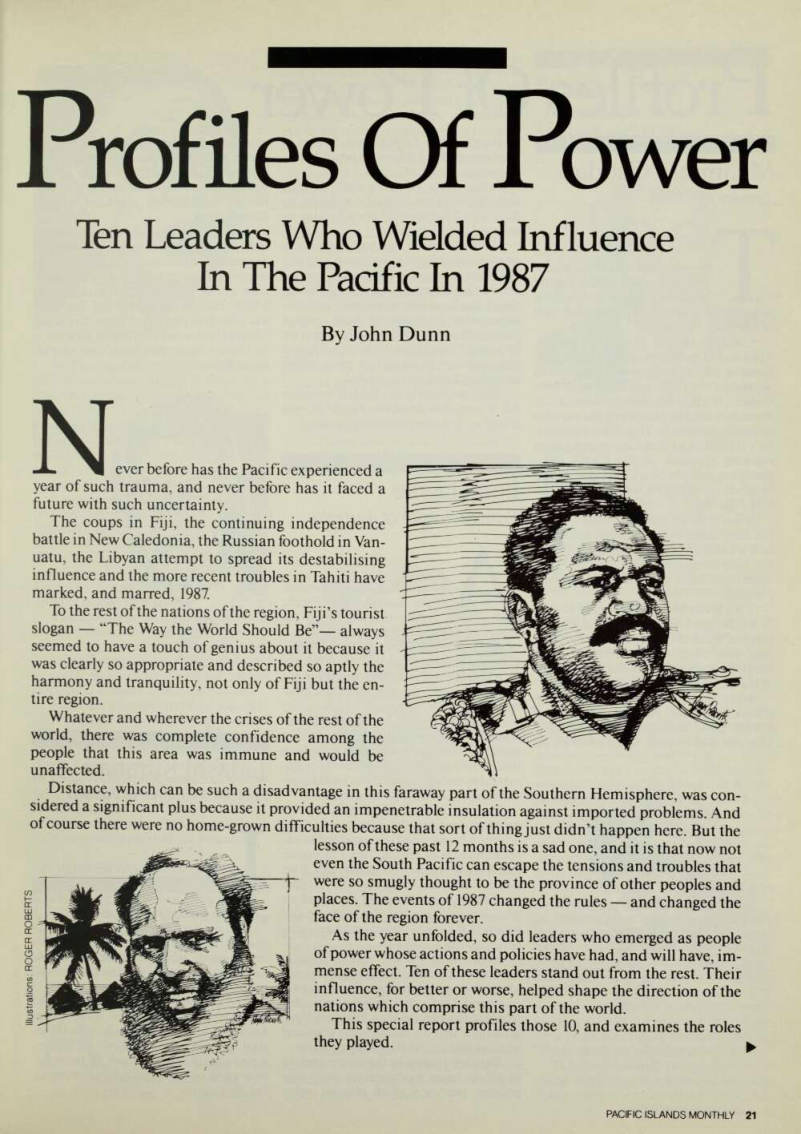
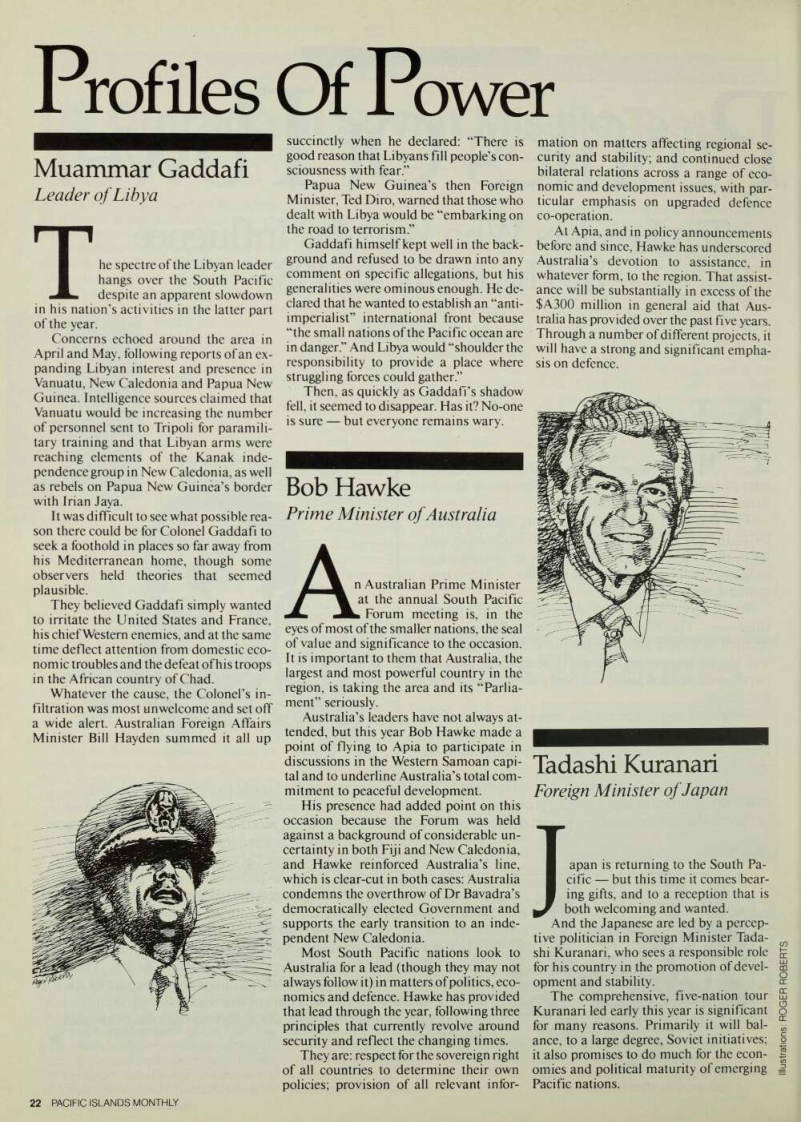
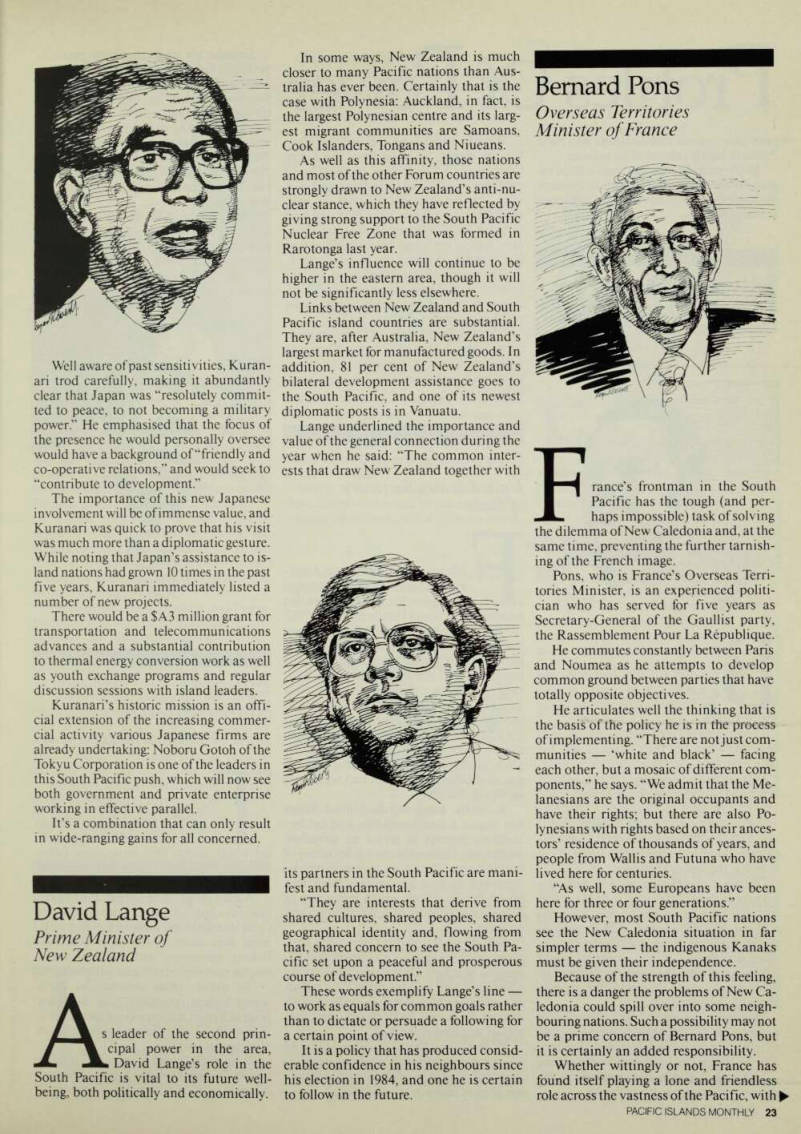
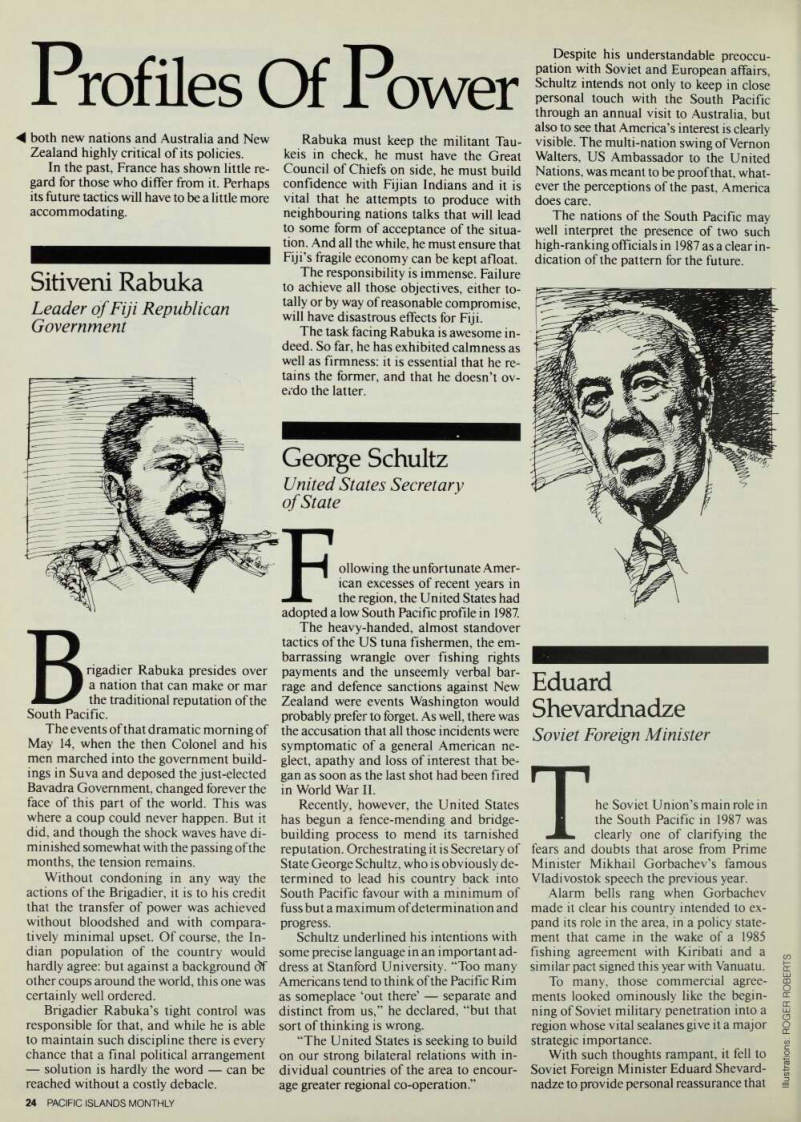
As the year unfolded, so did leaders who emerged as people of power whose actions and policies have had, and will have, im mense effect. Ten of these leaders stand out from the rest. Their influence, for better or worse, helped shape the direction of the nations which comprise this part of the world.
This special report profiles those 10, and examines the roles they played.
Muammar Gaddafi
Leader of Libya
T §■ he spectre of the Libyan leader j| hangs over the South Pacific ■JL. despite an apparent slowdown in his nation’s activities in the latter part of the year.
Concerns echoed around the area in April and May, following reports of an ex panding Libyan interest and presence in Vanuatu, New Caledonia and Papua New Guinea. Intelligence sources claimed that Vanuatu would be increasing the number of personnel sent to Tripoli for paramili tary training and that Libyan arms were reaching elements of the Kanak inde pendence group in New Caledonia, as well as rebels on Papua New Guinea’s border with Irian Jaya.
It was difficult to see what possible rea son there could be for Colonel Gaddafi to seek a foothold in places so far away from his Mediterranean home, though some observers held theories that seemed plausible.
They believed Gaddafi simply wanted to irritate the United States and France, his chief Western enemies, and at the same time deflect attention from domestic eco nomic troubles and the defeat of his troops in the African country of Chad.
Whatever the cause, the Colonel’s in filtration was most unwelcome and set off a wide alert. Australian Foreign Affairs Minister Bill Hayden summed it all up
succinctly when he declared: “There is good reason that Libyans fill people’s con sciousness with fear.”
Papua New Guinea’s then Foreign Minister, Ted Diro, warned that those who dealt with Libya would be “embarking on the road to terrorism.”
Gaddafi himself kept well in the back ground and refused to be drawn into any comment ort specific allegations, but his generalities were ominous enough. He de clared that he wanted to establish an “anti imperialist” international front because “the small nations of the Pacific ocean are in danger.” And Libya would “shoulder the responsibility to provide a place where struggling forces could gather.”
Then, as quickly as Gaddafi’s shadow fell, it seemed to disappear. Has it? No-one is sure but everyone remains wary.
Bob Hawke
Prime Minister of Australia
An Australian Prime Minister at the annual South Pacific ■ Forum meeting is, in the eyes of most of the smaller nations, the seal of value and significance to the occasion.
It is important to them that Australia, the largest and most powerful country in the region, is taking the area and its “Parlia ment” seriously.
Australia’s leaders have not always at tended, but this year Bob Hawke made a point of flying to Apia to participate in discussions in the Western Samoan capi tal and to underline Australia’s total com mitment to peaceful development.
His presence had added point on this occasion because the Forum was held against a background of considerable un certainty in both Fiji and New Caledonia, and Hawke reinforced Australia’s line, which is clear-cut in both cases; Australia condemns the overthrow of Dr Bavadra’s democratically elected Government and supports the early transition to an inde pendent New Caledonia.
Most South Pacific nations look to Australia for a lead (though they may not always follow it) in matters of politics, eco nomics and defence. Hawke has provided that lead through the year, following three principles that currently revolve around security and reflect the changing times.
They are: respect for the sovereign right of all countries to determine their own policies; provision of all relevant infor
mation on matters affecting regional se curity and stability; and continued close bilateral relations across a range of eco nomic and development issues, with par ticular emphasis on upgraded defence co-operation.
At Apia, and in policy announcements before and since, Hawke has underscored Australia’s devotion to assistance, in whatever form, to the region. That assist ance will be substantially in excess of the SA3OO million in general aid that Aus tralia has provided over the past five years.
Through a number of different projects, it will have a strong and significant empha sis on defence.
Tadashi Kuranari
Foreign Minister of Japan
Japan is returning to the South Pa cific but this time it comes bear ing gifts, and to a reception that is both welcoming and wanted.
And the Japanese are led by a percep tive politician in Foreign Minister Tada shi Kuranari, who sees a responsible role for his country in the promotion of devel opment and stability.
The comprehensive, five-nation tour Kuranari led early this year is significant for many reasons. Primarily it will bal ance, to a large degree, Soviet initiatives; it also promises to do much for the econ omies and political maturity of emerging Pacific nations.
Well aware of past sensitivities, Kuran ari trod carefully, making it abundantly clear that Japan was “resolutely commit ted to peace, to not becoming a military power.” He emphasised that the focus of the presence he would personally oversee would have a background of “friendly and co-operative relations,” and would seek to “contribute to development.”
The importance of this new Japanese involvement will be of immense value, and Kuranari was quick to prove that his visit was much more than a diplomatic gesture.
While noting that Japan’s assistance to is land nations had grown 10 times in the past five years, Kuranari immediately listed a number of new projects.
There would be a SA3 million grant for transportation and telecommunications advances and a substantial contribution to thermal energy conversion work as well as youth exchange programs and regular discussion sessions with island leaders.
Kuranari’s historic mission is an offi cial extension of the increasing commer cial activity various Japanese firms are already undertaking: Noboru Gotoh of the Tokyu Corporation is one of the leaders in this South Pacific push, which will now see both government and private enterprise working in effective parallel.
It’s a combination that can only result in wide-ranging gains for all concerned.
David Lange
Prime Minister of New Zealand As leader of the second prin cipal power in the area, David Lange’s role in the South Pacific is vital to its future well being, both politically and economically.
In some ways, New Zealand is much closer to many Pacific nations than Aus tralia has ever been. Certainly that is the case with Polynesia: Auckland, in fact, is the largest Polynesian centre and its larg est migrant communities are Samoans, Cook Islanders, Tongans and Niueans.
As well as this affinity, those nations and most of the other Forum countries are strongly drawn to New Zealand’s anti-nu clear stance, which they have reflected by giving strong support to the South Pacific Nuclear Free Zone that was formed in Rarotonga last year.
Lange’s influence will continue to be higher in the eastern area, though it will not be significantly less elsewhere.
Links between New Zealand and South Pacific island countries are substantial.
They are, after Australia, New Zealand’s largest market for manufactured goods. In addition, 81 per cent of New Zealand’s bilateral development assistance goes to the South Pacific, and one of its newest diplomatic posts is in Vanuatu.
Lange underlined the importance and value of the general connection during the year when he said: “The common inter ests that draw New Zealand together with
its partners in the South Pacific are mani fest and fundamental.
“They are interests that derive from shared cultures, shared peoples, shared geographical identity and, flowing from that, shared concern to see the South Pa cific set upon a peaceful and prosperous course of development.”
These words exemplify Lange’s line to work as equals for common goals rather than to dictate or persuade a following for a certain point of view.
It is a policy that has produced consid erable confidence in his neighbours since his election in 1984, and one he is certain to follow in the future.
Bernard Pons
Overseas Territories Minister of France
r> ranee’s frontman in the South I Pacific has the tough (and per- JL. haps impossible) task of solving the dilemma of New Caledonia and, at the same time, preventing the further tarnish ing of the French image.
Pons, who is France’s Overseas Terri tories Minister, is an experienced politi cian who has served for five years as Secretary-General of the Gaullist party, the Rassemblement Pour La Republique.
He commutes constantly between Paris and Noumea as he attempts to develop common ground between parties that have totally opposite objectives.
He articulates well the thinking that is the basis of the policy he is in the process of implementing. “There are not just com munities ‘white and black’ facing each other, but a mosaic of different com ponents,” he says. “We admit that the Me lanesians are the original occupants and have their rights; but there are also Po lynesians with rights based on their ances tors’ residence of thousands of years, and people from Wallis and Futuna who have lived here for centuries.
“As well, some Europeans have been here for three or four generations.”
However, most South Pacific nations see the New Caledonia situation in far simpler terms the indigenous Kanaks must be given their independence.
Because of the strength of this feeling, there is a danger the problems of New Ca ledonia could spill over into some neigh bouring nations. Such a possibility may not be a prime concern of Bernard Pons, but it is certainly an added responsibility.
Whether wittingly or not, France has found itself playing a lone and friendless role across the vastness of the Pacific, with
A both new nations and Australia and New Zealand highly critical of its policies.
In the past, France has shown little re gard for those who differ from it. Perhaps its future tactics will have to be a little more accommodating.
Sitiveni Rabuka Leader of Fiji Republican Government
r> rigadier Rabuka presides over W a nation that can make or mar the traditional reputation of the South Pacific.
The events of that dramatic morning of May 14, when the then Colonel and his men marched into the government build ings in Suva and deposed the just-elected Bavadra Government, changed forever the face of this part of the world. This was where a coup could never happen. But it did, and though the shock waves have di minished somewhat with the passing of the months, the tension remains.
Without condoning in any way the actions of the Brigadier, it is to his credit that the transfer of power was achieved without bloodshed and with compara tively minimal upset. Of course, the In dian population of the country would hardly agree: but against a background df other coups around the world, this one was certainly well ordered.
Brigadier Rabuka’s tight control was responsible for that, and while he is able to maintain such discipline there is every chance that a final political arrangement solution is hardly the word can be reached without a costly debacle.
Rabuka must keep the militant Tau keis in check, he must have the Great Council of Chiefs on side, he must build confidence with Fijian Indians and it is vital that he attempts to produce with neighbouring nations talks that will lead to some form of acceptance of the situa tion. And all the while, he must ensure that Fiji’s fragile economy can be kept afloat.
The responsibility is immense. Failure to achieve all those objectives, either to tally or by way of reasonable compromise, will have disastrous effects for Fiji.
The task facing Rabuka is awesome in deed. So far, he has exhibited calmness as well as firmness: it is essential that he re tains the former, and that he doesn’t ov erdo the latter.
George Schultz
United States Secretary
of State
T 7 ollowing the unfortunate Amer- I ican excesses of recent years in JL. the region, the United States had adopted a low South Pacific profile in 1987.
The heavy-handed, almost standover tactics of the US tuna fishermen, the em barrassing wrangle over fishing rights payments and the unseemly verbal bar rage and defence sanctions against New Zealand were events Washington would probably prefer to forget. As well, there was the accusation that all those incidents were symptomatic of a general American ne glect, apathy and loss of interest that be gan as soon as the last shot had been fired in World War 11.
Recently, however, the United States has begun a fence-mending and bridge building process to mend its tarnished reputation. Orchestrating it is Secretary of State George Schultz, who is obviously de termined to lead his country back into South Pacific favour with a minimum of fuss but a maximum of determination and progress.
Schultz underlined his intentions with some precise language in an important ad dress at Stanford University. “Too many Americans tend to think of the Pacific Rim as someplace ‘out there’ separate and distinct from us,” he declared, “but that sort of thinking is wrong.
“The United States is seeking to build on our strong bilateral relations with in dividual countries of the area to encour age greater regional co-operation.”
Despite his understandable preoccu pation with Soviet and European affairs, Schultz intends not only to keep in close personal touch with the South Pacific through an annual visit to Australia, but also to see that America’s interest is clearly visible. The multi-nation swing of Vernon Walters, US Ambassador to the United Nations, was meant to be proof that, what ever the perceptions of the past, America does care.
The nations of the South Pacific may well interpret the presence of two such high-ranking officials in 1987 as a clear in dication of the pattern for the future.
Eduard
Shevardnadze
Soviet Foreign Minister
nr 1 he Soviet Union’s main role in 1 the South Pacific in 1987 was clearly one of clarifying the fears and doubts that arose from Prime Minister Mikhail Gorbachev’s famous Vladivostok speech the previous year.
Alarm bells rang when Gorbachev made it clear his country intended to ex pand its role in the area, in a policy state ment that came in the wake of a 1985 fishing agreement with Kiribati and a similar pact signed this year with Vanuatu.
To many, those commercial agree ments looked ominously like the begin ning of Soviet military penetration into a region whose vital sealanes give it a major strategic importance.
With such thoughts rampant, it fell to Soviet Foreign Minister Eduard Shevard nadze to provide personal reassurance that
Moscow’s intentions were purely peace ful. To that end, his polished and charm ing performance in Australia was disarming indeed. Easily and affably, he set the tone at a lunch given by Australian Foreign Affairs Minister Bill Hayden.
“I have been told,” he said, “that in some of your coastal towns, facing the oceans, there are still cannons put there last century to fight off a Russian invasion.
That none of them has even fired a shot is in itself an eloquent fact.”
During talks with Hayden and Prime Minister Bob Hawke, Shevardnadze em phasised that Moscow sought only normal commercial and diplomatic relations with the small nations of the Pacific.
Shevardnadze’s style and credibility were well received, but the truth of the pol icy he promotes can be tested only by time; and there will be some who will want to reserve judgement on the words of the highest-ranking Russian ever to venture so deeply into the South Seas.
However, it must be said that his words overshadowed any current Soviet activity in Vanuatu and eased concern over Mos cow’s intentions at least a little.
Jean-Marie Tjibaou
New Caledonia FLNKS
Leader
T he success, or otherwise, of the game of patience that has been played so long and so well by Kanak leader Jean-Marie Tjibaou will probably have more effect on the peaceful future of the South Pacific than any other factor, Fiji included.
The battle for an independent New Ca ledonia waged by the Kanak Socialist Lib eration Front (FLNKS) has been waged relentlessly for years, and has been led with expert diplomacy by this former priest.
Apart from some isolated incidents, Tjibaou has been able to keep the lid on the aggressive factors in the self-govern ment movement and has managed to keep violence to a minimum. A militant, bot tom-line assessment of his performance, however, in terms of the gains achieved, would undoubtedly reveal that the tactics of dialogue and conciliation have failed. It would be no surprise if pressure began to mount on Tjibaou to take a much stronger and tougher line with the French.
Tjibaou is well aware of this. In addi tion to holding fast to his oft-repeated line “we call our country Kanaky and we are the irrevocable element that must be taken into account in any permanent so lution for the territory” he also sounds a strong warning. “Factions within the FLNKS are impatient with the non-vio lent strategy,” he says. “Of course our mil itants would prefer to take more positive action rather than letting themselves be struck by police.”
Some of those militants want to in volve Libya, Cuba and Vietnam by seek ing help from them. Again Tjibaou has so
far succeeded in maintaining his moder ate stance by preventing that.
But how long can he hold the line? As the French Government, buoyed by the September poll that voted by a massive 48,611 to 842 to remain a part of France, ignores the abstentions and marches on with its future plans for the territory, Tji baou counsels again.
“The referendum in no way changes the situation,” he points out. How it will change, and with what ramifications, de pends largely on the leadership of Jean- Marie Tjibaou.
Paias Wingti
Prime Minister of Papua New Guinea
T 7 very indication points to the f - Papua New Guinea of the fu lure under Prime Minister Paias Wingti being very different from the Papua New Guinea of the past.
Wingti has ambitious plans for his country and for what has become known as the Melanesian Spearhead, and he is bidding, albeit not too boldly, for a posi tion of power and influence not only within the region but also on the world stage.
Wingti sees a much more independent role ahead for Papua New Guinea. While its traditional ties with Australia will cer tainly remain, he aims to develop an un tied role both politically and commercially.
The Prime Minister wants to broaden his nation’s horizons and to develop strong associations with countries beyond his bailiwick, principally around the Pacific Rim the United States, the Soviet 'Union, China and Japan.
Says Wingti: “The Government now intends to move on to examine how re lations have been developing with other countries with substantial interests in our region, and to explore opportunities for increased, mutually beneficial, co operation.”
The first move in this new approach will be to establish trade commissioners in Australia, Japan and Europe and a dip lomatic mission in Beijing. That may be followed by a link with the non-aligned movement, though no firm decision on this step has yet been made. But despite this extension, Paias Wingti will continue to devote his principal attention to his own country and will not diminish his interest in relations with his neighbours.
He has firm rural development plans for his country. “I know what the priority is,” he says. “It’s to be with the people. To get the country moving and to get the people feeling it is moving.” □