Palau Suspends Nuclear Ban
pp. 42-43 · Read in the full issue
Palau
GIFF JOHNSON reports
BY A 3 to 1 margin Palau voters ap proved an amendment suspending a nuclear ban in the constitution which has effectively prevented the Com pact of Free Association from passing for five years. The August 4 vote virtually guaranteed that the disputed compact would win voters’ approval in the sixth try on August 21.
Palau’s now-amended constitutional provision requires a 75 per cent vote of ap proval for any agreement, such as the com pact, allowing nuclear weapons or nuclear waste transits or storage in the islands. The amendment will allow compact approval by simple majority for the US. The August 21 votes may be the final chapter in wrap ping up the last remaining UN Trustee ship. Compacts between the US and Marshall Islands and Federated States of Micronesia have already been implemented.
Although the previous votes in Palau on the compact produced majorities in fa vour, none could win 75 per cent support.
The US refused to change the central framework of the 50-year military/nu clear provisions that were the cause of the impasse.
After several initial votes rejecting the pact, the US agreed not to store nuclear weapons in Palau but allowed transit rights for nuclear-capable ships and aircraft, in addition to land for military use.
The US State Department said the
compact constitutional conflict was an in ternal Palauan problem to work out, and the US Congress went ahead and passed the compact late last year, although the pact as yet had to be formally approved by Palau.
When President Lazarus Salii was un able to win a 75 per cent majority in the June 30 vote, he immediately furloughed 900 government workers, nearly two-thirds of the workforce, citing a nearly bankrupt treasury.
Earlier in the year, Salii announced government workers, pay would be cut
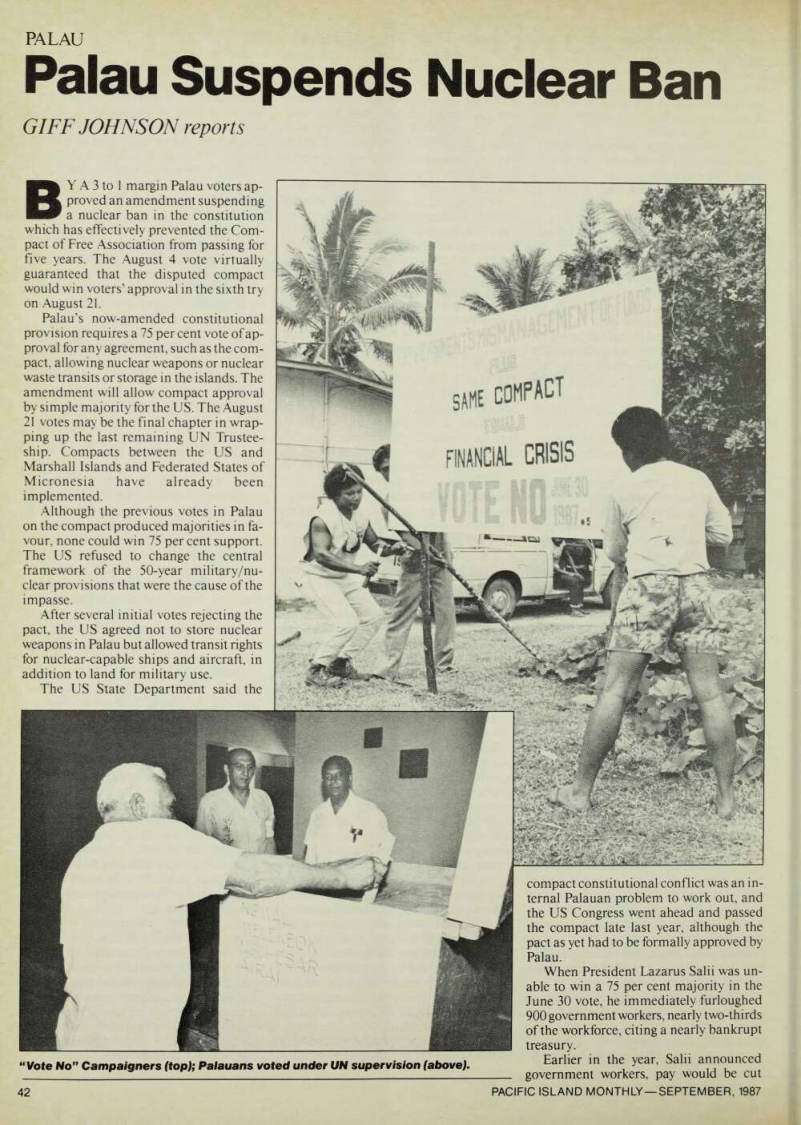
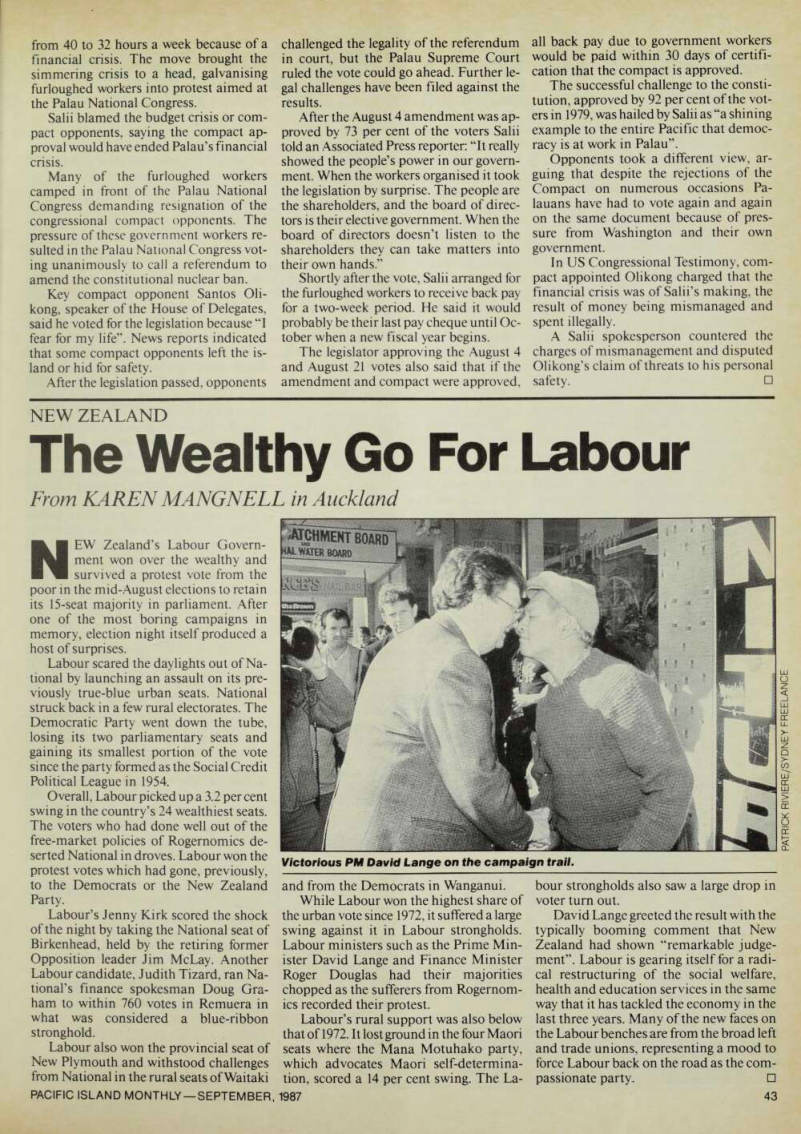
“Vote No” Campaigners (top); Palauans voted under UN supervision (above).
from 40 to 32 hours a week because of a financial crisis. The move brought the simmering crisis to a head, galvanising furloughed workers into protest aimed at the Palau National Congress.
Salii blamed the budget crisis or com pact opponents, saying the compact ap proval would have ended Palau’s financial crisis.
Many of the furloughed workers camped in front of the Palau National Congress demanding resignation of the congressional compact opponents. The pressure of these government workers re sulted in the Palau National Congress vot ing unanimously to call a referendum to amend the constitutional nuclear ban.
Key compact opponent Santos Oli kong, speaker of the House of Delegates, said he voted for the legislation because “I fear for my life”. News reports indicated that some compact opponents left the is land or hid for safety.
After the legislation passed, opponents
challenged the legality of the referendum in court, but the Palau Supreme Court ruled the vote could go ahead. Further legal challenges have been filed against the results.
After the August 4 amendment was approved by 73 per cent of the voters Salii told an Associated Press reporter; “It really showed the people’s power in our government. When the workers organised it took the legislation by surprise. The people are the shareholders, and the board of directors is their elective government. When the board of directors doesn’t listen to the shareholders they can take matters into their own hands.”
Shortly after the vote, Salii arranged for the furloughed workers to receive back pay for a two-week period. He said it would probably be their last pay cheque until October when a new fiscal year begins.
The legislator approving the August 4 and August 21 votes also said that if the amendment and compact were approved,
all back pay due to government workers would be paid within 30 days of certifi cation that the compact is approved, The successful challenge to the consti tution, approved by 92 per cent of the vot ers in 1979, was hailed by Salii as “a shining example to the entire Pacific that democ racy is at work in Palau”, Opponents took a different view, ar guing that despite the rejections of the Compact on numerous occasions Pa lauans have had to vote again and again on the same document because of pres sure from Washington and their own government.
In US Congressional Testimony, com pact appointed Olikong charged that the financial crisis was of Salii’s making, the result of money being mismanaged and spent illegally.
A Salii spokesperson countered the charges of mismanagement and disputed Olikong’s claim of threats to his personal safety. □