Alliance Activities
pp. 36-37 · Read in the full issue
A Pacific alliance would prepare and train to act in concert if the Soviets attack any of its members. It would also seek de velopment of the region, and would re solve disputes arising from economic competition. Given the Pacific’s geog raphy, the alliance would have a naval character. Many of its activities would re volve around maritime warfighting scen arios in the Pacific. In particular, an annual open-ocean exercise, similar to the cur rent Rim-Pac, would give all the treaty na val forces an opportunity to train together.
Each year, the exercise could take place in a different area of the Pacific Basin.
Some possible scenarios might include the following: Bering Sea Operations: The significance of the northernmost region of the Pacific is growing. The importance of the oil and natural gas fields and the sensitivity of the military bases there have caused US planners to rethink many battle group scenarios to include operating time in the region. Admiral Lyons has commented that the Pacific Fleet has made a “major
shift” in operating policy and its training now features the Tomahawk land-attack missile, amphibious assaults, and long range air intercepts in the Northern Pa cific. The United States, Japan, and the Soviet Union all come face-to-face in this region, which must be considered a poten tial zone of maritime conflict. Opera tional training there is needed soon for the alliance to develop an effective de fensive posture.
South China Sea Operations: The So viet military expansion at the $1 billion Cam Ranh Bay complex now includes more than 20 ships and hundreds of front line fighters, bombers, and strike aircraft.
From this strategic center on the South China sea, the Soviets and their Vietnam ese allies are positioned to strike at vital commercial and military targets through out the western Pacific. Any conflict with the Soviets would require the immediate neutralisation of the Cam Ranh Bay com plex which would be a proper alliance target.
SLOC Protection and Sea Control: Ensuring the continued freedom of the seas in the region would be a key alliance prior ity. Exercise scenarios that mainlian free transit despite both Soviet and Third World opposition - particularly at key choke points would help build alliance capabilities. These exercise regions in clude the major passages from the Indian Ocean into the Pacific, the sealanes from Japan to the United States, the rim archi pelagos, and the South Pacific lanes from the United States to Australia and New Zealand.
Amphibious Assault/Strike Opera tions: Alliance activities should include training for effective amphibious assault and land-attack operations. Both will be key to containing the Soviets effectively in the Pacific in open war.
In addition to developing naval capa bilities, the alliance could serve as a ve hicle for improving economic and political cooperation between the signatories. The concept of a Pacific summit to parallel the Western Summit meetings should be explored.
One possible format for the Pacific Al liance Treaty would be a simple document opening economic relations and enhanc ing collective security, based loosely on the model used successfully for NATO.
A Pacific alliance, if forged today, would be different from NATO in many ways.
Cultural differences are far more striking among many Pacific players than among the Western Europeans, for example, and the region has many long-standing con flicts and continuing controversies.
The US has far less influence and power to push a Pacific treaty than it had in 1945- 49. Yet the time may be coming for such an agreement, because of the increased Soviet threat, the passage of time since World War 11, and above all because of the surge of mutually beneficial eco nomic activity in the Pacific Basin.
A Pacific alliance would look to the fu ture, drawing together countries with dis parate cultural and religious backgrounds and widely diverse geopolitical positions and objectives.
A Pacific alliance might be the most ambitious treaty negotiation ever under taken and it might prove the most far seeing, as well. □
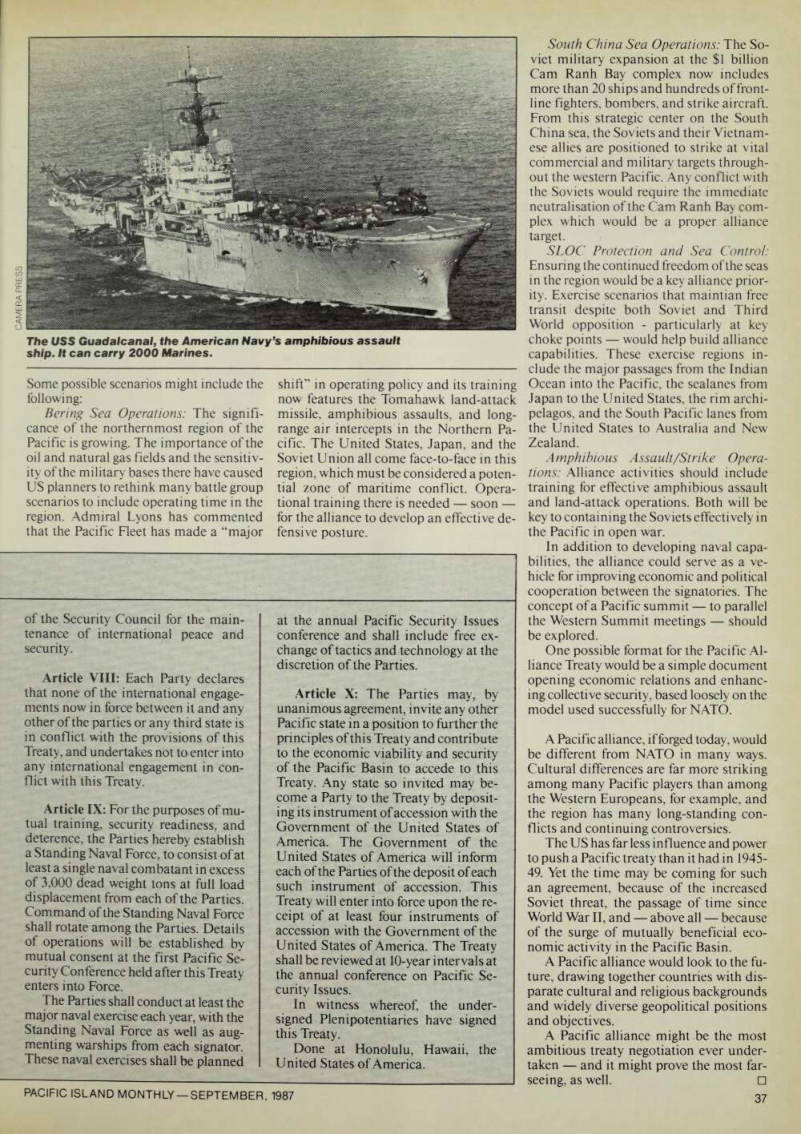
The USS Guadalcanal, the American Navy’s amphibious assault ship. It can carry 2000 Marines.