Alliance in the Pacific
pp. 34-35 · Read in the full issue
Defence
An article in the United States Naval Institute magazine Proceedings suggests that the US should take the lead in establishing a new economic and defensive alliance system to contain Soviet intrusion in the region.
By Lieutenant Commander JAMES STAVRIDIS.
ANEW wind is sweeping across the huge Pacific Basin. Many observers believe the destiny of the United States lies in the West. Yet the basin is far from a US lake. The Soviet Union is gradually intruding into the region, and the Japanese economic juggernaut continues.
Meanwhile, other vitally important countries are experiencing internal and external instability from dissension in both Koreas to the fighting by angry mi-
norities in the Philippines and Indonesia, The old alliance systems for the area are weak and lack direction. The Southeast Asia Treaty Organisation (SEATO), con ceived before the Vietnam War, was fi nally dissolved on June 30, 1977. The Australia-New Zealand-United States (ANZUS) Pact, dating from the immedi ate postwar era, appears to be finished, a victim of the Kiwis’ angry withdrawal over the US ship visit policy.
Neither Japan nor China, each facing a significant Soviet threat, is involved in a regional security arrangement. Even the US-Japanese security agreement, a cor nerstone of regional security, faces contin uing disagreement over spending levels and sea-lane defense.
There is no fully operative collective security arrangement in the Pacific region directed against the growing Soviet pres ence. At the same time, the Soviets are pursuing and signing new agreements such as that with Vanuatu. The accord allows extensive fishing and perhaps eventual basing rights.
The fall of Vietnam and the build-up in Cam Ranh Bay have increased Soviet mil itary flexibility enormously. Operating from bases even farther eastward, the So viet Pacific Fleet may grow into a serious blue-water threat to the sea lines of com munication (SLOCs) for something like 40
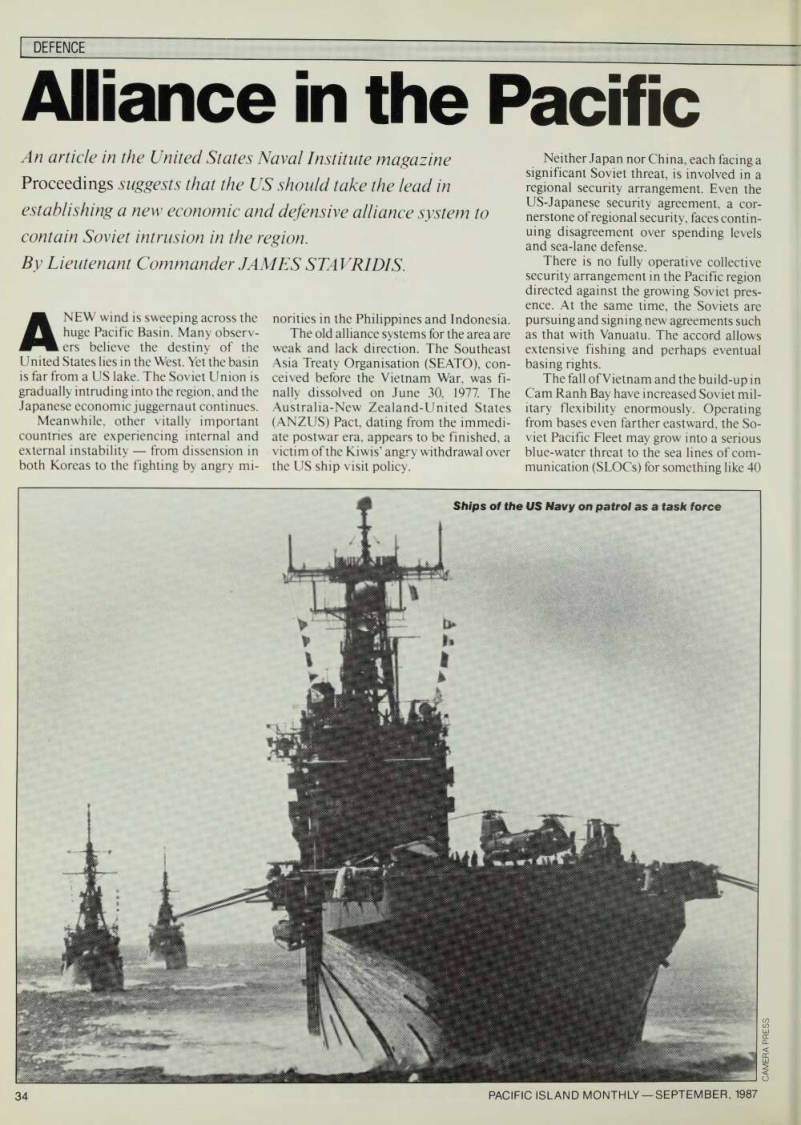
Ships of the US Navy on patrol as a task force
per cent of the world’s traded goods.
It is time to re-examine the premises of US strategy in the Pacific Basin and to es tablish a new economic and defensive al liance system with clearly defined roles and responsibilities for each of the members.
This arrangement must derive from a dynamic treaty, must be based on inter national law, and must receive ratification and popular support in the countries con cerned. It can serve as a guarantee of peace and as the nucleus of important economic advances. A new alliance can go far to ward containing Soviet adventurism and improving the image of US leadership in the region.