Royal Visit to Atomic Atoll
pp. 26-27 · Read in the full issue
King Tupou of Tonga and Western Samoa Economics Minister Pita in Mururoa.
By Edrampell.
TWO years after the Rainbow War rior incident, France has scored its greatest public relations success in the Pacific Islands, with the recent visit by the King of Tonga and Western Samoa’s Economics Minister to the nuclear testing site of Mururoa. King Tupou and Minis ter Pita flew to the top-secret atomic atoll located 1300 kilometres south of Tahiti the afternoon following Bastille Day, and spent about five hours at the controversial ex perimental facility.
While there, the official Polynesian party witnessed swimming, windsurfing, and canoeing at the purportedly radioac tive lagoon, and ate fish which had been captured on the oceanside of the atoll.
King Tupou and Minister Pita were es corted to “Point Zero”, where under ground nuclear devices are detonated. The Tongan monarch later said he “did not see any cracks in the ground or damage to Mururoa’s environment. . . It’s quite safe for people to work there.
“I think adequate precautions are being taken by the authorities and military per
sonnel to make certain that the under ground explosions will be contained in the basaltic rock and will not leak out into the ocean.”
The Western Samoan Minister de clined to say whether or not his govern ment had given him official permission to visit Mururoa, which is officially con demned by both Western Samoa and the South Pacific Forum.
Minister Pita’s comments were more noncommittal, as he said “time will tell” if Mururoa is safe or dangerous.
It is the official position of France and French Polynesia that more than 115 nu clear tests at Mururoa since 1966 are ab solutely safe. At a July 18 science conference in Papeete, Minister for Re search and Higher Education Jacques Va lade repeated Paris’ commitment to both the tests and their safety.
Admiral Pierre Thireaut, Commander in Chief of the French Pacific fleet and of the Centre for Experiments in the Pacific (the CEP, which supervises the nuclear testing program), told Reuters that “the
experiment is essential for maintaining France’s nuclear deterrent .. . and has a geopolitical significance”. The veteran of military campaigns in Indochina and Al geria stressed that the reason why Paris does not test its nuclear devices in France “is because of the seismic reaction, not ra dioactivity, Mururoa is very safe, really; it has lower radioactivity than Tahiti and Paris.”
The atmospheric tests ceased in 1974, when the underground program began.
Dr Raymond Bagnis, a retired military officer who has practiced medicine in French Polynesia for 25 years, said, “there has not been a significant increase in ra diation-related illnesses since the testing began,” and emphasized that “the in crease in fish poisoning here is due to cig uatera, not radioactivity.”
French Polynesia’s Vice President Jacques Teheiura told Reuters that “no body has proven that the tests are dangerous.”
But in addition to the South Pacific Forum, many in Tahiti disagree. Anthro pologist and author Bengt Danielsson, who first came to French Polynesia aboard the Kon-Tiki raft in 1947, refutes their “incon clusive findings” and claims that Paris “constantly refuses to allow independent scientific and medical surveys at Mururoa and the other isles to determine how safe the tests are.”
Oscar Temaru, Mayor of Tahiti’s sec ond largest town, Faaa, and the leader of the Polynesian Liberation Front, said that his “activism directly grew out of’ his work experiences at Mururoa, which he regards as being “extremely dangerous”. Another independence activist, Charlie Ching, ob jects so strongly to the nuclear testing that during the ’7o’s, he attempted to dynamite French planes servicing Mururoa.
The independents all claim that, since 1966, there has been a massive increase in the number of leukemia, brain tumor, thy roid cancer, and handicapped Tahitians, whom the dissidents allege are radiation victims of the CEP fallout. They also con tend that the tests have damaged Muru roa’s eco-system, and that the reason why France will not permit independent mon itoring of the testing is because the atoll is leaking radioactivity. They also assert that France’s nuclear program will halt once Tahiti gains independence.
The King of Tonga and the Western Sa moan Minister’s visit to Mururoa are part of Paris’ new Pacific policy of “glasnost”, in an attempt to win the hearts and minds of Oceania’s peoples with a sophisticated public relations offensive. This coordi
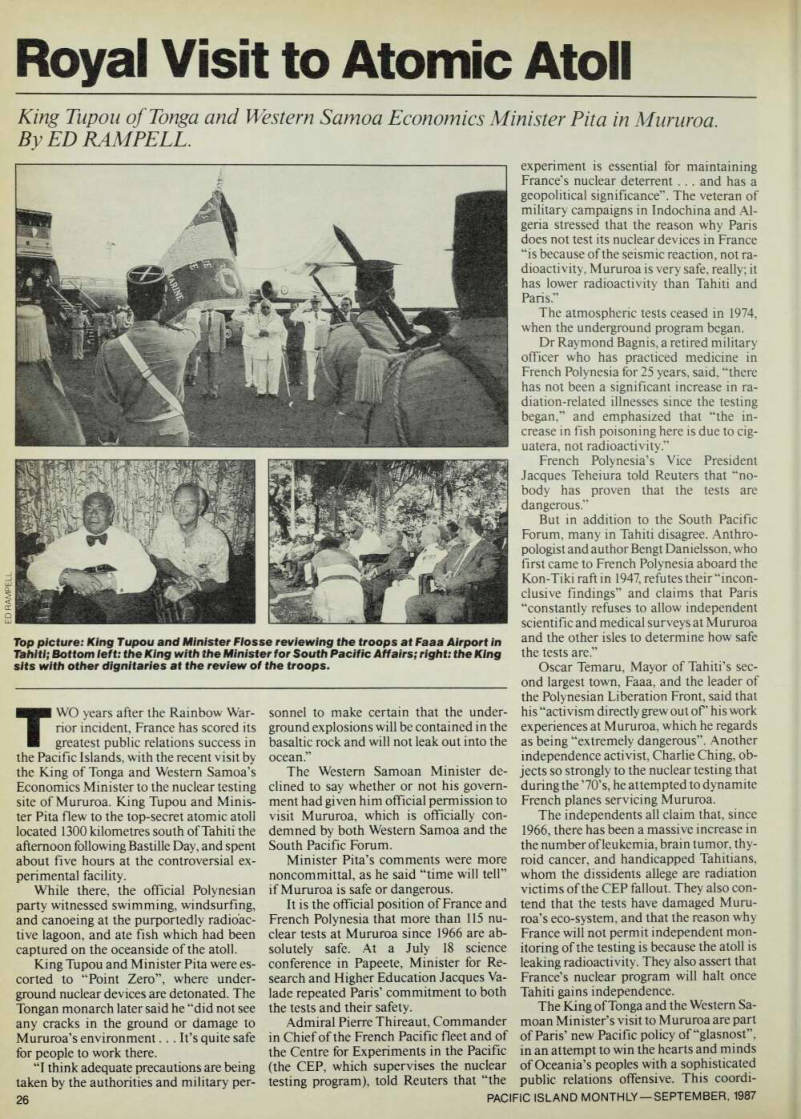
Top picture: King Tupou and Minister Flosse reviewing the troops at Faaa Airport in Tahiti; Bottom left: the King with the Minister for South Pacific Affairs; right: the King sits with other dignitaries at the review of the troops.
nated campaign is being launched on the diplomatic, scientific, cultural, economic, and education fronts.
This new openness and publicity strategy is being spearheaded by Prime Minister Jacques Chirac (who telephoned King Tupou at Huahine and facilitated His Majesty’s Mururoa sojourn) and long time French Polynesia politico Gaston Flosse, the former President of the Territorial Assembly and the current Minister of State for Pacific Affairs.
Minister Flosse is the first French cabinet minister of Polynesian ancestry, and he has been lobbying throughout Oceania on behalf of France and its Pacific policies. In addition to the almost universally condemned testing at Mururoa, France is concerned about the credibility of the upcoming referendum to be held in New Caledonia.
Paris is also worried that the South Paciflc Forum may try to place French Polynesia on the United Nation’s Decolonisation Committee’s list of nonself governing territories, as it has already done for New Caledonia.
France’s new Oceanic initiatives are especially aimed at influencing Western Samoa and Tonga, the current and future chairs of the Forum. In late June Western Samoa Prime Minister Vaai Kolone visited Tahiti on “Self-government Day”, and both Western Samoa and Tonga are bene-
fitting from a stepped-up aid program.
King Tupou declared that “as a result of this visit, France will help us more.”
But King Tupou said that Tonga will not sign the Forum’s Rarotonga Treaty, de clareing the South Pacific to be a vast nu clear free zone. His Royal Highness said that “The Forum speaks for the majority, but Tonga has its own ideas. We didn’t sign this anti-nuclear treaty because it seemed to us that it aimed at placing restrictions on only Western countries, because they have their warships in the Pacific. Other atomic powers don’t cross the Pacific; they travel from Vladivostok to Cam Ranh Bay, or along the coast of China. These coun tries aren’t restricted. On its own the treaty has already become ineffective.”
On other matters, King Tupou said that “Tonga will reserve its judgement of the referendum at New Caledonia until it is over.” The King also pronounced that “if I was Colonel Rabuka, I would have done the same thing, in order to save Fijian lives (from civil disorder)... I can understand why he did what he did. Tonga has its agents in Fiji monitoring the situation there.” The King declined an offer to meet with Mayor Temaru and the Tahitian opposition.
Faced with continuing challenges from abroad and inside its territories, France has resorted to this new policy of “glasnost” in an effort to win friends in the Islands. Un
der the surface changes aimed at perpet uating metropolitan rule, France continues the same colonial policies, from Noumea to Papeete to Mururoa. As such, these su perficial changes in form but not in content may be perceived as a policy of “GLOSS-nost”.
Part of France’s “glasnost” is a new openess with the foreign press. I received consistently hospitable and democratic treatment at Tahiti, in keeping with France’s traditions of freedom of the press.
Access was given to revolutionaries, admirals, government officials, techno crats, kings, high commissioners, dissi dents, and cabinet ministers alike. The only restrictions included a prohibition on a requested trip to Hao (where the Rain bow Warrior saboteurs are confined at a French military base), which the officials claim is part of an international agree ment barring journalists; plus a refusal to allow an independent scientist to accom pany an American TV team to Mururoa, although Minister Flosse said he’d per sonally intervene on behalf of the TV crew with the defence ministry in order facili tate their proposed Mururoa trip.
On the other hand, local journalists complain of a lack of objectivity and free dom in the French dominated media. Les Nouvelles is currently embroiled in a law suit with Minister Flosse, whom the paper accuses of being corrupt. □