Silent Majority Voice
p. 25 · Read in the full issue
But Fiji’s ‘Back To Early May’ movement discovers it does have opponents
A movement which describe itself as the voice of the silent majority in Fiji has embarked on a campaign known as “Back to Early May”. The movement urged the people of Fiji to sign a petition addressed to the Governor Gen eral which said: “We believe in a peaceful and progres sive multi-racial Fiji. Our present consti tution provides for and protects the basic rights of all the citizens of Fiji. These fun damental rights, including the right of as sembly, free expression, franchise, property and protection must not be vio lated. Fiji should remain a democracy.”
The movement which had a multi-ra cial group of people as the main organis ers, especially church leaders, proposed a six-point plan: • Retain the present constitution • Re-summon the dissolved parliament • Form a government of national unity • Return all the military personnel to the barracks as soon as the government of national unity is installed • Give full charge of law and order to the courts and the police • Appoint a royal commission to review any propose changes to the constitu tion; and proposed changes to be incor porated with the endorsement of the government of national unity and a ref erendum of the people.
The movement ran full page newspa per advertisements to publicise its cause and drew such an overwhelming response that the organisers could not cope with the demand for forms.
A spokesman for the movement said the response indicated that the majority of people in Fiji want a return to democratic freedom. The organisers emphasised that they were not politically motivated and had no other aim than to “assist the Gov ernor General in returning Fiji to a coun try of understanding, tolerance, patience and love of all our neighbours”.
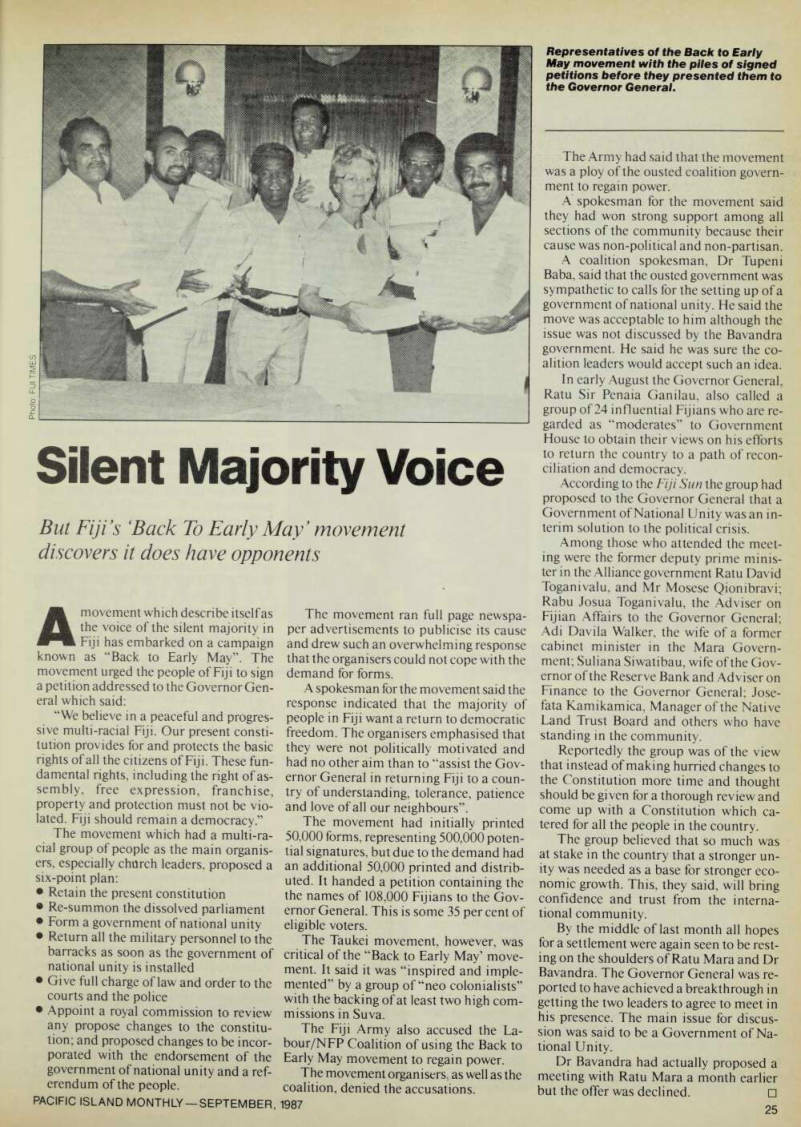
The movement had initially printed 50,000 forms, representing 500,000 poten tial signatures, but due to the demand had an additional 50,000 printed and distrib uted. It handed a petition containing the the names of 108,000 Fijians to the Gov ernor General. This is some 35 per cent of eligible voters.
The Taukei movement, however, was critical of the “Back to Early May’ move ment. It said it was “inspired and imple mented” by a group of “neo colonialists” with the backing of at least two high com missions in Suva.
The Fiji Army also accused the La bour/NFP Coalition of using the Back to Early May movement to regain power.
The movement organisers, as well as the coalition, denied the accusations.
The Army had said that the movement was a ploy of the ousted coalition govern ment to regain power.
A spokesman for the movement said they had won strong support among all sections of the community because their cause was non-political and non-partisan.
A coalition spokesman, Dr Tupeni Baba, said that the ousted government was sympathetic to calls for the setting up of a government of national unity. He said the move was acceptable to him although the issue was not discussed by the Bavandra government. He said he was sure the co alition leaders would accept such an idea.
In early August the Governor General, Ratu Sir Penaia Ganilau, also called a group of 24 influential Fijians who are re garded as “moderates” to Government House to obtain their views on his efforts to return the country to a path of recon ciliation and democracy.
According to the Fiji Sun the group had proposed to the Governor General that a Government of National Unity was an in terim solution to the political crisis.
Among those who attended the meet ing were the former deputy prime minis ter in the Alliance government Ratu David Toganivalu, and Mr Mosese Qionibravi; Rabu Josua Toganivalu, the Adviser on Fijian Affairs to the Governor General; Adi Davila Walker, the wife of a former cabinet minister in the Mara Govern ment; Suliana Siwatibau, wife of the Gov ernor of the Reserve Bank and Adviser on Finance to the Governor General; Jose fata Kamikamica, Manager of the Native Land Trust Board and others who have standing in the community.
Reportedly the group was of the view that instead of making hurried changes to the Constitution more time and thought should be given for a thorough review and come up with a Constitution which ca tered for all the people in the country.
The group believed that so much was at stake in the country that a stronger un ity was needed as a base for stronger eco nomic growth. This, they said, will bring confidence and trust from the interna tional community.
By the middle of last month all hopes for a settlement were again seen to be rest ing on the shoulders of Ratu Mara and Dr Bavandra. The Governor General was re ported to have achieved a breakthrough in getting the two leaders to agree to meet in his presence. The main issue for discus sion was said to be a Government of Na tional Unity.
Dr Bavandra had actually proposed a meeting with Ratu Mara a month earlier but the offer was declined. □
Representatives of the Back to Early May movement with the piles of signed petitions before they presented them to the Governor General.