At the Political Crossroads
pp. 22-24 · Read in the full issue
T
No hope of a consensus as Fiji’s Constitutional Committee is hit by a multitude of submissions
POST-coup Fiji is today plagued with the problem of blatant racism and discrimination. The Governor General, Ratu Sir Penaia Ganilau, who took charge of the island’s administration following the coup, is giving serious con sideration to various options to return the country to some form of acceptable democracy.
Highest on his list of priorities is the re port of the Constitutional Review Com mittee. It was appointed to hear submissions from all sectors of the Fiji Community. The 16-member committee, headed by a former attorney general and also an architect of the 1970 Fiji consti tution, Sir John Falvey, received both written and oral submissions from all over the country.
While submissions ranged from calls to retain the present constitution to a wholly indigenous Fijian parliament with no representation of any other communi ties in Fiji the submission which received most attention and publicity was from the influential Great Council of Chiefs. All 14
provincial councils held their separate meetings in their respective districts be fore coming to the capital, Suva, to a meet ing of the great council of chiefs to prepare a final submission for the constitutional review committee.
The CRC has been charged with “re viewing the constitution of Fiji with a view to proposing to the Governor General amendments which will strengthen the political representation of indigenous Fi jians, and, in so doing, bear in mind the best interests of the other peoples in Fiji”.
The Great Council of Chiefs meeting, scheduled to last only a couple of days, dragged on for seven days before a final list of submissions was agreed upon.
This came only after a special sub com mittee of the council was appointed, un der the chairmanship of the former Prime Minister, Ratu Sir Kamisese Mara who led the Alliance Government for the past 17 years.
Before the Great Council of Chiefs meeting the mood in the country had im proved somewhat and tension had eased
after the country’s mostly Indian cane farmers agreed to harvest their crop and the deposed Bavandra Government’s rep resentatives agreed to serve on the 16member Constitutional Review Committee.
The coalition representatives had re fused to serve on the committee unless the terms of reference were altered. It had claimed that the original terms of refer ence gave preferred treatment to indige nous Fijians and, in effect, will create a racial apartheid in Fiji.
However, this air of optimism and hope slowly diminished as the chiefs deliber ated on the various submissions from each provincial council. Ironically, Dr Timoci Bavandra, and his Fijian parliamentari ans, were invited to also explain their stand on the issue. The Taukei movement, which has been advocating the concept of Fiji for Fijians, was pushing for a single parlia ment of all Fijian (Taukei) members while others wanted Fijian dominance. Finally, after seven days of deliberations, the chiefs resolved that:
• There will be a 71-member, single chamber Parliament. It will be made up of 40 Fijians (an increase of 18 members from present 22), 22 Indians, as at pres ent (four must be Muslims), one Rou tuman and eight General Electors, as at present, but now must include a repre sentative of Rabi Council. The 14 Prov incial Councils will nominate 28 Fijian members to the House, the Great Coun cil of Chiefs to nominate eight and the Prime Minister to nominate four mem bers of his own choice to Parliament. • The Senate to be abolished. • Christianity is to be the foundation of the nation. • Fiji to remain a sovereign democratic state (the Taukei movement had been demanding a republic). • The Governor General be appointed by the Queen, on the advice of the Great Council of Chiefs, and not the Prime Minister, as at present and the term shall be for five years. • The appointment of an acting Governor General be on the advice of the Great Council of Chiefs, not the Chief Justice, as at present. • The speaker, and his deputy, to be ap pointed by the Govenor General from outside the House of Representative, on the advice of the Prime Minister and the Leader of the Opposition. • The Prime Minister to be a Fijian to be elected from Fijian members of Parliament. • The Prime Minister to select his own Cabinet. • Four ministerial portfolios to be re served for Fijians: Home Affairs, Fijian Affairs, Foreign Affairs and Finance Industry. • Not less than 50 per cent of public of fices to be held by Fijians. • Return the proprietary interests of the basic resources in Fiji from the Crown to the landowners. • Fijian customary laws be recognised as laws of Fiji. • Relaxing the discriminatory laws to al low the making of laws beneficial to Fijians. • The Fijian court to be included in the judiciary. • On procedures in legislation, royal as sent is needed, and in the case of a de cision by simple majority and on protecting Fijian interests, six out of the eight chiefs’ nominees must approve the Governor General to have powers of amnesty.
• Of the 40 Fijian members four will be nominated by the Prime Minister, eight by the Great Council of Chiefs and 28 will be elected by the 14 Provincial Councils.
This, in effect, means that the Fijians will not participate in general elections as at present but will go through their Tikina (district) councils for final selection of members by the provincial councils.
The cross voting system which came into effect after the 1970 Constitution will be abolished and the 22 Indian and eight General Elector seats will be contested on a communal system of voting. The con stituencies will be redefined.
In announcing the chiefs’ submissions, the Adviser on Fijian Affairs, Ratu Josua Toganivalu, who had chaired the meeting, said the compromise was reached by consensus.
Reacting to the final list of submis sions, a spokesman of the Tauki move ment, Ratu Meli Vesikula, said: “We had asked for 100 per cent and look what we ended up with.”
Ratu Meli said they were not particu larly happy because “our aim was the total abolition of the present constitution as it had proved harmful to the Fijians over the past 17 years”.
“But it’s a start and we hope we will fi nally get what we want. And the only way to get it is to declare Fiji a republic,” he said.
Dr Tupeni Baba, the ousted Minister for Education in the short-lived Bavandra Government, said it was a “selling out” of the Fijian people.
Dr Baba said: “Under the proposals put forward by the chiefs the Fijian people will be disenfranchised because Fijian mem bers of parliament will be selected through
the traditional process of consensus by the provincial councils.”
He said that a number of educated, progressive Fijians will not live under the system. He warned that there will be mas sive flight of educated and professional Fijians from Fiji.
Dr Baba said the move was a “regres sive” step and was designed to keep the “Fijian backward and segregate him from society and modern forces which he can’t get away from”.
He described the proposal of taking away the right of vote from the Fijians as a major blow to the process of political, so cial and economic integration of the Fijian with other races.
The labour-NFP Coalition, in its sub missions to the constitutional review committee, said the present constitution had served the country and its people well.
It adequately protected the rights and in terests of Fijians through specific provi sions and also protected the rights of other minorities and, also, of the Indians.
The coalition said it was necessary, first, to determine whether there was a need to review the constitution which had worked well for the past 17 years. It asked whether the country “had been forced to review the constitution by a radical mi nority who have enlisted the army to fur ther their narrow interests?”
Besides submissions from the Council of Chiefs and the Labour/NFP Coalition the CRC received a total of 800 submis sions from people from all walks of life.
The committee was given extra time to prepare its final report. Initially the Gov ernor General had charged the committee to have its final report handed in to him by the end of July but by the middle of Au gust it had only reached the draft stage.
In appointing the 16-member commit- ►
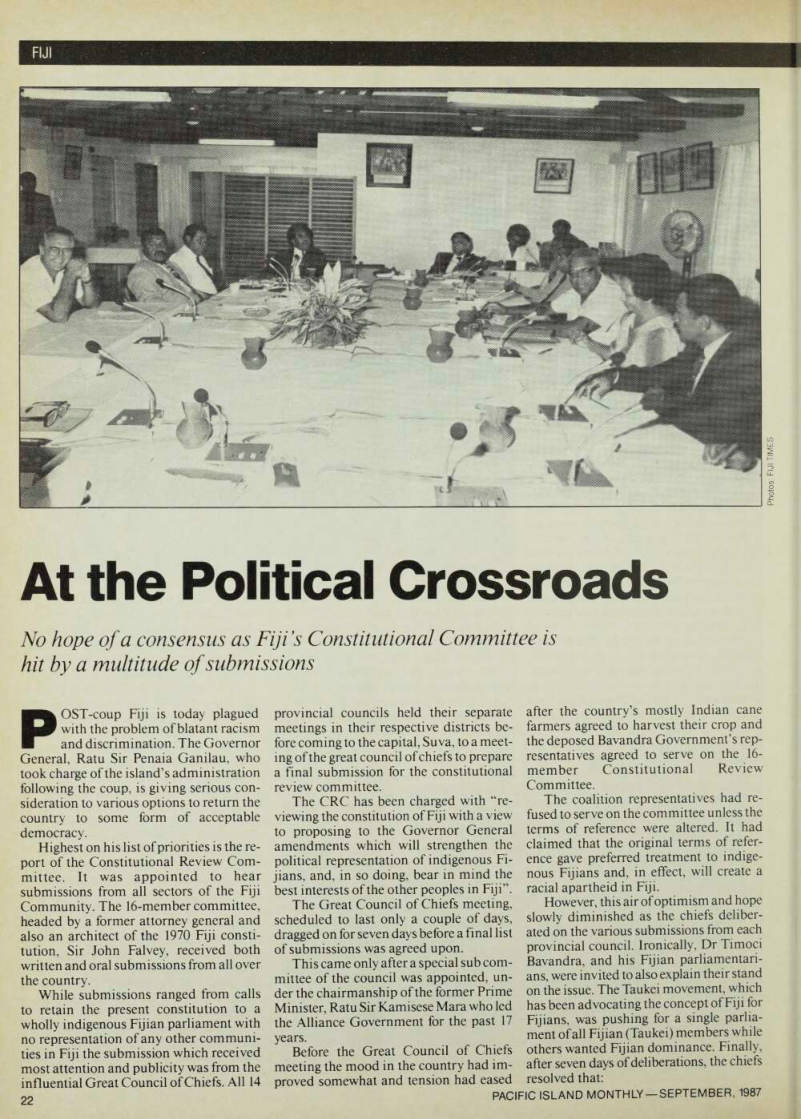
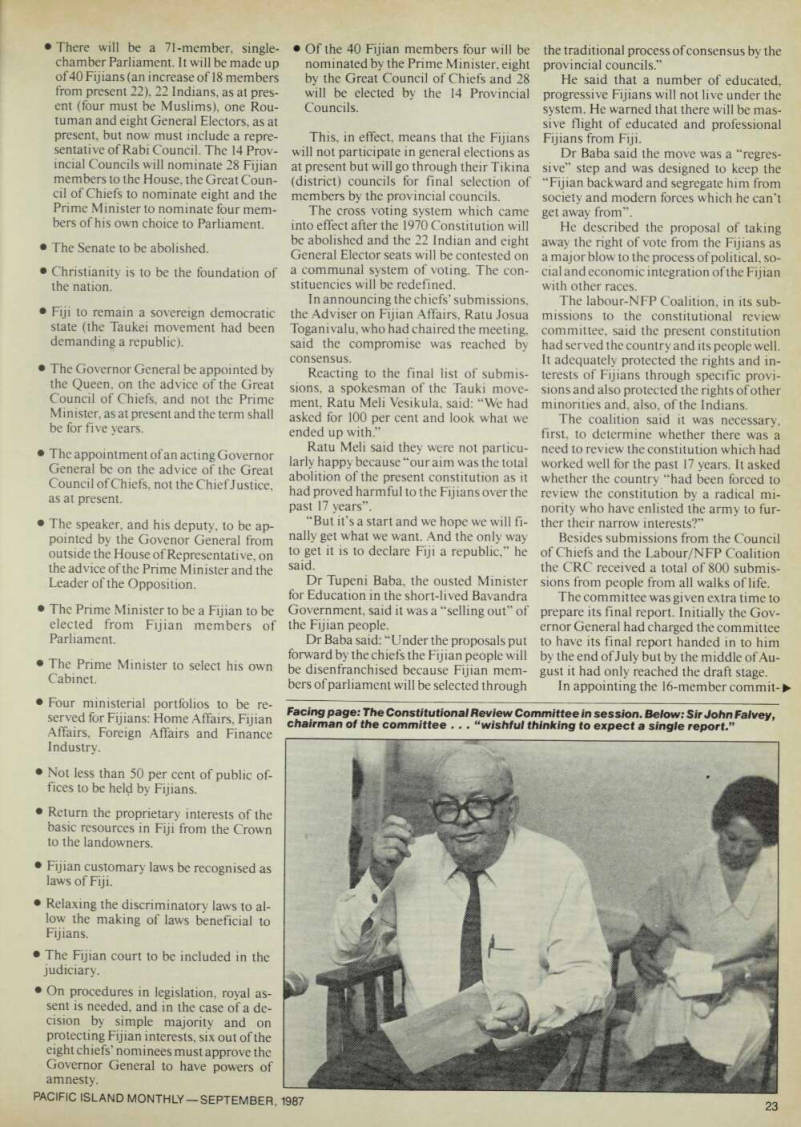
Facing page: The Constitutional Review Committee in session. Below: Sir John Falvey, chairman of the committee .. . “wishful thinking to expect a single report
◄tee the Governor General had urged them to arrive at a consensus in their final re port and recommendations. However, the committee’s membership is so divergent, and the views so far apart, that there is no hope of a single report based on consensus.
The Governor General has four nom inees on the committee who are generally seen as moderates, the Great Council of Chiefs also has four representatives, in cluding Colonel Rabuka, and the former prime minister’s nominees include Mr Apisai Tora and Mr Taniela Veitata who
are seen as radicals. The other four nom inees are of the Bavandra.
The chairman Sir John Falvey agreed that with such a group it was wishful thinking to expect a single report. He said the coalition side was likely to present a minority report because there were major disagreements between the various sides.
Observers in Suva say this will create a major headache for the Governor General and could prove to be a major stumbling block in his efforts to restore democracy in the country. □