The French Viewpoint
pp. 21-47 · Read in the full issue
New Caledonia Referendum
The French Minister of Overseas Territories , BERNARD PONS, explains his government case in the run-up to the crucial independence referendum.
IN its population of 145,000, New Ca ledonia has four major ethnic groups - Melanesian, European, Polynesian and Asiatic. The Melanesians represent 43 per cent of the population, the Europeans 38 per cent and the Polynesians 12 per cent.
But this simple demographic breakdown in no way portrays the extroardinary melt ing pot of cultures and races that makes up the New Caledonia of today. Over several generations these different races have mixed and inter-married. What’s more, according to census regulations, each adult has the right to choose his or her ethnic or igin with little regard to the exact nature of his or her racial background. As a result, today’s New Caledonia can only be de scribed as a multi-racial mosaic of people.
For each 100 inhabitants, today, 77 were born in New Caledonia, 17 were born in Metropolitan France or in its overseas de partments or territories and six were born in foreign countries. Mixed marriages are comparatively frequent 12 per cent in the Melanesian Community, T 9 per cent in the European one and the proportion of illegitimate birth is very high; 47 per cent in New Caledonia is the largest of the three French overseas territories located in the Pacific Ocean.
The “Grande Terre” or main island stretches more than 400 kms from north to south. With its dependencies, such as the Loyalty Islands, Belep, Huon, Ches terfield and the Isle of Pines, it covers a total land area of some 19,000 square kms.
The population density is not only very low (less than eight inhabitants per square kil ometre) but also unevenly distributed. For example, the capital Noumea has 1431 in habitants per square kilometre compared to four per square kilometre in the Centre region and seven per square kilometre in the Loyalty Islands.
Almost half of the Melanesian popu lation lives in town while the rest resides in the country on untitled land. All of the surrounding islands are the property of the Melanesian people and are administered by common law. Twenty-eight Melane sian dialects, each one different from the rest, are practised in New Caledonia. The common French language serves as com munication between these diverse linguis tic groups.
To reduce the New Caledonian situa tion to Kanaks versus non-Kanaks cannot possibly represent the true diversity of races to be found in this territory. In ad dition to this fact, election results have
adequately demonstrated that not all Me lanesians share the views of the FLNKS independence movement. Two of New Caledonia’s three elected representatives in the French National Parliament are Melanesian. These two representatives Senator Dick Ukeiwe, who is also Presi dent of the New Caledonia Congress and Maurice Nenou, MP are both members of the political party headed by French Prime Minister Jacques Chirac. Also, at the Congress the new Caledonian Ter ritorial Assembly a majority of elected representatives and Melanesians (28 out of a total of 46), coming from all political parties.
New Caledonia is divided into four Re gions (North, Centre, South, Loyalty Is lands, which administer themselves freely through Regional Councils elected by di rect universal suffrage with proportional representations. Each region has an exec utive committee elected from among the member of its Council. The Chairman of the Regional Council is the Head of Ad ministration of the Region. These terri torial collectivities with specialised functions are responsible for cultural ac tivities, local cultures and vernacular lan guages, natural improvements within the regional boundaries and local economic development activities. They also define
their fundamental aims as regards to de velopment, advancement of the popula tion, exploitation of natural resources and environmental protection. The Regional Council adopts the budget of the Region.
The Congress of the Territory, consist ing of the members of the four Regional Councils, is responsible for primary edu cation, health and social welfare, housing, youth and sports, as well as vocational and in-service training. It adopts the Territo ry’s budget. In the areas where it shares re sponsibility with the French State, the Congress obtains extended powers in the fields of taxation, rural development and land improvement, labour laws and eco nomic development.
The executive of the Territory is pres ently embodied in the French Govern ment Delegate, High Commissioner in New Caledonia and Dependencies. He is assisted by an Executive Council chaired by the President of the Congress and con sisting of the Chairmen of the four Re gional Councils, which has an advisory role only. The statute will of course fully confer the executive power upon elected representatives.
As a democratic country, New Cale donia will abide by the principle of “one man, one vote” at the forthcoming refer-
Continued from page 47
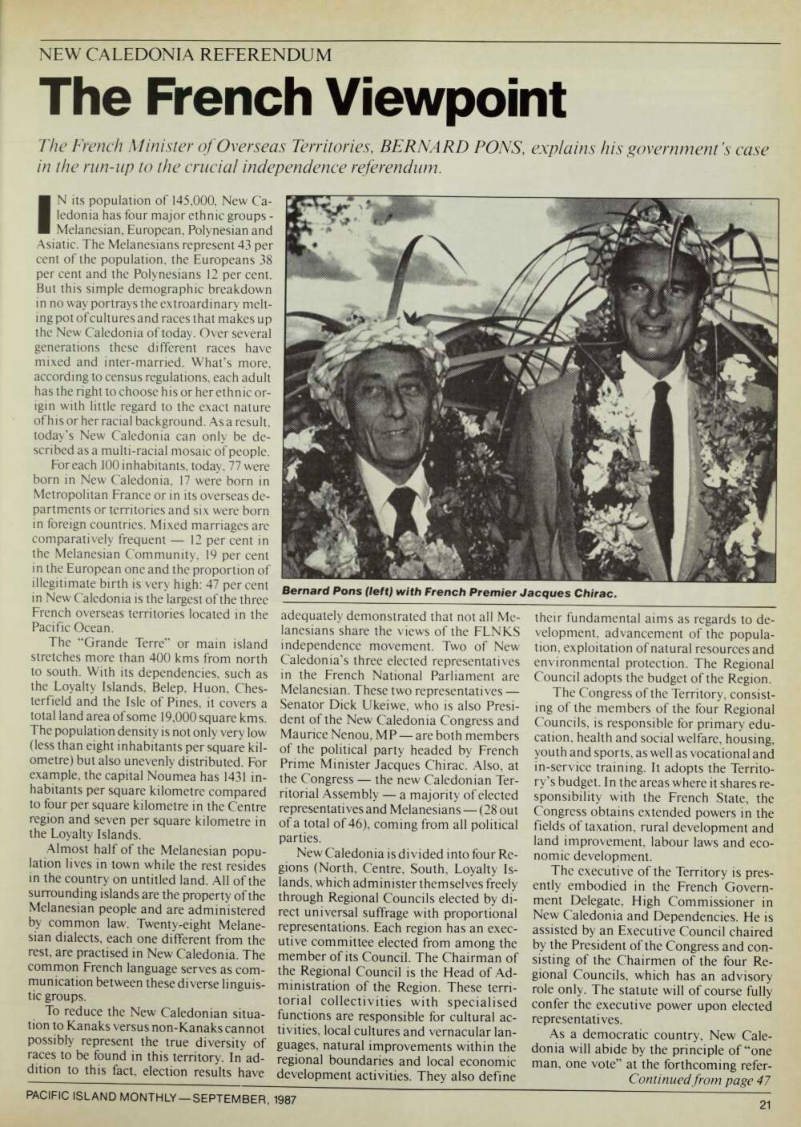
Bernard Pons (left) with French Premier Jacques Chirac.
endum on independence. To ensure this basic right, each citizen must be free to go to the polling booths without fear or being exposed to any form of reprisals. The ref erendum has been organised by France so that New Caledonians can clearly and freely express whether or not they wish to remain a part of the French Republic.
Supporters of the independence move ment have claimed that Melanesians should be the only people with the right to vote. But, where would that leave the New Caledonian citizens of European, Polyne sian, Indonesian, Vietnamien or other origins, many of whose families have lived in new Caledonia for several generations.
To restrict the vote to Melanesians would be to deny equal rights to these other com munity groups. Nevertheless, the French Government has made one concession to the independentists. It has ruled that only people who have lived in New Caledonia for more than three years will have the right to vote in the referendum. This decision successfully excludes all French civil serv ants and military personnel on temporary assignment in the territory. The question that people from New Caledonia will answer to will be a very simple one: “Do you want New Caledonia to accede to in dependence or to remain a part of the French Republic?” People will then have
to answer, by their secret votes, either “I want New Caledonia to accede to in dependence” or ‘T want New Cale donia to remain a part of the French Republic”.
It is already known that, in case of a majority of voters choosing to stay with France, the new statute will be based on self government, of territorial and regional levels. According to the law of 17 July 1986, each polling place will be chaired by a judge, and the whole referendum will be controlled by a commission made up of judges. Thus, because the choice is clear, and the vote free and secret according to the principles of democracy, one would think that the results of the referendum will terminate uncertainties and establish the legal framework for future discussions and adjustments. If the population of New Ca ledonia votes to remain a part of the French Republic, the French Government undertakes to re-establish regional boundaries so that they correspond to the geographic, linguistic, economic and so ciological differences that exist in the ter ritory. The regions will be given wider powers and an appropriate budget. The elected territorial government will coor dinate these powers and the French State will play an arbitrator’s role, respecting the principle of wide self-government.
But let us leave aside all these legal as pects, which are very important indeed, to become aware once again that what mat ters in life is everyday living. I am a med ical doctor by training and, as such, I am a practical person. One must live. Live with dignity and, of course, in an environ ment that was chosen within institutions that were chosen. Everyone, all the chil dren of New Caledonia, must be able to participate tomorrow in the future of this Territory and its development. They must be able to gain access to every position that is there.
New Caledonia must make a new start.
I have been told that the referendum would not solve all the problems, which is true.
The problems were existing before, there are some today, there will be some tomor row. The referendum, however, will have this quality: that is, the substitution of a legal State of Affairs for what is now a sit uation of fact, and also to show interna tional public opinions that there is a majority in New Caledonia wishing to go in a given direction. From there, the ref erendum will be a starting point and not a point of conclusion. It will allow all Ca ledonian people, who wish to do so and who love this land, whatever their behav iour in the last few months or years, to get together for a better New Caledonia.
Bernard Pons,
Minister of Overseas Departments and Territories.