A Pacific Alliance
pp. 7-8 · Read in the full issue
IN this issue, PIM presents an intriguing proposal for a draft “Pacific Alliance Treaty”, put forward by Lieu tenant Commander James Stavridis in the United States Naval Institute’s Proceedings. The mere fact that an American strategist should consider the need for such a treaty indicates the change that has come over the Pa cific, long considered an “American lake”, in the year since Soviet leader Mikhail Gorbachev declared, in his Vladi vostok address, that “the Soviet Union is also an Asian and Pacific country.”
Lt Comm Stavridis clearly takes NATO as his model, and envisages a treaty alliance of Pacific nations, led by the United States, and formed, as was NATO, with a mis sion of containment in mind, aiming to limit the expan sion of the Soviet Union into the region. But the Pacific rim is not Western Europe in embryo; the region sur mounts a vast, empty ocean stretching across one third of
the globe. This is no crowded continent under threat of military annexation.
Further, while the Soviets could be simply excluded from NATO territory, nothing can exclude Soviet vessels from the seas of the Pacific.
Lt Comm Stavridis believes a new “economic and de fensive alliance system” in the Pacific basin should be es tablished, based on a treaty ratified by member nations.
His scheme ties together the economic advancement of the Pacific with its military protection.
Significantly, he writes that such an alliance could not only help contain Moscow’s advances, but also “go far to ward improving the image of United States leadership in the region.”
The Pacific potential of the Soviet Union, poised in its bases in Vladivostok and Vietnam’s Cam Ranh Bay, is evident. Whether an alliance on the model of NATO is conceivable is less clear. NATO member countries share common borders and a common culture, much history and some ideological convictions.
Yet the Pacific rim countries range from Australia to the island nations, from the United States, a global su perpower, to Japan, economic titan and military gelding all in one.
Treaties are not abstract documents that can be drafted by one party. They are agreements that contain compro mises and shared judgements, marking a strategic con sensus amongst affected parties. Treaties that last are hammered out on the basis of power relations.
The draft “Pacific Alliance Treaty” we present here raises as many questions as it answers: If Japan is to be encouraged to accept “further defence responsibilities,” what guarantees will there be for Pacific nations that To kyo’s economic prowess will not be translated into direct
military leverage? Should China, a communist state, form part of an al liance formed to contain another communist superpower? How will re lations between western nations such as Australia, and the US, and smaller Pacific states with strategic locations, be governed?
The proposal for such a treaty re cognises that the current bilateral def ence arrangements of the US in the Pacific leave much to be desired. The future of the vital American bases in the Philippines is unclear, and there is continuing debate throughout the Pa cific over the passage of nuclear-armed ships.
Yet Lt Comm Stavridis’s plan pointedly considers only the Pacific rim nations, excluding even that im portant Pacific regional power, France. The focus of recent Soviet diplomatic and trade initiatives has been such strategically placed, eco nomically vulnerable Pacific island nations as Kiribati and Vanuatu.
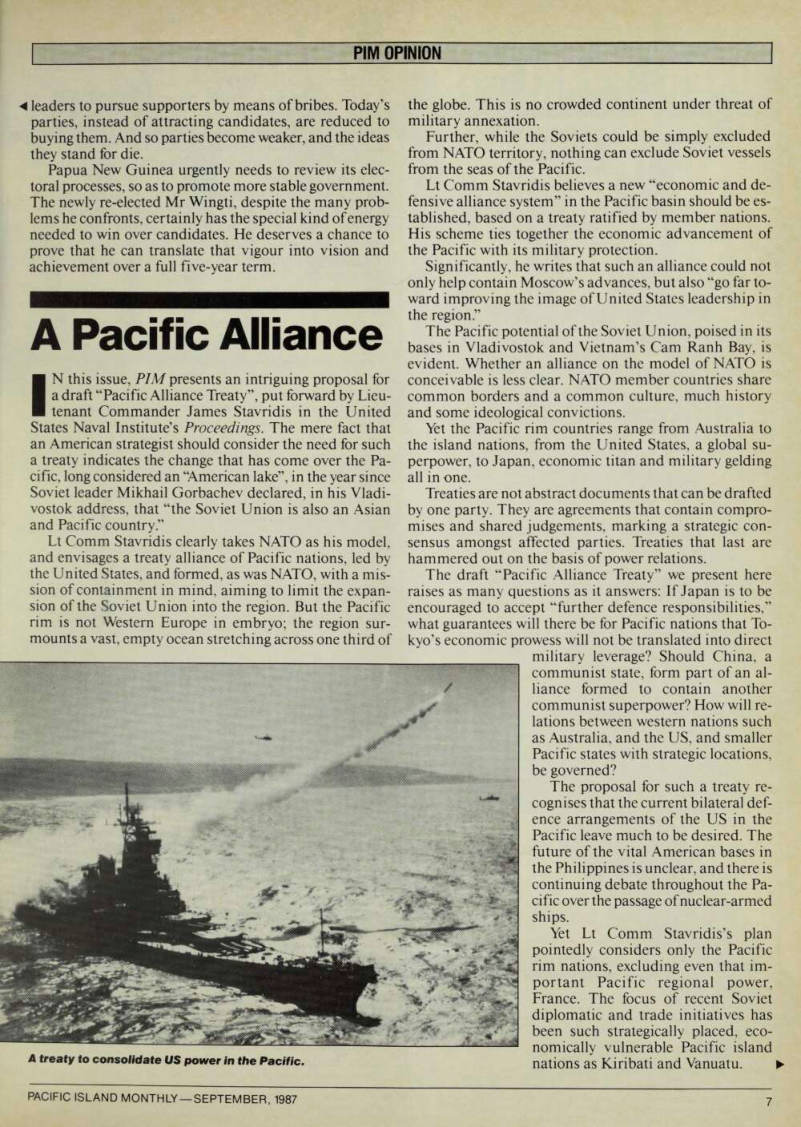
A treaty to consolidate US power in the Pacific.
< The nations of the rim could well sign the most iron clad defence pact, and still be powerless to prevent the So viets from setting up bases, in such countries, that strad dle their crucial trade routes. However insignificant the Pacific island states may be on the economic level, they wield considerable leverage simply because of their ge ography. While many of these countries are by inclination “pro-western”, they are not ciphers and have no desire to be taken for granted.
The American posture in the Pacific is, at present, un fortunate, with many of the island nations choosing to re member only the US refusal to sign the first major diplomatic initiative, the South Pacific Nuclear Free Zone treaty, or the protracted wrangle over the regional fish eries accord.
Any workable Pacific treaty will have to take into ac count the needs and concerns of these Pacific island states as well as the countries on the ocean’s rim, if it is to achieve its goal of locking out the Soviets.
Heavy-handed American actions in the region merely breed Soviet opportunities. Since there has, until now, been no significant Soviet diplomatic presence in the Pa cific, any advances by Moscow mark an important gain.
In this connection, the penetration of the ocean by sur rogates and friendly states such as Cuba or Libya, or proxy organisations such as the Pacific Trade Union Forum, should also be a matter of urgent concern for the US and its allies.
Lt Comm Stavridis’ proposal begs many questions, and raises more problems than it satisfies. Yet it is a valuable venture, for it reveals the pressing need for the Pacific na tions to develop a coherent view of their aims and goals.