A Special Kind of Energy
pp. 5-7 · Read in the full issue

Pim Opinion
Paias Wingti’s election euphoria is fading in the face of the momentous task facing the new government.
THE problems confronting Papua New Guinea’s youthful Prime Minister, Paias Wingti, as he strug gles to hold together his flimsy governing coalition, provide an uncanny echo of the broader dilemmas facing his young nation.
After the counting of votes in July’s general election, Mr Wingti’s Peoples Democratic Movement trailed the apparent winner, Mr Michael Somare’s Pangu Pati.
Through a combination of raw energy and political wheel ing and dealing, Mr Wingti managed to emerge on top, by a slender 54 to 51 margin.
Now he has been returned to power, he finds a cloud hanging over his coalition. One of his key coalition sup porters, the leader of the People’s Action Party, Mr Ted Diro, stands accused of improper business dealings by a commission of inquiry into the forestry industry. Mr So
mare, after congratulating Mr Wingti on his victory in a speech in the new parliament, promptly warned him that he would not last. The twin demons of Papua New Guinea politics, corrup tion and instability, remain to plague the energetic Mr Wingti. They could yet prevent him from realising his fine sounding policies of agrarian development.
The new nation he must govern shares this ambiguous balance of strengths and weaknesses. Papua New Guinea’s fabulous mineral wealth is still being uncovered. Its democratic institutions provide a sound basis for social progress. Yet confusion sur rounds the nation’s economic policies.
The traditional tribal system has given way to a collapse of law and order in the urban areas, with a consequent rise in violent crimes and rapes, commit ted against both expatriates and na tionals, that the country’s political leaders cannot ignore.
Both in its politics and in its social development, Papua New Guinea faces a period of transition. The first decade, when Mr Somare was “the chief’ and progress was straightforward, if not simple, has passed. Mr Wingti, and other “young turks” such as human rights lawyer Mr Ber nard Narokobi and Mr Utala Samana represent a new, post-colonial generation. They are now the same age as was Mr Somare when he first seized power from the pre independence United Party. It would be tragic if the inst abilities inherent in the political system prevented such men from trying to fulfil their vision of the future for
Papua New Guinea. \fet Mr Wingti must govern with the constant knowledge that after six months, he can be dis lodged by a simple parliamentary vote of no confidence.
If there has been a generational change in Port Mores by’s political cast, there is also a change in economic di rection. Mr Wingti harbours utopian dreams of using the nation’s mining wealth to create an advanced agrarian economy. Plans are afoot to sell off the government’s near half-billion dollar stake in Bougainville Copper to fund such projects. Papua New Guinea’s leaders are reaching for grand ideas. They would do well to reflect that dog matic ideas have often before proved the undoing of de veloping nations.
The task will be to straddle this period of transition with care and common sense. Papua New Guinea has travelled, in less than a century, from the stone age to the
computerised vote-count. A nation’s identity is proved not by the speed with which it changes, but by the manner in which, while changing, it remains true to itself.
At the political level, Mr Wingti, patient, determined, calm under pres sure, has displayed in the recent elec tion campaign all the skills needed to ride his country’s political roller coaster. Yet winning power does not require the same skills as exercising it well. Mr Wingti must seek to break the destructive cycle of truncated terms of office that has prevented Papua New Guinea’s prime ministers from mov ing their country forward. If there were stable political leadership, a constant economic policy could follow. And a more stable government, one which was obliged to look after all its con stituents, not just the politically pow erful, would go a long way toward addressing the law and order problems
that are tearing the nation’s cities apart.
Foreign policy is another area where Papua New Guinea must consider its position carefully. Mr Wingti’s modish enthusiasm for the Melanesian Spearhead group, which lobbies against the French presence in New Caledonia, may be emotionally satisfying, but it is far from offering a coherent answer to the problems of that territory.
July’s elections provided a litmus of the country’s prog ress. The large number of independents elected to parlia ment indicated voters were dissatisfied with the corruption and patronage widespread among established politicians.
Yet the election of independents itself encourages party ►
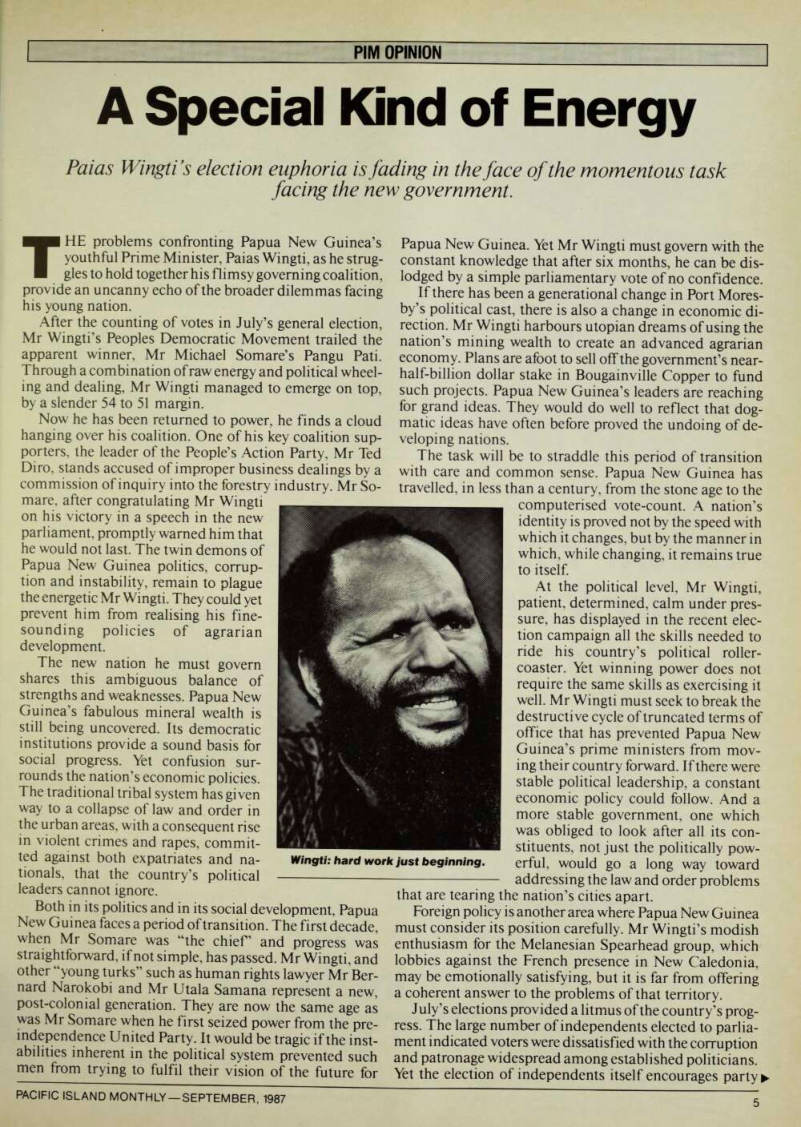
Wingti: hard work just beginning.
◄ leaders to pursue supporters by means of bribes. Today’s parties, instead of attracting candidates, are reduced to buying them. And so parties become weaker, and the ideas they stand for die.
Papua New Guinea urgently needs to review its elec toral processes, so as to promote more stable government.
The newly re-elected Mr Wingti, despite the many prob lems he confronts, certainly has the special kind of energy needed to win over candidates. He deserves a chance to prove that he can translate that vigour into vision and achievement over a full five-year term.