pre-coup Fiji
pp. 45-46 · Read in the full issue
books
A look at pre-coup Fiji
Politics in Fiji. Studies in Con temporary History. Edited by Brij V. Lai. Published by Allen & Unwin, Sydney, 1986.
A 514.95. 158N086861 929 9.
“Fiji, the Way the World should be,” used to run the advertising slogan. On the back of Dr Brij Lai’s book there is another familiar praise: “Fiji is a post-colonial success story; peaceful, stable, democratic.”
The people of Fiji, when they went abroad, could raise their heads with pride, and not with out a bit of justified smugness.
Outsiders spent a lot of time trying to explain how Fiji, a country that should have been in racial strife, wasn’t; why a big bang racial conflagration had not taken place.
Fiji is an ethically diverse society where discrimination by race is a fact of daily life. Fijians continue to live like Fijians and the diverse “Indian” popula tions also follow their practices, along with the Europeans and Chinese.
When I was in Fiji, attached to the University of the South Pacific (another justifably proud institution), I encountered few exceptions to the hermetic sea ling of racial boxes, so the apparent harmony had not been achieved by the creation of some sort of idyllic melting pot At first my family and I were coy about openly identifying people by their race, so strong is the disapproval for that sort of thinking in the English speaking Pacific rim countries from which we came. And I never did feel comfortable using race as the first identifying marker for a person. However, as our time continued, and one became more involved and interested in Fiji, for it is difficult not to find
such a place extremely attrac tive, it became clear that “Fi jian” and “Indian” were far from unitary categories.
For shopping, we knew Mus lim stores could be found when others might be closed. And Sikh traders had their special ties. I recall asking a friend to help me get a cheap cassette radio. He replied that he was not a Gujarati and therefore would be as much as a victim as I in their shops. There were Indians whose ancestors had come during the shameful “Gir mit” period that so scars some Indo-Fijian souls. Others again, like the Gujaratis, had come with capital after World War I
and had not so suffered.
I was much slower in coming to understand the differences between the Fijian populations.
The most obvious one was generational and social, as a growing pool of non-chiefly educated men (and a few women) who had won their scholarships from overseas but who returned to Fiji to complain that they had to work as clerks for incompetents who were either going to be in their positions forever or had only gotten them due to family, that is, regional ties.
I discovered a new meaning for the “East-West Conflict”, more usually associated with
the global than the local. In a conversation one day some friends kept talking about “Ton gans” (using some fairly power ful adjectives). It seemed to me odd since the people men tioned were political and public figures in Fiji and not, from my point of view, foreigners.
Then it was explained to me.
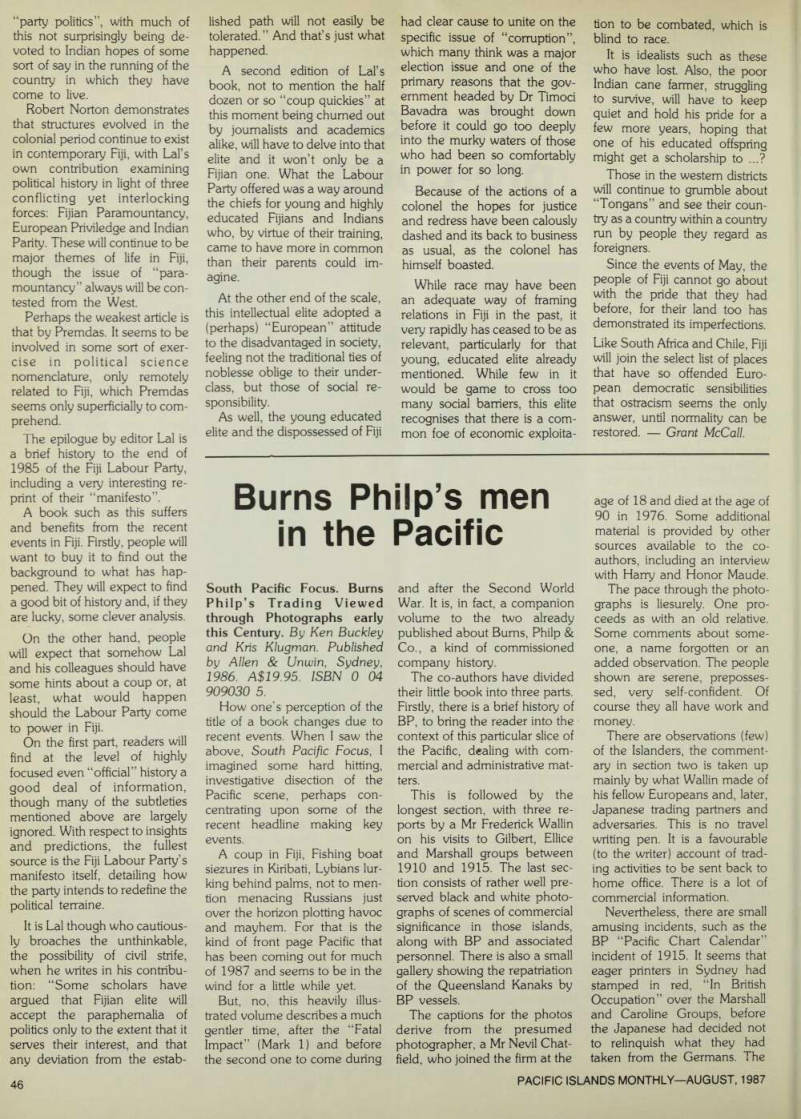
It was the “Tongans” (Eastern Fijians) who had given the islands to the British; it was the “Tongans” who continued to run the place; and it was the “Tongans” who were responsi ble for most of the ills of the country These “Tongans”, my friends said, included Ratu Sir Kamisese Mara, the current Governor-General and, by de sign, virtually the entire army.
During my time in Fiji, and subsequently, I have looked in vain for a source covering the observed and very deeply felt diversity that is so familiar to anyone in Fiji.
Does Brij Lai provide it, felicitiously having his edited volume published on the eve of the portentious 1987 elections?
Partially.
This slim volume consists of five main pieces, with an intro duction and epilogue by the editor.
Ahmed Ali goes over ground that he has covered in several other papers but this time ex panding his time scale from 1874 to 1960. We leam that there was a serious proposal in 1900 to federate Fiji with New Zealand so that that country, like Australia, would have a tropical area to exploit. Ahmed Ali shows how the usual scare theme of Indian domination of the Fijians is chronicled and that Europeans used this to con vince the indigenous popula tion that their only future lay in trusting outsiders.
Roderic Alley discusses
Ratu Sir Kamisese Mara
“party politics”, with much of this not surprisingly being de voted to Indian hopes of some sort of say in the running of the country in which they have come to live.
Robert Norton demonstrates that structures evolved in the colonial period continue to exist in contemporary Fiji, with Lai’s own contribution examining political history in light of three conflicting yet interlocking forces: Fijian Paramountancy, European Priviledge and Indian Parity. These will continue to be major themes of life in Fiji, though the issue of “para mountancy” always will be con tested from the West.
Perhaps the weakest article is that by Premdas. It seems to be involved in some sort of exer cise in political science nomenclature, only remotely related to Fiji, which Premdas seems only superficially to com prehend.
The epilogue by editor Lai is a brief history to the end of 1985 of the Fiji Labour Party, including a very interesting re print of their “manifesto”.
A book such as this suffers and benefits from the recent events in Fiji. Firstly, people will want to buy it to find out the background to what has hap pened. They will expect to find a good bit of history and, if they are lucky, some clever analysis.
On the other hand, people will expect that somehow Lai and his colleagues should have some hints about a coup or, at least, what would happen should the Labour Party come to power in Fiji.
On the first part, readers will find at the level of highly focused even “official” history a good deal of information, though many of the subtleties mentioned above are largely ignored. With respect to insights and predictions, the fullest source is the Fiji Labour Party’s manifesto itself, detailing how the party intends to redefine the political terraine.
It is Lai though who cautious ly broaches the unthinkable, the possibility of civil strife, when he writes in his contribu tion; “Some scholars have argued that Fijian elite will accept the paraphernalia of politics only to the extent that it serves their interest, and that any deviation from the estab
lished path will not easily be tolerated.” And that’s just what happened.
A second edition of Lai’s book, not to mention the half dozen or so “coup quickies” at this moment being churned out by journalists and academics alike, will have to delve into that elite and it won’t only be a Fijian one. What the Labour Party offered was a way around the chiefs for young and highly educated Fijians and Indians who, by virtue of their training, came to have more in common than their parents could im agine.
At the other end of the scale, this intellectual elite adopted a (perhaps) “European” attitude to the disadvantaged in society, feeling not the traditional ties of noblesse oblige to their under class, but those of social re sponsibility.
As well, the young educated elite and the dispossessed of Fiji
had clear cause to unite on the specific issue of “corruption”, which many think was a major election issue and one of the primary reasons that the gov ernment headed by Dr Timoci Bavadra was brought down before it could go too deeply into the murky waters of those who had been so comfortably in power for so long.
Because of the actions of a colonel the hopes for justice and redress have been calously dashed and its back to business as usual, as the colonel has himself boasted.
While race may have been an adequate way of framing relations in Fiji in the past, it very rapidly has ceased to be as relevant, particularly for that young, educated elite already mentioned. While few in it would be game to cross too many social barriers, this elite recognises that there is a com mon foe of economic exploita
tion to be combated, which is blind to race.
It is idealists such as these who have lost. Also, the poor Indian cane farmer, struggling to survive, will have to keep quiet and hold his pride for a few more years, hoping that one of his educated offspring might get a scholarship to ...?
Those in the western districts will continue to grumble about “Tongans” and see their coun try as a country within a country run by people they regard as foreigners.
Since the events of May, the people of Fiji cannot go about with the pride that they had before, for their land too has demonstrated its imperfections.
Like South Africa and Chile, Fiji will join the select list of places that have so offended Euro pean democratic sensibilities that ostracism seems the only answer, until normality can be
restored.
Grant McCall.