political hot potato
pp. 42-43 · Read in the full issue
Nuclear study: a political hot potato
Everyone has heard of the Bikinians. Those dis placed Marshall Islanders have epitomised the de structive legacy of the nuclear age in the Pacific.
The neighboring atoll of Rongelap, however, engulfed in a cloud of nuclear fallout from a massive hydrogen bomb test at Bikini in 1954, has rarely been the focus of media atten tion.
Since the people evacuated their home over two years ago, with the aid of the ill-fated Greenpeace ship Rainbow Warrior , they have been wait ing for a restudy of their atoll to determine if it is safe for them to return.
Following the much publi cised evacuation of Rongelap in
1985, the U S Congress agreed to provide funds for the con duct of a radiological assess ment of Rongelap by scientists independent of the U S Gov ernment. Rongelapese have been asking for an independent radiation check for many years.
But the Congress approval of funds was more than two years ago, and Rongelap leaders have been unable to get the Marshall Islands Government to agree on their choice of scien tists for the survey. The U S law requires the Marshall Islanders to make the selection in con sultation with Rongelap leaders.
United States Government scientists have told the Ronge lapese since 1957 that their atoll is safe for habitation.
Thirty-three years ago, the
U S detonated its largest hyd rogen bomb on Bikini. Within minutes of the test, Rongelap 125 miles away felt a jarring crash of a huge explo sion and with it the ground began to shake as if struck by an earthquake.
The entire sky turned red and a few hours later an ashlike substance began falling. Ronge lap experienced a snowstorm of radioactive particles.
“When the fallout started,” recalls Rongelapese Mr Nikti mus Antak, “I was eating doughnuts and drinking coffee.
I had no idea the ash was poisonous. I brushed the ashes off the doughnuts and con tinued to eat, but the ashes that fell into my coffee I drank.”
Although U S officials insist that an “unpredicted shift in winds” caused the fallout, a 1982 Defence Nuclear Agency report confirmed that test authorities knew the night be fore the test that winds were blowing towards Rongelap. In addition, the documentary film “Half-Life” shows that a US Navy destroyer was stationed at the entrance to Rongelap lag oon the day of the test but sailed away without evacuating the people. They were evacu ated two days after the test.
In 1957 the people were allowed to return to Rongelap for the first time since 1954. No radiological clean-up was per formed, but the Atomic Energy Commission (now Department of Energy) scientists pro nounced the islands safe.
Since the early 1960 s the
Rongelap people, 86 of whom were exposed to radiation in 1954, have suffered epidemic levels of thyroid tumors. Every
year more Rongelapese are sent to U S hospitals for thyroid surgery. Five children on the island are seriously mentally or physically handicapped. It is the latter problems, coupled with many other health complaints developing in recent years, that led people to believe their home of generations was caus ing their illnesses.
Mr Antak said the people are worried because Rongalapese who were not there in 1954 are getting thyroid tumors and hav ing other health disorders today.
Following a special radiologi cal survey of the northern Mar-
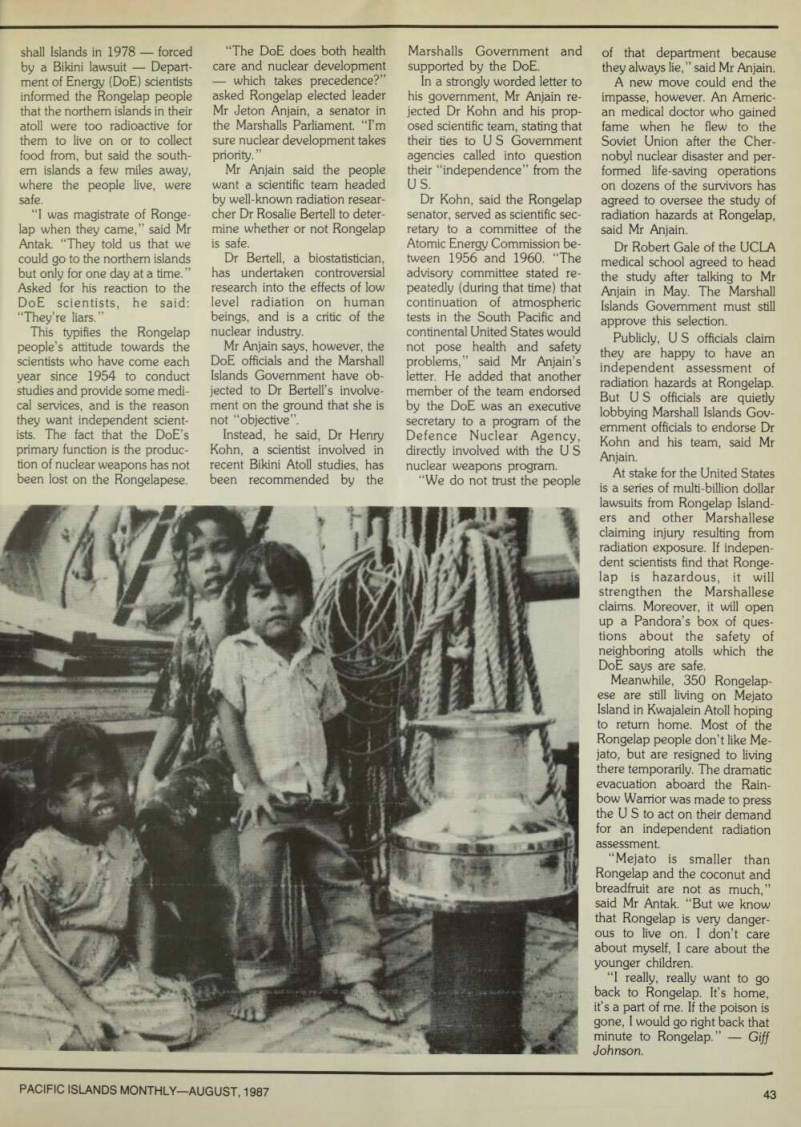
Three young children being evacuated from Rongelap Atoll on the Greenpeace ship Rain bow Warrior. Photo: Fernando Pereira, who died when the Rainbow Warrior was blown up in Auckland Harbour.
shall Islands in 1978 forced by a Bikini lawsuit Depart ment of Energy (DoE) scientists informed the Rongelap people that the northern islands in their atoll were too radioactive for them to live on or to collect food from, but said the south ern islands a few miles away, where the people live, were safe.
“I was magistrate of Ronge lap when they came,” said Mr Antak. “They told us that we could go to the northern islands but only for one day at a time. ”
Asked for his reaction to the DoE scientists, he said: “They’re liars.”
This typifies the Rongelap people’s attitude towards the scientists who have come each year since 1954 to conduct studies and provide some medi cal services, and is the reason they want independent scient ists. The fact that the DoE’s primary function is the produc tion of nuclear weapons has not been lost on the Rongelapese.
“The DoE does both health care and nuclear development which takes precedence?” asked Rongelap elected leader Mr Jeton Anjain, a senator in the Marshalls Parliament. “I’m sure nuclear development takes priority. ”
Mr Anjain said the people want a scientific team headed by well-known radiation resear cher Dr Rosalie Bertell to deter mine whether or not Rongelap is safe.
Dr Bertell, a biostatistician, has undertaken controversial research into the effects of low level radiation on human beings, and is a critic of the nuclear industry.
Mr Anjain says, however, the DoE officials and the Marshall Islands Government have ob jected to Dr Bertell’s involve ment on the ground that she is not “objective”.
Instead, he said, Dr Henry Kohn, a scientist involved in recent Bikini Atoll studies, has been recommended by the
Marshalls Government and supported by the DoE.
In a strongly worded letter to his government, Mr Anjain re jected Dr Kohn and his prop osed scientific team, stating that their ties to U S Government agencies called into question their “independence” from the US.
Dr Kohn, said the Rongelap senator, served as scientific sec retary to a committee of the Atomic Energy Commission be tween 1956 and 1960. “The advisory committee stated re peatedly (during that time) that continuation of atmospheric tests in the South Pacific and continental United States would not pose health and safety problems,” said Mr Anjain’s letter. He added that another member of the team endorsed by the DoE was an executive secretary to a program of the Defence Nuclear Agency, directly involved with the U S nuclear weapons program.
“We do not trust the people
of that department because they always lie, ” said Mr Anjain.
A new move could end the impasse, however. An Americ an medical doctor who gained fame when he flew to the Soviet Union after the Cher nobyl nuclear disaster and per formed life-saving operations on dozens of the survivors has agreed to oversee the study of radiation hazards at Rongelap, said Mr Anjain.
Dr Robert Gale of the UCLA medical school agreed to head the study after talking to Mr Anjain in May. The Marshall Islands Government must still approve this selection.
Publicly, U S officials claim they are happy to have an independent assessment of radiation hazards at Rongelap.
But U S officials are quietly lobbying Marshall Islands Gov ernment officials to endorse Dr Kohn and his team, said Mr Anjain.
At stake for the United States is a series of multi-billion dollar lawsuits from Rongelap Island ers and other Marshallese claiming injury resulting from radiation exposure. If indepen dent scientists find that Ronge lap is hazardous, it will strengthen the Marshallese claims. Moreover, it will open up a Pandora’s box of ques tions about the safety of neighboring atolls which the DoE says are safe.
Meanwhile, 350 Rongelap ese are still living on Mejato Island in Kwajalein Atoll hoping to return home. Most of the Rongelap people don’t like Me jato, but are resigned to living there temporarily. The dramatic evacuation aboard the Rain bow Warrior was made to press the U S to act on their demand for an independent radiation assessment.
“Mejato is smaller than Rongelap and the coconut and breadfruit are not as much,” said Mr Antak. “But we know that Rongelap is very danger ous to live on. I don’t care about myself, I care about the younger children.
“I really, really want to go back to Rongelap. It’s home, it’s a part of me. If the poison is gone, I would go right back that
minute to Rongelap.”
Giff
Johnson.