A Colonial’s view from
pp. 45-46 · Read in the full issue
books
A Colonial’s view from the last mountain
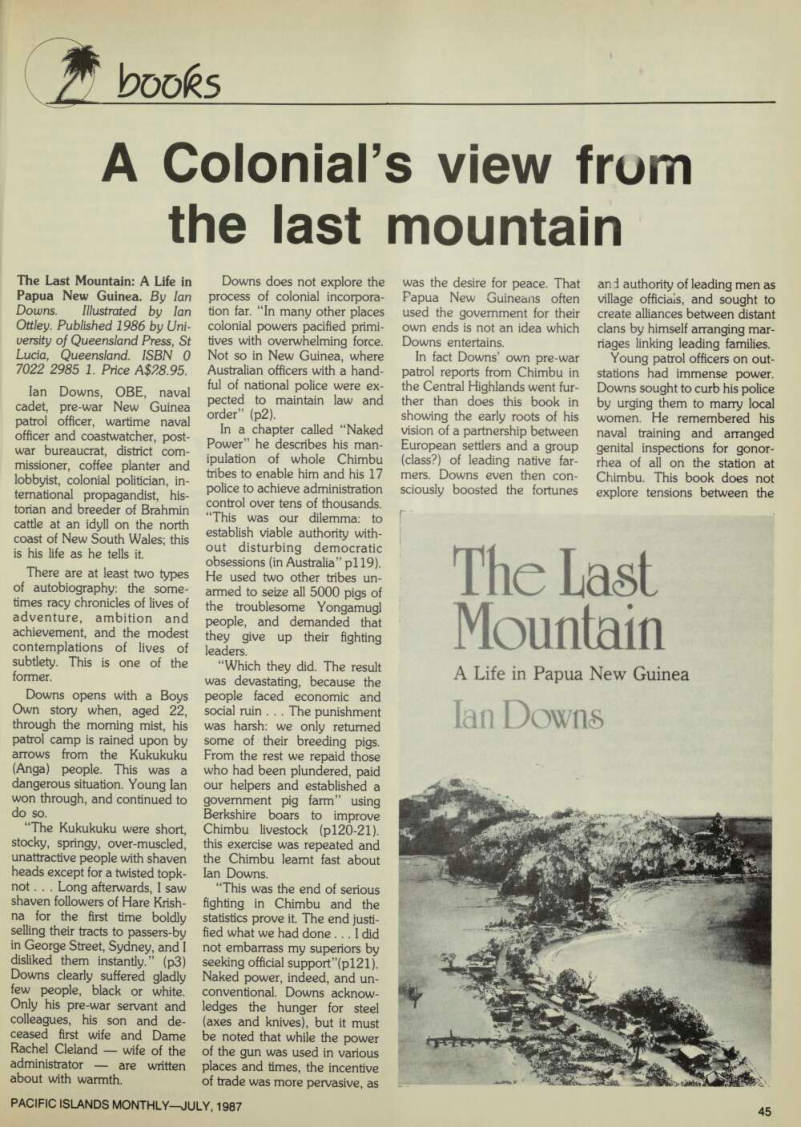
The Last Mountain: A Life in Papua New Guinea. By lan Downs. Illustrated by lan Ottley. Published 1986 by Uni versity of Queensland Press, St Lucia, Queensland. ISBN 0 7022 2985 1. Price A 528.95. lan Downs, OBE, naval cadet, pre-war New Guinea patrol officer, wartime naval officer and coastwatcher, post war bureaucrat, district com missioner, coffee planter and lobbyist, colonial politician, in ternational propagandist, his torian and breeder of Brahmin cattle at an idyll on the north coast of New South Wales; this is his life as he tells it.
There are at least two types of autobiography: the some times racy chronicles of lives of adventure, ambition and achievement, and the modest contemplations of lives of subtlety. This is one of the former.
Downs opens with a Boys Own story when, aged 22, through the morning mist, his patrol camp is rained upon by arrows from the Kukukuku (Anga) people. This was a dangerous situation. Young lan won through, and continued to do so.
“The Kukukuku were short, stocky, springy, over-muscled, unattractive people with shaven heads except for a twisted topk not.. . Long afterwards, I saw shaven followers of Hare Krish na for the first time boldly selling their tracts to passers-by in George Street, Sydney, and I disliked them instantly.” (p 3) Downs clearly suffered gladly few people, black or white.
Only his pre-war servant and colleagues, his son and de ceased first wife and Dame Rachel Cleland wife of the administrator are written about with warmth.
Downs does not explore the process of colonial incorpora tion far. “In many other places colonial powers pacified primi tives with overwhelming force.
Not so in New Guinea, where Australian officers with a hand ful of national police were ex pected to maintain law and order” (p 2).
In a chapter called “Naked Power” he describes his man ipulation of whole Chimbu tribes to enable him and his 17 police to achieve administration control over tens of thousands.
“This was our dilemma: to establish viable authority with out disturbing democratic obsessions (in Australia” pi 19).
He used two other tribes un armed to seize all 5000 pigs of the troublesome Yongamugl people, and demanded that they give up their fighting leaders.
“Which they did. The result was devastating, because the people faced economic and social ruin . . . The punishment was harsh: we only returned some of their breeding pigs.
From the rest we repaid those who had been plundered, paid our helpers and established a government pig farm” using Berkshire boars to improve Chimbu livestock (pl2o-21). this exercise was repeated and the Chimbu learnt fast about lan Downs.
“This was the end of serious fighting in Chimbu and the statistics prove it. The end justi fied what we had done ... I did not embarrass my superiors by seeking official support”(pl2l).
Naked power, indeed, and un conventional. Downs acknow ledges the hunger for steel (axes and knives), but it must be noted that while the power of the gun was used in various places and times, the incentive of trade was more pervasive, as
was the desire for peace. That Papua New Guineans often used the government for their own ends is not an idea which Downs entertains.
In fact Downs’ own pre-war patrol reports from Chimbu in the Central Highlands went fur ther than does this book in showing the early roots of his vision of a partnership between European settlers and a group (class?) of leading native far mers. Downs even then con sciously boosted the fortunes
and authority of leading men as village officials, and sought to create alliances between distant clans by himself arranging mar riages linking leading families.
Young patrol officers on out stations had immense power.
Downs sought to curb his police by urging them to marry local women. He remembered his naval training and arranged genital inspections for gonor rhea of all on the station at Chimbu. This book does not explore tensions between the
government and mission staff, or mention how closely he watched all Germans (then seen by him as “enemy aliens”) for Nazi sympathies in 1939-40 The ego of the man does blaze through, however. “It takes a certain flair to blandly accept the attention and sub mission of three hundred thousand Stone Age people who are convinced that you can solve their problems . . . They were eager to do almost any thing we suggested” (p 125).
Pre-War, Downs used thousands of Highlanders to make bridle paths up the Wahgi Valley for his stallion. Post-war he used them to build the first vehicular roads across the Kas sam and Daule passes into the Highlands where a million people live and where Euro peans started the coffee in dustry and peasant smallhol ders took off with it.
“There are dangers and di sappointments for those who use all their time and talents in the service of another race. In Chimbu, before the war, I had gone close to that. Now I was more detached ... I used my little knowledge of their thinking to identify myself with them . . .
This arrogant imitation some times took me out of my own origins so that I saw two sides, leading to a personal impasse which 1 put aside” (p 236).
He explains the creative accounting which enabled him to pay his labourers, and the subterfuges to keep official doubters ignorant till they were presented with a fait accompli.
Thus the Highlands were opened to European business and the Coast to the Highland ers before the days of environ mental and social impact state ments. The conflicts, human pain and death are not analy sed. Unlike the German-built road along New Ireland, the Highlands Highway does not carry the name of its overseer.
This book chronicles little of Downs the planter and politi cian. Kenya was his implicit model, not Zimbabwe, and after a trip to Africa (including a visit to the disintegrating Con go) he never sought to become an lan Smith. Yet he held to his dream of partnership and play ed an important role early in the decolonisation process when he
another Puerto Rico and be attached to Australia. After the War, he says, “we were too
proud in our dreams of sharing a racial partnership to concede that we were wrong” (p 297).
There was only one lan Downs, despite his disarming preface: “I belonged to that last wave of white men, who, with ex traordinary didactic arrogance, went out to colonies to make other people do things they would not have done for them selves. I had my share of ambition and greed occasional ly tempered with compassion and altruism. But I never pre tended that I really ‘under stood’ Papua New Guineans.
People are different. Not better or worse. I accepted the differ ences between us and I left their country when I realised that I belonged to an era that they had outgrown”. - Bill Standish.
(and the late colonial national) only slowly leamt that Papua New Guinea would not be like
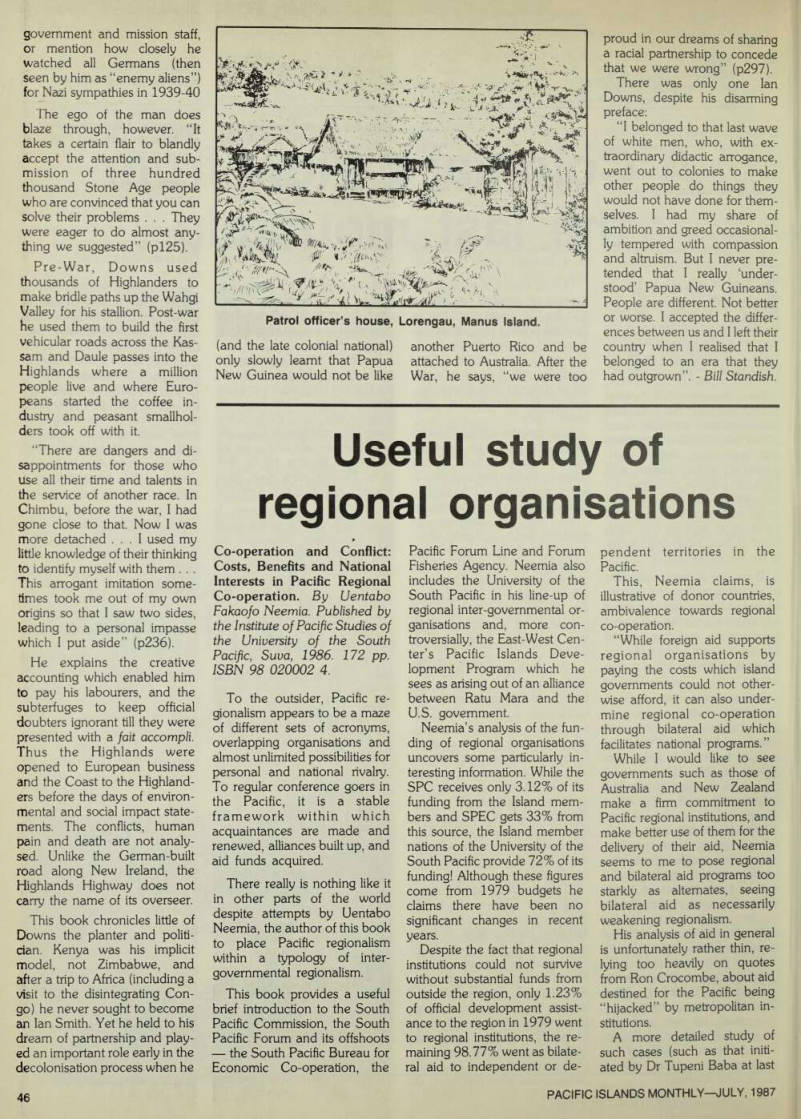
Patrol officer’s house, Lorengau, Manus Island.