Mead/Freeman
pp. 43-44 · Read in the full issue
debate continues
Derek Freeman’s fundamental reassessment of Dr Margaret Mead’s work on Samoa was strongly criticised in the June PIM review of The Quest For The Real Samoa: The Mead/Freeman Controversy and Beyond.
Professor Freeman refutes Joseph Theroux’s attack on his work.
In 1925, at the height of the nature-nurture controversy, the 23-year-old Margaret Mead was sent to Samoa by Franz Boas, the Professor of Anthropology at Columbia Uni versity, to secure a scientific answer to the question; “Are the disturbances which vex our adolescents due to the nature of adolescence itself or to the civilisation?”
In 1928, in Coming of Age in Samoa, Dr Mead came to the unequivocal conclusion, fully in accord with the then ruling ideology of American cultural anthropology, that “we cannot make any explanations of the “disturbances” of adolescence other than “in terms of” the “social environment”.
During the ensuing years this unqualified environmental dog ma, which gets a fundamental matter fundamentally wrong, was repeated in millions of copies of Coming of Age in Samoa, as well as in an un broken sequence of academic textbooks. It thus became a hallowed part of the belief system of very many Amer icans, including numerous pro fessional anthropologists.
However, since the publication almost sixty years ago of Mead’s extreme en vironmentalist conclusion, there have been many fundamental advances in the behavioral sci ences, so that today, as Stephen Jay Gould has put it, “every scientist, indeed every intelligent person, knows that human social behavior is a complex mix of biological and social influences.”
Indeed, in March, 1987, in Science, the journal of the American Association for the Advancement of Science, its editor, Daniel Koshland, Jr., declared; “the debate on nature and nurture in regard to be havior is basically over. Both are involved and we are going to have to live with that com-
plexity ...”
This means that in the light of modem scientific knowledge Mead’s extreme en vironmentalist conclusion can not possibly have been right, and is now decidedly obsoles cent.
Furthermore, this judgment is decisively confirmed by a criti cal examination of the evidence on which Mead based her de monstrably false conclusion.
Thus, on Mead’s own evi dence, at least four of her sample of twenty-five adoles cent girls were delinquents. This means that in the 1920 s delin quency, with its attendant “disturbances” (as described by Mead herself), was present among adolescent Samoan girls at as high a level as has been established for other twentieth century societies.
Again, while Mead, in sustaining her erroneous en vironmentalist conclusion, claimed that “Samoans never hate enough to want to kill anybody,” and that in warfare in Manu’a in the nineteenth century “casualties were low” with “only one or two indi viduals being killed,” in fact, during a war in Manu’a that
lasted from 1866 to 1872, some eighty-two individuals were killed a very severe rate of loss, representing well over ten per cent of the adult male population.
Similarly, Mead’s assertion that “the idea of forceful rape or of any sexual act to which both participants do not give them selves freely is completely fore ign to the Samoan mind”, is conclusively refuted by numer ous cases of the forcible rape of Samoan females by Samoan males documented in the arc hives of the high courts of both American and Western Samoa for the 19205, as for all the other decades for which these archives are available.
However, the error that most angers Samoans is Dr Mead’s claim that in traditional Samoan society “promiscuity” before marriage was both “permitted” and “expected”, with the ideal of chastity applying only to taupou, or ceremonial virgins.
This erroneous claim has been decisively refuted by Aiono Dr Fanaafi Le Tagaloa, the sometime Professor of Sa moan Studies in the University of Samoa.
“Virginity in Samoa,” she
writes, “cannot be glossed over and reduced to the easy and cheap sexual farce that Dr Mead has bequeathed to the papalagi (i.e. European and American) world; . . . every Sa moan’s daughter is a sister and covenant (feagaiga) to the males of her ’aiga (family)” and “therefore the attitude towards teine muli (virgins) is the same within all ’aiga.”
And, this testimony of the most distinguished of living Sa moan scholars is supported by that of Professor Albert Wendt, who has unequivocally stated that the Samoans, in their public morality, “forbid pre marital and extramarital sex and promiscuity”.
These statements by Aiono and Wendt about their own society have been confirmed by numerous non-Samoan scho lars, including the American cultural anthropologist Profes sor Lowell D. Holmes, who has accurately reported that in the 1950 s and earlier “Samoan society certainly did not sanc tion sex outside of marriage,” and that in Samoa “there are prohibitions against premarital sex”.
“This and much other of the evidence contained in Holme’s ethnography of Samoa de cisively contradicts Mead. Fur ther, when in 1967 I wrote to Holmes from Samoa enquiring how, given these contradic tions, he could possibly claim, as he had done in his Ph.D. thesis of 1957 that “the reliabil ity of Mead’s account is remark ably high,” he replied, in writ ing: “I think it is quite true that Margaret finds pretty much what she wants to find. While I was quite critical of many of her ideas and observations I do not believe that a thesis is quite the place to expound them. I was forced by my faculty adviser to soften my criticisms.”
To which he added: “The only tragedy about Mead is that she still refuses to accept the
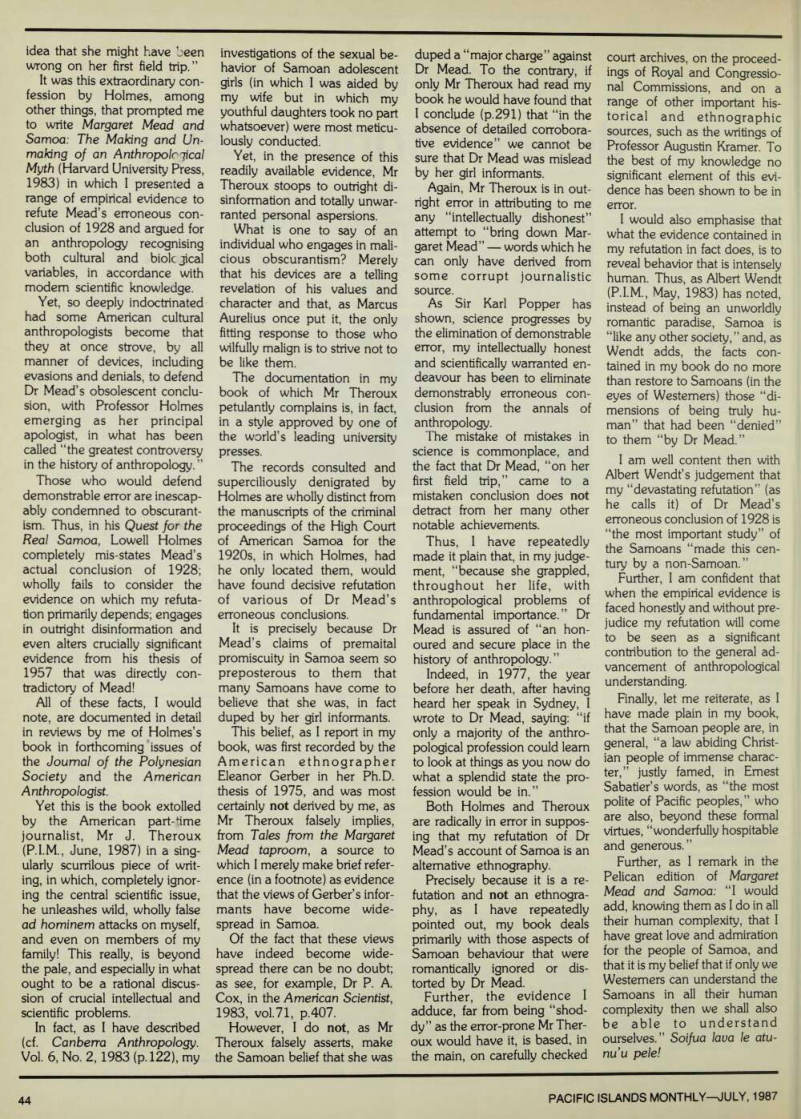
Professor Derek Freeman.
idea that she might have been wrong on her first field trip.”
It was this extraordinary con fession by Holmes, among other things, that prompted me to write Margaret Mead and Samoa: The Making and Un making of an Anthropological Myth (Harvard University Press, 1983) in which I presented a range of empirical evidence to refute Mead’s erroneous con clusion of 1928 and argued for an anthropology recognising both cultural and biolc jical variables, in accordance with modem scientific knowledge.
Yet, so deeply indoctrinated had some American cultural anthropologists become that they at once strove, by all manner of devices, including evasions and denials, to defend Dr Mead’s obsolescent conclu sion, with Professor Holmes emerging as her principal apologist, in what has been called “the greatest controversy in the history of anthropology. ”
Those who would defend demonstrable error are inescap ably condemned to obscurant ism. Thus, in his Quest for the Real Samoa, Lowell Holmes completely mis-states Mead’s actual conclusion of 1928; wholly fails to consider the evidence on which my refuta tion primarily depends; engages in outright disinformation and even alters crucially significant evidence from his thesis of 1957 that was directly con tradictory of Mead!
All of these facts, I would note, are documented in detail in reviews by me of Holmes’s book in forthcoming issues of the Journal of the Polynesian Society and the American Anthropologist.
Yet this is the book extolled by the American part-ime journalist, Mr J. Theroux (P.1.M., June, 1987) in a sing ularly scurrilous piece of writ ing, in which, completely ignor ing the central scientific issue, he unleashes wild, wholly false ad hominem attacks on myself, and even on members of my family! This really, is beyond the pale, and especially in what ought to be a rational discus sion of crucial intellectual and scientific problems.
In fact, as I have described (cf. Canberra Anthropology.
Vol. 6, No. 2,1983 (p. 122), my
investigations of the sexual be havior of Samoan adolescent girls (in which I was aided by my wife but in which my youthful daughters took no part whatsoever) were most meticu lously conducted.
Yet, in the presence of this readily available evidence, Mr Theroux stoops to outright di sinformation and totally unwar ranted personal aspersions.
What is one to say of an individual who engages in mali cious obscurantism? Merely that his devices are a telling revelation of his values and character and that, as Marcus Aurelius once put it, the only fitting response to those who wilfully malign is to strive not to be like them.
The documentation in my book of which Mr Theroux petulantly complains is, in fact, in a style approved by one of the world’s leading university presses.
The records consulted and superciliously denigrated by Holmes are wholly distinct from the manuscripts of the criminal proceedings of the High Court of American Samoa for the 19205, in which Holmes, had he only located them, would have found decisive refutation of various of Dr Mead’s erroneous conclusions.
It is precisely because Dr Mead’s claims of premaital promiscuity in Samoa seem so preposterous to them that many Samoans have come to believe that she was, in fact duped by her girl informants.
This belief, as I report in my book, was first recorded by the American ethnographer Eleanor Gerber in her Ph.D. thesis of 1975, and was most certainly not derived by me, as Mr Theroux falsely implies, from Tales from the Margaret Mead taproom, a source to which I merely make brief refer ence (in a footnote) as evidence that the views of Gerber’s infor mants have become wide spread in Samoa.
Of the fact that these views have indeed become wide spread there can be no doubt; as see, for example, Dr P. A.
Cox, in the American Scientist, 1983, v 01.71, p. 407.
However, I do not, as Mr Theroux falsely asserts, make the Samoan belief that she was
duped a “major charge” against Dr Mead. To the contrary, if only Mr Theroux had read my book he would have found that I conclude (p. 291) that “in the absence of detailed corrobora tive evidence” we cannot be sure that Dr Mead was mislead by her girl informants.
Again, Mr Theroux is in out right error in attributing to me any “intellectually dishonest” attempt to “bring down Mar garet Mead” words which he can only have derived from some corrupt journalistic source.
As Sir Karl Popper has shown, science progresses by the elimination of demonstrable error, my intellectually honest and scientifically warranted en deavour has been to eliminate demonstrably erroneous con clusion from the annals of
anthropology.
The mistake of mistakes in science is commonplace, and the fact that Dr Mead, “on her first field trip,” came to a mistaken conclusion does not detract from her many other notable achievements.
Thus, I have repeatedly made it plain that, in my judge ment, “because she grappled, throughout her life, with anthropological problems of fundamental importance.” Dr Mead is assured of “an hon oured and secure place in the history of anthropology.”
Indeed, in 1977, the year before her death, after having heard her speak in Sydney, I wrote to Dr Mead, saying: “if only a majority of the anthro pological profession could learn to look at things as you now do what a splendid state the pro fession would be in.”
Both Holmes and Theroux are radically in error in suppos ing that my refutation of Dr Mead’s account of Samoa is an alternative ethnography.
Precisely because it is a re futation and not an ethnogra phy, as I have repeatedly pointed out, my book deals primarily with those aspects of Samoan behaviour that were romantically ignored or dis torted by Dr Mead.
Further, the evidence I adduce, far from being “shod dy” as the error-prone Mr Ther oux would have it, is based, in the main, on carefully checked
court archives, on the proceed ings of Royal and Congressio nal Commissions, and on a range of other important his torical and ethnographic sources, such as the writings of Professor Augustin Kramer. To the best of my knowledge no significant element of this evi dence has been shown to be in error.
I would also emphasise that what the evidence contained in my refutation in fact does, is to reveal behavior that is intensely human. Thus, as Albert Wendt (P.1.M., May, 1983) has noted, instead of being an unworldly romantic paradise, Samoa is “like any other society,” and, as Wendt adds, the facts con tained in my book do no more than restore to Samoans (in the eyes of Westerners) those “di mensions of being truly hu man” that had been “denied” to them “by Dr Mead.”
I am well content then with Albert Wendt’s judgement that my “devastating refutation” (as he calls it) of Dr Mead’s erroneous conclusion of 1928 is “the most important study” of the Samoans “made this cen tury by a non-Samoan.”
Further, I am confident that when the empirical evidence is faced honestly and without pre judice my refutation will come to be seen as a significant contribution to the general ad vancement of anthropological understanding.
Finally, let me reiterate, as I have made plain in my book, that the Samoan people are, in general, “a law abiding Christ ian people of immense charac ter,” justly famed, in Ernest Sabatier’s words, as “the most polite of Pacific peoples,” who are also, beyond these formal virtues, “wonderfully hospitable and generous.”
Further, as I remark in the Pelican edition of Margaret Mead and Samoa: “I would add, knowing them as I do in all their human complexity, that I have great love and admiration for the people of Samoa, and that it is my belief that if only we Westerners can understand the Samoans in all their human complexity then we shall also be able to understand ourselves.” Soifua lava le atu nuu pele!