Welfare for American Samoa?
p. 41 · Read in the full issue
Hill cash welfare pay ments be available to poor families in Amer ican Samoa? The answer in the future will be yes if a bill pressed by Congress man Fofo Sunia (D AS.) continues its current progress in the US Congress.
The United States Govern ment has adopted a patch-work quilt of policies towards assist ance to no-and-low income families in its territories. Prog rams that are routinely available on the Mainland are available to some US territories pretty much on Mainland terms, in other territories limited versions of the programs are available (i.e. the benefits are lower), and in still other situations, the prog rams do not exist at all.
The three most important assistance programs in the Un ited States are Ad to Families with Dependent Children (AFDC to the professionals and “welfare” to most Americans), Supplemental Security Income (SSI) and Food Stamps. None of these programs is now avail able in American Samoa, and Congressman Sunia’s initiative would, at least for starters, bring AFDC to the islands.
AFDC is for low and no income families where there are children, and where the father is dead, absent, disabled or (in some American states) unem ployed. Monthly cash payments are made, usually to the mother. The amount of these benefits are set by the states, and vary widely; a couple of years age a family of six in Wisconsin would receive SUS76O a month from AFDC, while the same family, if living in Aabama, would get US $206 per month. Benefit levels in American Samoa have not been set but presumably would be at or below the Aabama level.
SSI is for aged, blind and disabled adults of low or no income, and food stamps are for all no or low income indi
viduals (the food stamps play the role of money, but can only be used to buy food).
While American Samoa has none of these programs, the Commonwealth of the North ern Mariana Islands (CNMI) has a small SSI program, and has a limited Food Stamps program. (When the latter program was introduced into the islands the Mainland policymakers were worried that its presence would discourage local agriculture and gardening, and the rules were set in such a way as to limit that problem). CNMI does not have
Afdc.
There is a still different mix of programs on nearby Guam, which has AFDC and Food
Stamps, but no SSI. The AFDC program in Guam, like the ones in the American Caribbean ter ritories, does not have the open formula available to Mainland states; the Government in Washington will provide only a stipulated amount of matching money to Guam, while it makes unlimited matching grants avail able to Mainland states.
Congressman Ben Blaz (RG) has introduced legislation lifting the Guam AFDC ceiling from the SUS 3.3 million a year set in 1979 to $4.8 million a year in future years to reflect the im pact of inflation. That legislation has not yet been acted upon.
Congressman Sunia’s legisla tion probably faces Reagan Ad-
ministration opposition (and an uncertain future) and it reflects some of the down-side con sequences of the arrival of the cash economy to American Samoa.
The legislation is a prelimin ary step in the American sys tem, in that it would authorise such a program in American Samoa; a program needs to be authorised and funded through the appropriations process be fore the money actually flows.
Getting through both steps will be a long process, probably taking, with luck, at least a year.
Sunia has enlisted the assist ance of a 41-year-old Demo cratic congressman from Bos ton, Brian Donnelly, a member of the House Subcommittee on Public Assistance and Un employment Compensation.
Donnelly, in turn, pushed the Samoan authorisation amend ment through the subcommit tee, which is working on a comprehensive reform of the whole welfare program.
The Republican Reagan Ad ministration, on the other hand, is seeking to reduce the welfare program, not to expand it. The program has been criticised in recent years for being too gen erous, at least in the more affluent of the American states and as being a force discourag ing work.
In a subsistence economy, such as the traditional one in American Samoa, no cash wel fare programs are needed, it is argued, because the extended family takes care of the econo mic needs of the young, the old and the widowed. But a break down of family systems and the spread of the cash economy create arguments for such a program.
American Samoa, and maybe CNMI, for better or for worse, appear to be on the verge of adopting the cash welfare programs that first came to the Mainland more than fifty years ago. David S. North in Washington.
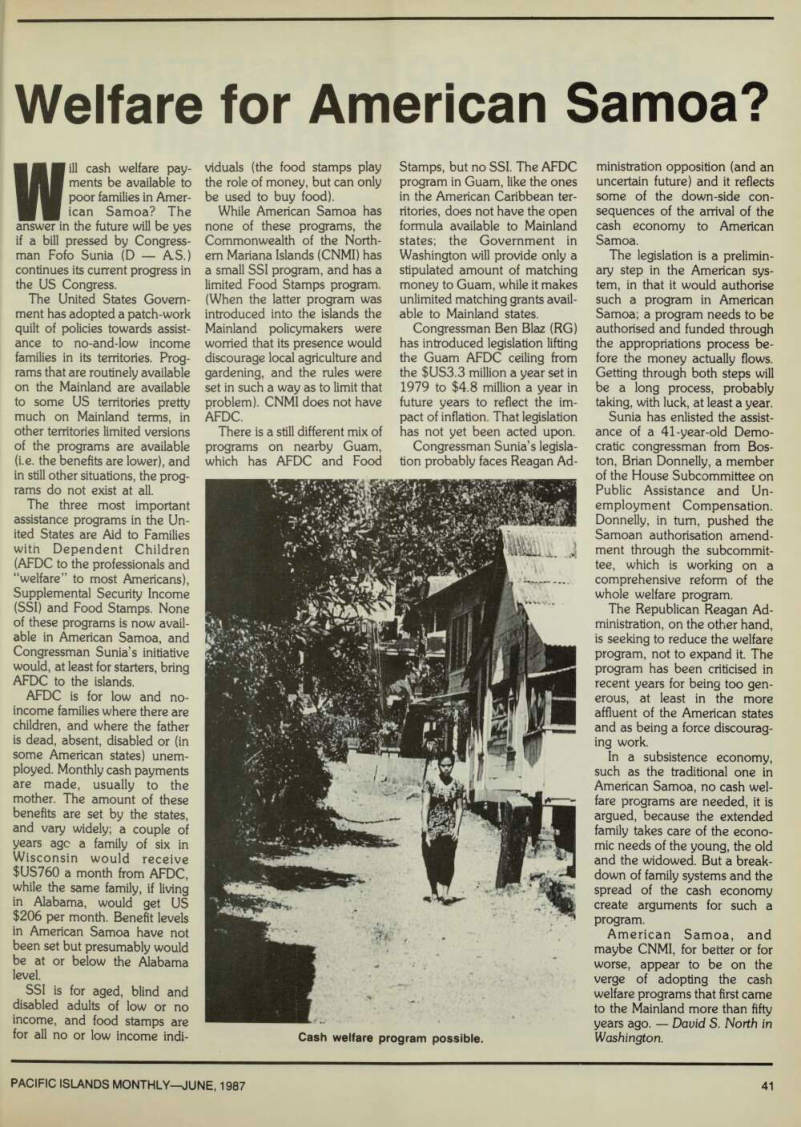
Cash welfare program possible.