Women and education
pp. 39-40 · Read in the full issue
in Vanuatu
In Vanuatu there is a sort of joke about girls: they are called “Toyotas” because the market price for a young bride equals a new car for her family. This entrenched view of women as tradeable items is the daunting obstacle Kathy Rarua faces every day.
“We have a lot of problems with girls’ education because traditionally they are regarded as not amounting to much, just as child-bearers. They are somebody who can help the husband or his family build wealth and status by working the land, breeding the pigs and so on.”
She believes the traditional exchange of marriage gifts be tween in-laws has been man ipulated to excuse selling off girls for as much as possible.
Bride prices of several thousand dollars are not uncommon these days in Vanuatu, hence the Toyota joke.
“It is a misplacement of our culture to regard girls merely as something to be sold off.” But sold they are, bringing a wind fall profit to their family. As girls then are expected only to en rich their husband’s family, pa rents give them little encourage ment to gain an education.
“Parents are more willing to pay school fees for boys. ” Sons stay with the family and are worth the investment.
“As we emerge into the Western world, there seems to be this halo around girls, that they are meant to grow up merely to have children and stay at home.” While the boys are free to roam with friends, fishing or playing sport, the girls must stay at home, cleaning and minding younger children.
Early stamping of gender roles and lack of parental sup port make it inevitable that
many girls fail the exams needed to progress from pri mary to junior secondary school.
So last year Vanuatu intro duced a 50:50 quota for both sexes in forms one to four to push more girls into higher education. The girls sit another exam at the end of the fourth form and the best students continue to upper secondary school.
But Kathy says many in Vanuatu doubt the need for such quotas. They see the competition for secondary places as “survival of the fit test”, without recognising inhe rent obstacles which shut out girls.
Ironically, the very pressure of Western consumerism which has distorted the worth of ni- Vanuatu girls to the price of a
Japanese 4-door, may itself provide the key to girls’ ad vancement. Modem economic imperatives competition for scholarships, better jobs, more money and status are slowly encouraging parents to push all their children into higher educa tion. But so far this has not produced any improvement in the numbers of girls making it through school.
Vanuatu’s wider economic
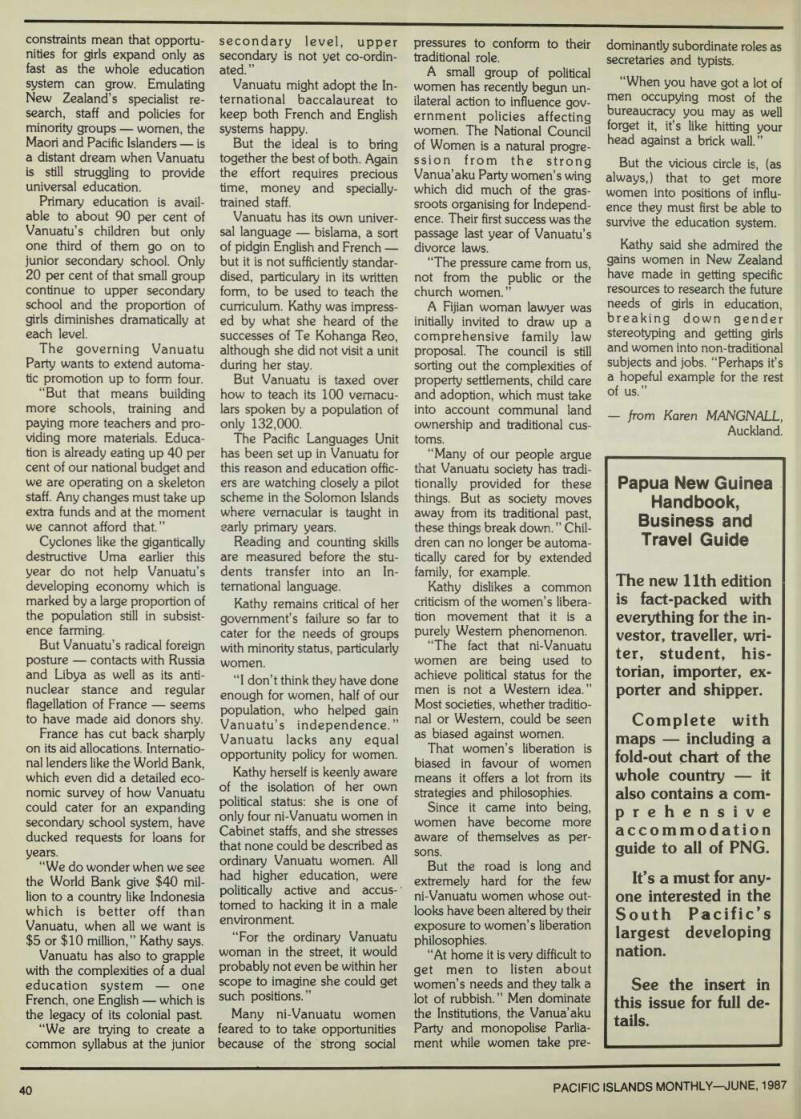
Ms Kathy Rarua, Vanuatu Education Minister’s adviser on pre-school, primary and girls' education.
constraints mean that opportu nities for girls expand only as fast as the whole education system can grow. Emulating New Zealand’s specialist re search, staff and policies for minority groups women, the Maori and Pacific Islanders is a distant dream when Vanuatu is still struggling to provide universal education.
Primary education is avail able to about 90 per cent of Vanuatu’s children but only one third of them go on to junior secondary school. Only 20 per cent of that small group continue to upper secondary school and the proportion of girls diminishes dramatically at each level.
The governing Vanuatu Party wants to extend automa tic promotion up to form four.
“But that means building more schools, training and paying more teachers and pro viding more materials. Educa tion is already eating up 40 per cent of our national budget and we are operating on a skeleton staff. Any changes must take up extra funds and at the moment we cannot afford that.”
Cyclones like the gigantically destructive Uma earlier this year do not help Vanuatu’s developing economy which is marked by a large proportion of the population still in subsist ence farming.
But Vanuatu’s radical foreign posture contacts with Russia and Libya as well as its anti nuclear stance and regular flagellation of France seems to have made aid donors shy.
France has cut back sharply on its aid allocations. Internatio nal lenders like the World Bank, which even did a detailed eco nomic survey of how Vanuatu could cater for an expanding secondary school system, have ducked requests for loans for years.
“We do wonder when we see the World Bank give S4O mil lion to a country like Indonesia which is better off than Vanuatu, when all we want is $5 or $lO million,” Kathy says.
Vanuatu has also to grapple with the complexities of a dual education system one French, one English which is the legacy of its colonial past.
“We are trying to create a common syllabus at the junior
secondary level, upper secondary is not yet co-ordin ated.”
Vanuatu might adopt the In ternational baccalaureat to keep both French and English systems happy.
But the ideal is to bring together the best of both. Again the effort requires precious time, money and specially trained staff.
Vanuatu has its own univer sal language bislama, a sort of pidgin English and French but it is not sufficiently standar dised, particulary in its written form, to be used to teach the curriculum. Kathy was impress ed by what she heard of the successes of Te Kohanga Reo, although she did not visit a unit during her stay.
But Vanuatu is taxed over how to teach its 100 vernacu lars spoken by a population of only 132,000.
The Pacific Languages Unit has been set up in Vanuatu for this reason and education offic ers are watching closely a pilot scheme in the Solomon Islands where vernacular is taught in early primary years.
Reading and counting skills are measured before the stu dents transfer into an In ternational language.
Kathy remains critical of her government’s failure so far to cater for the needs of groups with minority status, particularly women.
“I don’t think they have done enough for women, half of our population, who helped gain Vanuatu’s independence.”
Vanuatu lacks any equal opportunity policy for women.
Kathy herself is keenly aware of the isolation of her own political status: she is one of only four ni-Vanuatu women in Cabinet staffs, and she stresses that none could be described as ordinary Vanuatu women. All had higher education, were politically active and accus-' tomed to hacking it in a male environment.
“For the ordinary Vanuatu woman in the street, it would probably not even be within her scope to imagine she could get such positions.”
Many ni-Vanuatu women feared to to take opportunities because of the strong social
pressures to conform to their traditional role.
A small group of political women has recently begun un ilateral action to influence gov ernment policies affecting women. The National Council of Women is a natural progre ssion from the strong Vanua’aku Party women’s wing which did much of the gras sroots organising for Independ ence. Their first success was the passage last year of Vanuatu’s divorce laws.
“The pressure came from us, not from the public or the church women.”
A Fijian woman lawyer was initially invited to draw up a comprehensive family law proposal. The council is still sorting out the complexities of property settlements, child care and adoption, which must take into account communal land ownership and traditional cus toms.
“Many of our people argue that Vanuatu society has tradi tionally provided for these things. But as society moves away from its traditional past, these things break down.” Chil dren can no longer be automa tically cared for by extended family, for example.
Kathy dislikes a common criticism of the women’s libera tion movement that it is a purely Western phenomenon.
“The fact that ni-Vanuatu women are being used to achieve political status for the men is not a Western idea.”
Most societies, whether traditio nal or Western, could be seen as biased against women.
That women’s liberation is biased in favour of women means it offers a lot from its strategies and philosophies.
Since it came into being, women have become more aware of themselves as per sons.
But the road is long and extremely hard for the few ni-Vanuatu women whose out looks have been altered by their exposure to women’s liberation philosophies.
“At home it is very difficult to get men to listen about women’s needs and they talk a lot of rubbish. ” Men dominate the Institutions, the Vanua’aku Party and monopolise Parlia ment while women take pre
dominantly subordinate roles as secretaries and typists.
“When you have got a lot of men occupying most of the bureaucracy you may as well forget it, it’s like hitting your head against a brick wall.”
But the vicious circle is, (as always,) that to get more women into positions of influ ence they must first be able to survive the education system.
Kathy said she admired the gains women in New Zealand have made in getting specific resources to research the future needs of girls in education, breaking down gender stereotyping and getting girls and women into non-traditional subjects and jobs. “Perhaps it’s a hopeful example for the rest of us.”
from Karen MANGNALL,
Auckland.