Nuclear testing -
pp. 25-26 · Read in the full issue
Nuclear testing a pain in the tummy?
The French have been and are blamed for a lot in the South Pacific, yet it seems far fetched to say that nuclear testing causes food poisoning. But in fact the evi dence is quite strong.
At the 1985 International Coral Reef Conference in Tahi ti, Dr Raymond Bagnis of the Louis Malarde Institute of Medi cal Research in Papeete pre sented a paper which showed that in the past 25 years there have been over 24,000 cases of Ciguatera (fish poisoning) in French Polynesia. And 25 years just happens to correlate with the period of maximum French military activity in the region. Of course these kinds of associa tions can be rather spurious. An eminent professor once illus trated how ludicrous medical statistics can be by showing convincing figures relating the declining birth rate in Europe to fewer sightings of storks on chimney pots.
Nonetheless the arguments about fish poisoning and nuc lear testing in the Pacific go beyond the mythology of procreation. Ciguatera is an extremely unpleasant form of food poisoning which comes from eating certain kinds of fish.
The condition occurs in tropi cal and sub-tropical waters around the world. In fact Span ish mariners gave the illness its name in the Caribbean about 400 years ago. Ciguatera poisoning is caused by a toxic chemical (toxin) concentrated in the flesh of certain fish. A type of plankton which attaches itself to algae on damaged coral manufactures the toxin. Fish like parrot fish which feed on coral reefs consume the toxin and then like the children’s song about the lady who swal lowed the fly, as these fish are eaten by other fish, the toxin collects in greater quantities.
In technical terms, ciguatoxin is concentrated up the food
chain. This means that flesh eating fish pose the greatest risk to hungry humans. In Australia, the commonest contaminated fish species are red bass, Span ish mackerel, paddletail, coral trout and barracuda.
The curious feature though, is that while ciguatera can be quite devastating for us, it doesn’t turn a gill on a fish.
According to Dr Michael Capra of the Queensland Institute of Technology, somehow fish manage to “partition” away the toxin from key parts of fishes’ anatomy. If Dr Capra can discover how this happens then perhaps a treatment could be developed.
Those who have suffered ciguatera will never forget the experience. About five hours after the fish meal which did not taste badly at all (cooking makes no difference) the nausea, abdominal pains, diar rhoea and vomiting start. At this stage it is much like any other food poisoning but soon other problems begin like pins and needles, especially around the mouth and temperature rever sal where hot things feel cold and cold things, hot.
Muscle pains and even para lysis have been described and there is a small mortality rate.
The symptoms of ciguatera can reappear months or even years later after eating fish which may only contain very tiny amounts of the toxin not enough to poison other people.
The other substance which can bring on the illness again is alcohol and no one is sure why.
So with 24,000 cases in French Polynesia and perhaps 3,000 in Northern Australia since the ’6o’s ciguatera is of major con cern particularly in areas where people rely on fish for food as well as income.
If the word gets around that a particular island nation has ciguatera then its markets can shrivel considerably. And the
problem with ciguatera is that outbreaks are very patchy. One part of a coastline can carry the toxin for a time while the rest is clear.
Which brings us to the reasons why this troublesome plankton attaches itself in some places and not in others. One common but not absolute fin ding is that damaged coral reefs seem to be susceptible to inva sion.
Dr Tilman Ruff of the Medical Association for the Prevention of War and Fairfield Infectious Diseases Hospital in Melbourne claims that the French nuclear programme is a major culprit.
“In fact the incidence of ciguatera increased 10-fold
from the early ‘6o’s to the early 70’s and hasn’t gone down since then,” he told me.
This is not simply from the trauma of the explosions, but the disruption which accompa nies the military, Dredging, building jetties and blasting reefs for construction activities can all cause ciguatera. Dr Ruff gives the example of what happened on the French Polynesian island of Hao.
“On Hao there was no ciguatera until the French came in 1965 to build a staging base.” Then cases started to appear and the outbreak spread around the island. And at its peak, the incidence of
ciguatera was 43% in one year.
That means that nearly half the inhabitants came down with the illness in 12 months. “The Hao case study and the enormous rate of ciguatera in French Polynesia as a whole points to reef damage from military activity. ”
A recent paper in the Medical Journal of Australia also emphasised the clear relation ship with coral reef disturb ances, although in the Austra lian context, the concern is usually from industrial or tourist developments.
Critics of this view say that it is hard to relate ciguatera to such factors since its appear ances are so random with con taminated fish turning up all over the place.
But fisheries experts explain that some of the sporadic cases are due to the immense dist ances that fish like mackerel can cover.
So in the end, apart from arguing for a nuclear free Paci fic and ecologically sensitive development what should travellers and residents in the region do to protect themselves from ciguatera?
Well, one practice is to test an individual fish out on an animal like a cat. If the unfortunate beast doesn’t fall apart then one can devour the rest of that one fish. But it is unlikely that this technique will be terribly popu lar and a cheap chemical test is long way off. That won’t come until scientists find a way of making the ciguatoxin in large amounts for their studies.
Therefore the best advice from the experts is to avoid the risky fish (particularly the large specimens) and to find out from the locals what they think is safe on their part of the coast. If you are still not sure then eat small rather than large portions to minimise the potential dose of toxin. Never eat the liver, roe or intestines of fish since the poison is at its highest con centration in the viscera.
The only consolation if pre vention fails and you feel as though a one-rnegaton explo sion has just detonated in your stomach and colon, is that you might know who to blame.
From Dr Norman Swan of ABC Radio’s “The Health Re port”.
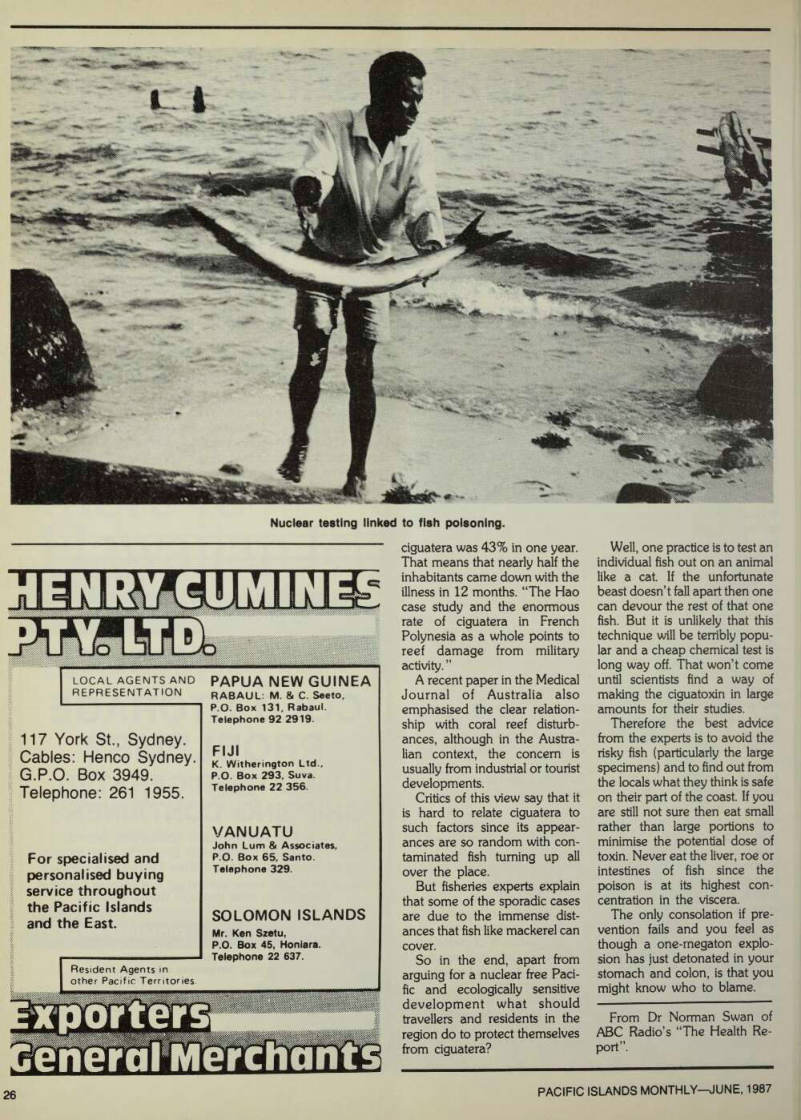
Nuclear testing linked to fish poisoning.