Treaty ends tuna war
pp. 22-23 · Read in the full issue
To the blast of conch shells, the beat of gara mut drums and the wavering of bamboo flutes, United States Ambassa dor John Negroponte signed the fishing treaty. He was flank ed by more than a dozen elaborately painted and tradi tionally dressed Mekeo dancers from the coastal plains of Papua New Guinea’s Central Pro vince.
The Treaty guarantees the Pacific island countries at least SUS6O million over the next five years. Its signing closes a long chapter of acrimony dur ing which at least two island countries PNG and Solomon Islands confiscated multi mil lion dollar American Purse seiner fishing trawlers for catch ing tuna without a licence in their 200 mile economic zones.
Both countries had to with stand the repercussions of the retaliatory Magnusson Act which swung trade embargoes into immediate effect against them. Under that Act tuna were declared a “migratory” species and therefore the property of no nation.
The activities of the American Tuna Boat Association had won the United States no friends.
Indeed, the climate had been created for the Russians to get sympathetic hearings when they proposed their fishing deals.
In his address to the signing ceremony, Ambassador Negroponte said the U.S. Sec retary for State, Mr George Schultz, had taken a personal interest in seeing the whole issue resolved: “The fisheries negotiations have caused the United States, at the highest levels of our government, to examine the state of our relations with the Pacific Island countries.
“Let me assure you that this examination has fully recon firmed the great value which we attach to this region of the world. The Treaty we are sig ning is unique. The Treaty area covers nearly l/20th of the Earth’s surface. It is the most complex multi-lateral fisheries
An impressive ceremony in Port Moresby in early April marked in one way the coming of age of the South Pacific island nations as an effective political and economic group. After two tough years of bargaining, the “Tuna War” between the United States and the South Pacific Forum nations came to an end with the United States finally admitting that it had to recognise the island states’ jurisdiction over tuna within their 200-mile economic zones. PlM’s report on the signing of the Fisheries Treaty between America and the member nations of the Forum Fisheries Agency comes courtesy of the recently returned Port Moresby correspondent for the ABC and Radio Australia, Sean Dorney.
agreement ever concluded.
“There really is no other agreement quite like it any where in the world. Our cere mony today represents the end of the negotiating process but at the same time the beginning of a new chapter in our multi lateral relations.”
On the Pacific Islands side, getting agreement amongst 16 countries on such a complex agreement was not easy.
But, the Marshall Islands Foreign Minister, Mr Charles Dominick, told the gathering the breakthrough against the powerful American tuna lobby had come about only through joint action:
“What we see here today is the result of a regional, com mon approach towards a super power. Indeed, only a few years ago such a treaty would have been said by many to be unobtainable. Most of the na tions represented here have attempted over the years to do business with the United States tuna industry.
“But this industry’s failure to recognise and respect our juris diction over tuna inevitably led to a head-on confrontation.
“Accordingly the Republic of the Marshall Islands has for the past four years, as a matter of policy, refused to license United States purse-seiners.
“The coming into force of this Treaty will represent a change in direction. We see the Treaty as recognition of our jurisdiction over tuna and accordingly we welcome joining with out friends represented here and participating in both the internal agreement (on funds distribution) and the principal Treaty.”
Australia’s Primary Industry Minister, Mr John Kerin, signed the Treaty for Australia. Parts of the Coral Sea are included in the Forum Fisheries Agency zone where tuna are found.
Mr Kerin said the previous attitude taken by the Americans that tuna being migratory be longed to no nation was an affront to the region.
“We would not compromise on issues of sovereignty. And we did not. And the U.S. fishermen when fishing in our zones will fish under our laws and our penalties.”
The President of Nauru, President Hammer Deßoburt, spoke of the importance of the region’s marine resources to the economies of the island na tions.
But he said his country, like others, had to overcome re servations before agreeing to sign: “Our position is based in large measure on the realisation that Nauru’s phosphate de posits will be exhausted within a short time. It is vital for us that whatever resources of ours re main available are conserved and managed for our future benefit.
“Predominant among these resources is our ocean. It is our wish and intention to develop and manage these resources ourselves. To this end we attempted a few years ago to begin a purse-seining operation based on Nauru at very great cost.
“To say the least the opera tion has not achieved the suc cess that we had hoped for.
Nevertheless it is our intention to persevere.
“The decision to participate in this Treaty has not been an easy one for us.
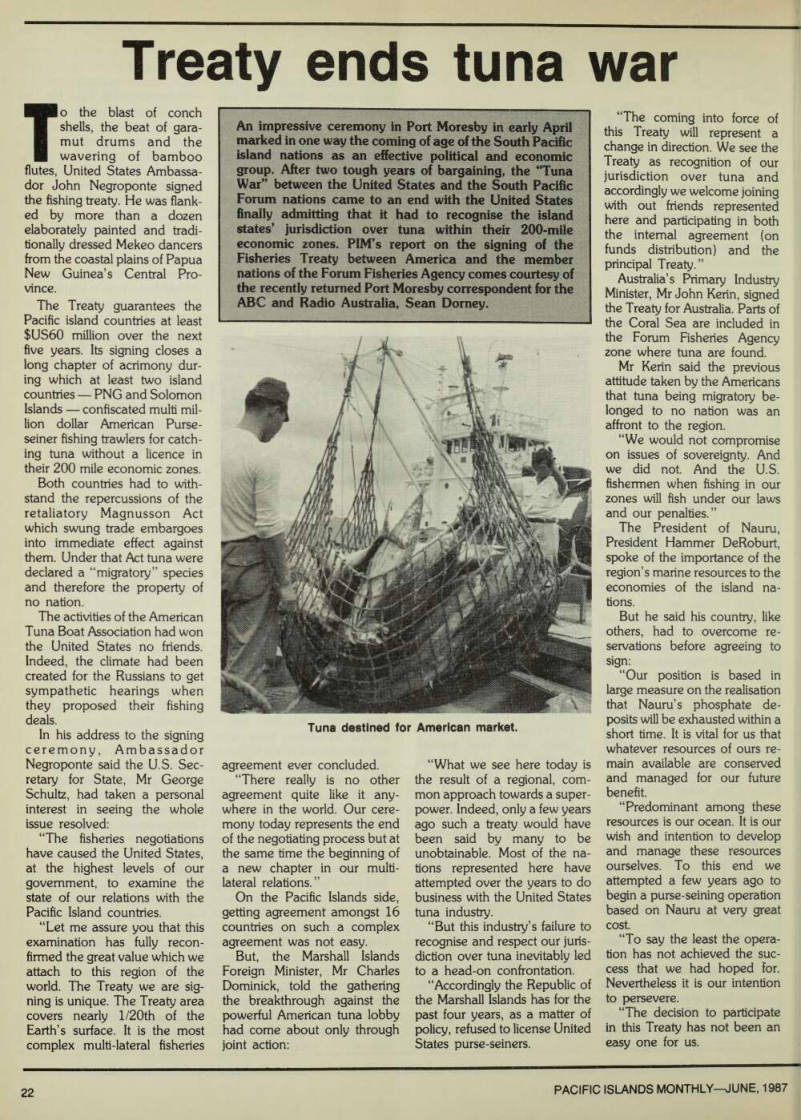
Tuna destined for American market.
“Apart from those policy considerations we have had difficulties of principle in accepting that the United States tuna fishing industry should now gain legal access to our waters, “I would be less than frank with you if I did not say that our natural instincts were against Nauru s participation in this Treaty. It is because of the imperative of maintaining regional solidarity and regional cooperation on the vital issue of the exploitation of the resources of our exclusive economic zones and to make a start on the development of them that my Cabinet has agreed to participate.
The fisheries treaty is worth
Sa£di!S£££3
"d ■ F h“
“tin n P *, s ,,cr on ‘ S C °T S „° m
U |o S m ,°
££ n t S ar l, aSSISt ‘ ance grant and $1 million as project aid. Fee revenue to be derived from the tuna boats themselves is at the rate of $50,000 U.S. per vessel per year. For the first year we have a guarantee of 35 vessels bringing in a total of $1.75 million.
“Should there be in excess of is
SSKi=SfiS!
W.Jssffi.E.'Ss
million Treaty but it could in fact be in excess of that “The other $250,000 will come as technical assistance from the American Tuna Foundation which will be inkind assistance to the Pacific countries.
“Beyond the total of $l2 million there’s an additional aid package that has been linked to the negotiations. That’s currently running at $1.5 million a year. ”
In the weeks leading up to the signing of the Treaty, Papua New Guinea’s Fisheries Minister, Mr Neville Bourne, was concerned about how the money would be divided up amongst the 16 participants.
Mr Muller says the Treaty money will be divided two ways: “15% of the total will be
divided as equal shares amongst all the parties to the Treaty and 85% will be divided on the basis of where the fish is caught. There are provisions in the Treaty governing how the tuna boat fishermen will report where their catch is taken. ”
Mr Muller says the island countries will be allowed to put their fisheries officials on board the American boats if they wish, Although the Fisheries Agreement resolves one prob lem for the United States, Papua New Guinea’s Prime Minister, Mr Paias Wingti, left the American delegates at the signing ceremony in no doubt that it was not the only matter on the regional agenda l
JS t ».>"
b W«~0. but we believe this has been achieved in this treaty. a however that this has not been the case in other matters of great concern to our reqion
%ii‘ • .. n •
™ Paclftc , w f"‘ f instrume "? L , We de ' 'TV e PaS “ “u; . ,
nUf^r fj™ ° P
--rlr
ejssasis:
Kl . , J a j>“ a N K e T w p um * a ha * not Free Z° ne Treaty because wefelt it did not ?° f f, r . en ? u h - Great , ? ritain ’
United States and France have not signed because it goes to ° * ar “We would ask that if they are genuine in their desire for Peace and the welfare of the People in the Pacific then they should show this by signing the protocols. ”
Mr Wingti said he’d be failing if he did not express his dissatis faction over this issue and he said he could assure those assembled for the ceremony that his Government would continue to press the metropoli tan powers until they conceded that island nations had the right to control affairs in their own region.
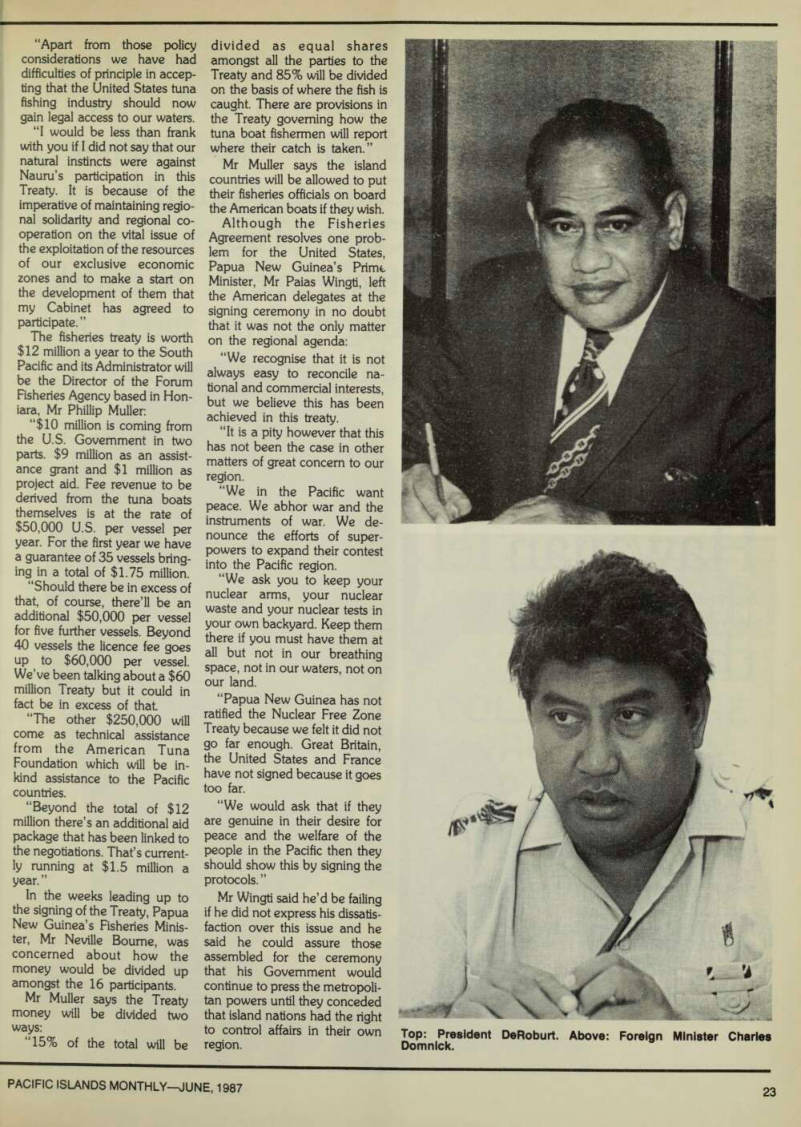
Top: President DeBoburt. Above: Foreign Minister Charles Domnick.