over Libya[?] Hayden says
pp. 16-18 · Read in the full issue
France to blame over Libya[?] Hayden says
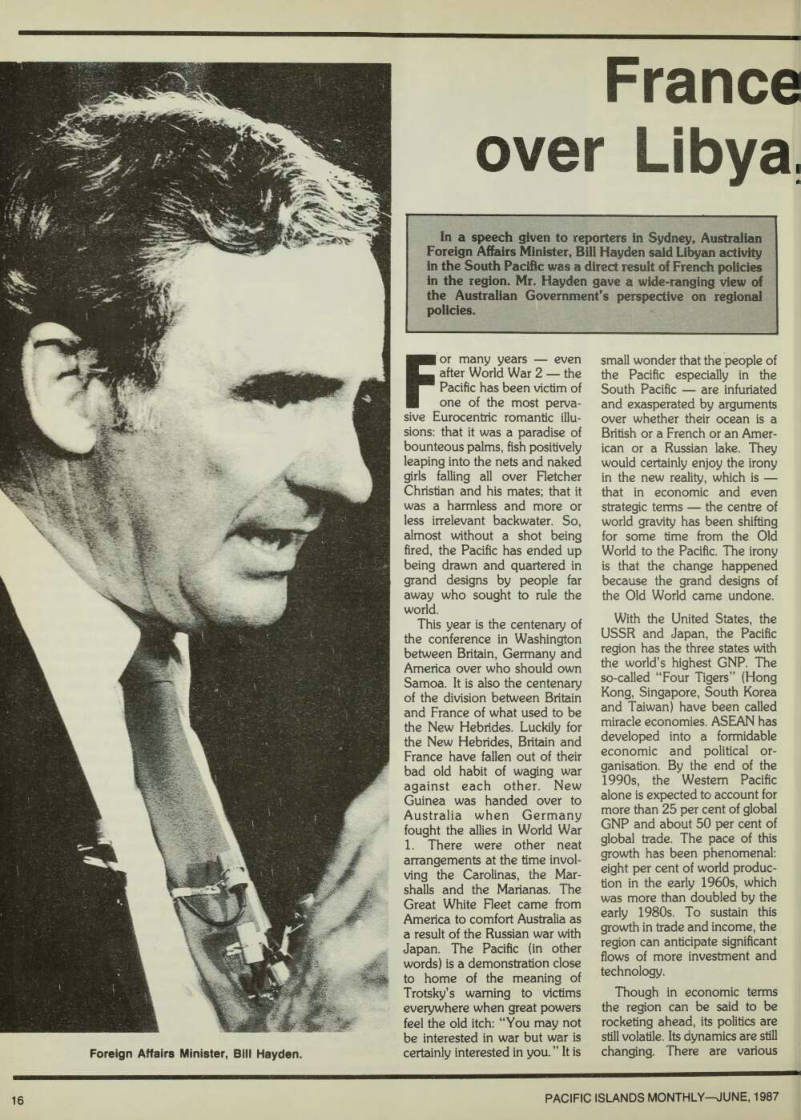
!n a speech given to reporters in Sydney, Australian Foreign Affairs Minister, Bill Hayden said Libyan activity in the South Pacific was a direct result of French policies in the region. Mr. Hayden gave a wide-ranging view of the Australian Government’s perspective on regional policies.
F or many years even after World War 2 the Pacific has been victim of one of the most perva sive Eurocentric romantic illu sions; that it was a paradise of bounteous palms, fish positively leaping into the nets and naked girls falling all over Fletcher Christian and his mates; that it was a harmless and more or less irrelevant backwater. So, almost without a shot being fired, the Pacific has ended up being drawn and quartered in grand designs by people far away who sought to rule the world.
This year is the centenary of the conference in Washington between Britain, Germany and America over who should own Samoa. It is also the centenary of the division between Britain and France of what used to be the New Hebrides. Luckily for the New Hebrides, Britain and France have fallen out of their bad old habit of waging war against each other. New Guinea was handed over to Australia when Germany fought the allies in World War 1. There were other neat arrangements at the time invol ving the Carolinas, the Mar shalls and the Marianas. The Great White Fleet came from America to comfort Australia as a result of the Russian war with Japan. The Pacific (in other words) is a demonstration close to home of the meaning of Trotsky’s warning to victims everywhere when great powers feel the old itch: “You may not be interested in war but war is certainly interested in you. ” It is
small wonder that the people of the Pacific especially in the South Pacific are infuriated and exasperated by arguments over whether their ocean is a British or a French or an Amer ican or a Russian lake. They would certainly enjoy the irony in the new reality, which is that in economic and even strategic terms the centre of world gravity has been shifting for some time from the Old World to the Pacific. The irony is that the change happened because the grand designs of the Old World came undone. , With the United States, the USSR and L Ja P an ' the p a c >ftc r p on has th ® *ree states with the world s highest CNR The f?- calle c d Four T, ers tU K ° n S- Singapore, South Korea and T a,wan > have “" ed "" ra f e economies. ASEAN has developed into a formidable economic and political or- San.sat.oa By the end of the I" 05 - the W«tem Pacific alone is expected to account for ?°, r ® ? p f “ n f 9 3 , a " d . abo 50 per ce , n , ° global trade_ The pace of this Srowth has been phenomenal: e.ghtpercent of world produc bon m the tl f arly . K wh £ h was more than doubled by the early 198 ° s . To . sustam * h ' S srowth in trade and income, the region can anhc.pate^gn.ficant ° f more lnvestment and technology.
Though in economic terms the region can be said to be rocketing ahead, its politics are still volatile. Its dynamics are still changing. There are various
Foreign Affairs Minister, Bill Hayden.
factors in this process of change: international trade poli cy, for instance; the pressure for increased military spending by Japan; the effect on the re lationship between China and the USSR of the tragic situation in Indo-China; the effect on the relationship between China and the US of the future of Taiwan; the whole symbiotic interaction among the US, the USSR, China and Japan; and (most significantly) the potential for either international co-opera tion or discord over the Pacific’s potentially enormous marine and seabed resources.
Any of these factors could take up a speech of its own and they are in the main deve lopments north of the Equator.
I want to dwell for a moment on the state of affairs that is crucial ly interesting to Pacific Ocean countries: the situation which will underlie much of what will take place at the meeting in a few weeks’ time of the South Pacific Forum. By this I mean the burgeoning rivalry in the region by its two greatest powers.
The USSR has made no secret of its enhanced interest in the region. We have noted the increased investment in studies of Pacific region affairs in Soviet academic, institutions. The USSR’s dealings with Kiribati and Vanuatu over fishing rights have created a great deal of interest and even some alarm around the region. The mani festation of the USSR’s interest in Pacific affairs which has stimulated the most con troversy, of course, is General Secretary Gorbachev’s Vladi vostok speech last July. There isn’t time today to analyse this speech in any detail. I mention it as an example of the fact that not only is the USSR an un doubted geographical entity in this region, it has also decided to raise the status of the region in policy priorities. In other
words, the USSR is more actively challenging American policies in the Pacific region and the situation of the region as a sphere of influence of the West ern community of nations.
Secretary of Defence Weinberger (in his report to the Congress for the 1986 financial year) made the explicit point that the US has vital security and economic interests in the Pacific. His point is being underlined right now in Prime Minister Nakasone’s discussions in Washington. The Pacific re gion provides at the same time America’s major market, its ma jor competition and its major economic problems. It is host to America’s enormous military assets: in the Philippines, Guam, Japan and the Mar shalls. Five of the 18 mutual security agreements which America has with other coun tries are in this region: with Japan, South Korea, the Philip pines, Thailand and Australia and (on paper at least) New Zealand.
There is not a lot of mileage in complaining about the USSR and the US being member countries of the region. It’s like the honky-tonk pianist next door: he may be driving you mad but he’s an unavoidable physical fact and, if we can’t move, we have to leam to live with him. We do have the right to be worried, though, if our neighbors want to fight in the street outside the front door.
And the Australian Govern ment does worry that the new, higher level of rivalry between our Superpower neighbors is happening in a very sensitive and vulnerable area; an area which, after Central Europe, is the most heavily armed in the world, yet which is the least protected by arms control arrangements. The Soviet Union has in the northern part of the Pacific one-third of its naval resources, one-third of its
ss2o IRBMs and nearly one third of its airforce, including both combat aircraft and long range bombers. The US has the long-range bombers of the Strategic Air Command and the combat planes of the Pacific Air Command. The Pacific Fleets of both superpowers are huge, though the US Pacific Fleet is considerably more powerful. In the past few years especially, both countries have been carrying out manoeuvres near and in some cases very near each other’s forces.
I describe these facts not to suggest that Armageddon is on the way for that would be silly and unwarranted but to demonstrate a point that is especially disturbing to the Aus tralian Government. The most immediate point of contact be tween the forces I have de scribed is a long way to our north and it has to be admitted that the southern part of the Pacific is a relatively low-threat area. But we are concerned that the deployment of forces in the north means in effect that a military structure is being set up which will be a severe and entrenched obstacle to the cause of arms control and dis armament in the vast Pacific region. This was why South Pacific countries awarded such urgency to the process which culminated in the South Pacific Nuclear Free Zone Treaty.
Many small countries in the Pacific particularly small is land countries lack the clout and muscle of their neighbors.
They have reason to be wary of some of the elements of change overtaking this region. After all, this is the change which is speeding up the pace at which once familiar and acceptable forces in the region are being reformed. It is hastening the process in which new centres of power are emerging and new opportunities being created for interests to collide. These coun
tries exist in paradoxical circumstances (and, in many cases, with colonial legacies) with which some of the shakers and movers in the new Pacific have shown little patience.
There are states in the Pacific with populations too small for self-supporting economic activ ity but growing too fast to benefit from any economic growth. Their land areas are tiny but their sea areas huge.
For many of them, their colo nial past has presented them with unhelpful consequences: living standards set by previous administrations which cannot be sustained; minimal experi ence of training and education for their people, over-large bureaucracies providing in appropriate services; having to make do with narrow resource bases; dependent on aid and migrant labor remittances in stead of production for their wealth. Their economic condi tions are too serious and press ing for them to be misused for cold war purposes. They under stand full well the burden im posed by yet another paradox: that at the same time they are too small and remote to be economically influential and so placed as to be strategically vital.
All this describes in fact the two main elements of the Aus tralian Government’s motives for its more active and more sympathetic policy towards our South Pacific neighbors. The evidence for this concern is in our aid figures. Australian aid to the South Pacific in 1986-87 was the only item in our aid program which was not subject to last year’s broad budget cuts.
We expect to allocate $B6 million this year: 10 years ago it was only $l3 million. The first element is the strong moral justification the Government sees in helping our neighbors out of their economic vulnerability to outside ex ploitation and interference. The other and I’m quite happy to be open about it is that this vulnerability is not in Australia’s own interests.
We are a nation dependent on trade. The share of regional nations in our exports has in creased in the past three de cades from about 14 per cent to about 55 per cent. The share of
imports into Australia from the region has grown from about 10 per cent to about 41 per cent. So far as the South Pacific is concerned, our exports to the region are valued at about $1 billion a year. Imports from the region are worth about $3OO million. The annual average growth figure over the past five years has remained steady at about nine per cent for exports and 13 per cent for imports.
Any destabilisation in the South Pacific is against our interests as a trading nation, whether it is caused by economic stagnation or by political action by others.
This is why the Australian Gov ernment is concerned at some of the policies brought into the South Pacific, which it consid ers are misperceived by their creators and ultimately unhelp ful to the interests of their targets.
I have already mentioned the head-butting which has been going on for the past five years between the Superpowers in the northern Pacific and our fears that it is triggering an arms race that will not easily be reversed. But we are also con cerned at what I might call the civilian version of the rivalry in the South Pacific.
There can be little doubt that the Soviet interest in doing fishing deals with South Pacific nations is connected to clumsy attempts by private American interests to exploit fishing areas and the subsequent protracted dealings between US officials and the South Pacific Forum Fisheries Agency. These deal ings led to a regional agreement on US access to fishing grounds. We were glad we were able to help bring about this development. We advised the US that, if the island states did not get a fair shake from the American fishing interests, they would look for a better deal elsewhere. Some of them did: with the USSR who, it has to be said, behaved more fairly than their capitalist competitors.
Australia has made no secret of its concern that the USSR was establishing its presence. We did so not because we have the right to lecture others on how they should conduct their busi-
ness. In any case, having our own commercial relationship with the USSR, we were hardly in a position to deny others the same right. But we are con cerned at this extension of superpower rivalry into a very vulnerable area. I found Mr Gromyko very much to the point in my dealings with him. I recommend to my South Paci fic friends his typically pungent advice when nominating Mr Gorbachev to the Politbureau: “Comrades, this man has a nice smile,” he said, “but he has Lions’ teeth.”
Another political action by others that we consider to be unhelpful to the South Pacific is the decision by the US and Britain not to sign the protocols to the Nuclear Free Zone Trea ty. Given that they are on the verge of one of the most heavily-armed regions in the world, South Pacific countries have the right to try to insulate themselves from the activities and mistakes of the nuclear powers. This is the Treaty’s motivation and the Australian Government supports it totally.
This is why we regret so much that neither the US nor Britain would sign the protocols. It was a mistake which I fear they will regret in their future dealings with South Pacific nations. I am concerned that the announce ment by both powers that they would in practice adhere to the Treaty will add to the injury.
South Pacific nations may well
therefore judge the decision to be unnecessarily scholastic and cynical.
There was, naturally, never any real expectation in the South Pacific that France would support the Treaty or in any way co-operate with its provi sions. France has always made it clear that its Manifest Destiny demanded the services of Mururoa, even though the atoll is said to have sunk 150 cen timetres because of the more than 100 tests conducted there.
Since France insists that its tests are safe and before Mururoa disappears altogether, Australia has invited it to transfer the tests from the South Pacific to the Central Massif in mainland France or Corsica, where the geological structure is suitable.
Our suggestion has been re jected and the tests continue.
The French must appreciate, however, that the fallout from each test will ultimately be quite destructive to their relationship with the region. It is odd be havior in a nation which has a Pacific history going back to the 17th Century. The Australian Government regrets it sincerely, for reasons to which I shall come in a moment French policies in this region and New Caledonia are seen as provocative. South Pacific na tions have been trying to press on France the necessity for regional stability of a solution to the New Caledonia problem in which differences can be re solved peacefully and construc tively and a truly multiracial society encouraged to develop.
We have argued that this is the only sensible and just option, that the alternative was the potent and poisonous mix of hubris, honor and investment that caused such trouble in Vanuatu. It is this concern, not any intention to persecute France, that led to the move for reinscription of the case of New Caledonia at the United Na tions. Indeed, in the view of the Australian Government, the de colonisation experiences of Vanuatu and New Caledonia are directly responsible for the Libyans arriving to stir the South Pacific pot. The Austra lian Government welcomes the
reports that France intends to increase its financial and other assistance to the South Pacific region. But it does seem a great contradiction to do this and at the same time help create the circumstances in which Libya’s agents will prosper. We support the continued presence of France as an influential factor in maintaining the region as part of the Western community. But we maintain that it should be the kind of presence that the people of the region consider acceptable and constructive.
My abiding concern and I don’t say this lightly is that a major factor in the force for unification in the region will be opposition to France brought on by its policies on nuclear testing and New Caledonia.
This would be inimical to Aus tralian and Western interests. It would certainly be a source of great regret to the Australian Government because, apart from the three issues of nuclear testing, the Nuclear Free Zone Treaty and New Caledonia, the relationship between Australia is good and healthy.
These matters will be part of, or will underlie, the discussions at the South Pacific Forum next month. The Australian Govern ment has found its experience of the Forum instructive and valuable. We have gained a much greater awareness of the issues that concern our neigh bors and a much better-in formed sensitivity about how we can be good neighbors. In fact, in our time in office, the Prime Minister has made the Forum his personal field of interest. I have been to eight of the nine independent nations of the region, the most extensive visits by any Foreign Minister of Australia or indeed any other country. I hope I can repeat at least some of these visits later on in the year. In my depart ment, the South Pacific now generates the heaviest work load of any geographical re gion. I mention these points to demonstrate the Australian Government’s commitment to assist our neighbors in the re gion and its strong sense of friendship and community with them.
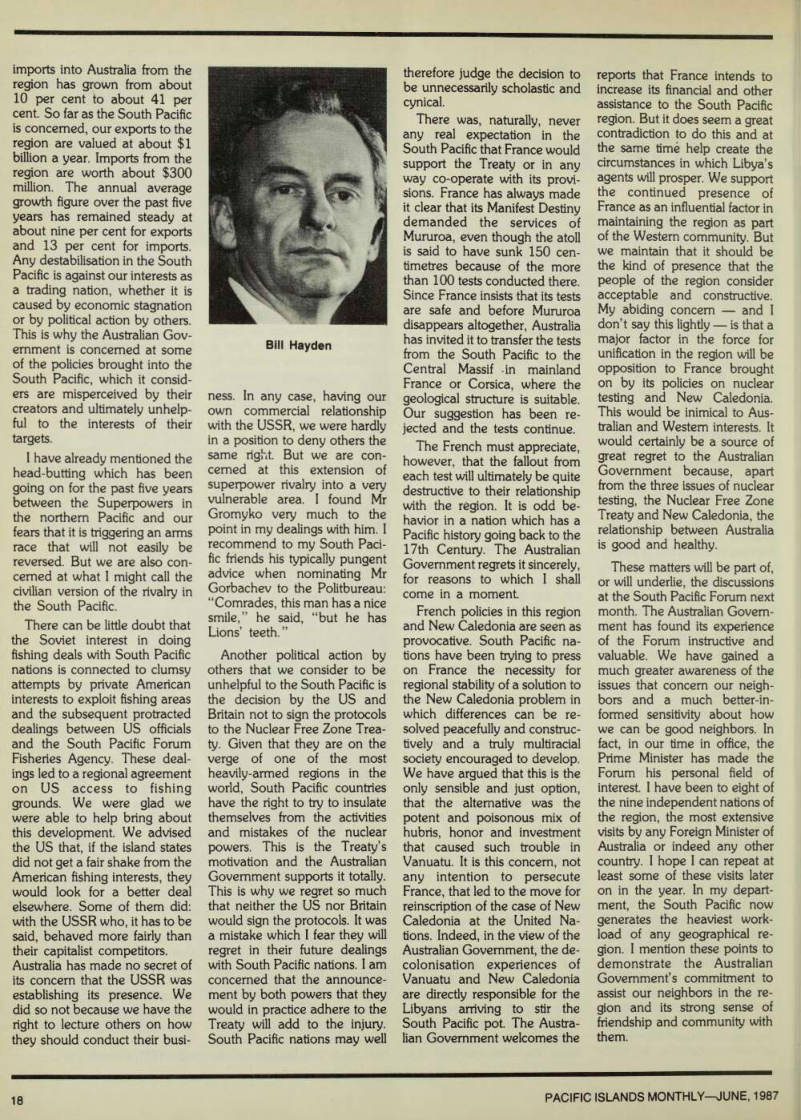
Bill Hayden