Celebrating what?
pp. 14-15 · Read in the full issue
W. Samoa 25 years after: Celebrating what?
As Western Samoa celebrates its 25th anniversary of independence, prominent Samoan novelist and academic. Prof. Albert Wendt gives a personal view of the quarter century.
After 25 years of so called Independence, what are we again celebrating so lavishly?
For me, a pessimist by in clination, the 25 years has been a drift into middle-aged defeat ism held together precariously by a glib cynicism.
At the beginning, it wasn’t like that I remember vividly our First Independence Celebrations in 1962. I was in Samoa, at Mulinuu, with Maurice Shad bolt, the New Zealand novelist, who was writing the story for National Geographic Magazine. (I was on vacation from Victoria University where, among other things, I was studying the his tory of independence move ments and revolutions. Nkru mah, Mao, Ho Chi Minh, Sukarno, Jomo Kenyatta, Cas tro and Che, were special heroes.) Maurice and I were only a few yards away from Tupua Tamasese and Malietoa Tanu mafili II as they raised the Independence Flag. I’ve never forgotten that. Young and full of the beans of idealism, I believed our lives and country were to be transformed: We were “free” to determine what and who we wanted to be. (Free to commit our own mis takes, Maurice reminded me.) After all, we’d spent since the Mau of Pule in 1909 fighting for our independence. And now we had it! The Flag at the masthead, the parades, bands, fautasi races, crowds and crowds, the foreign dignitaries, the mass choirs and dance teams said so. I was determined to return, after university, and help in the transformation, in the fulfilment of our Independ ence ideals.
Jenny, my wife, and I re turned at the end of 1964; and for a few years, while I taught at Samoa College, raised a family and participated in the often
hectic and demanding affairs of my Aiga and community, tried to write, and relearn my way back into the roots of our way of life, I thought we could do it.
Some of my friends, who were politicians, reinforced that be lief. But I should’ve remem bered the one important lesson from my history classes: Power corrupts, absolute power cor rupts absolutely, irrespective of race, color, or ideology.
For a while Mataafa Mulinuu
11, our first Prime Minister, held to the ideals and traditions, for our politicians hadn’t yet ac quired the habit of living beyond our country’s means, modesty, and integrity. Elec tions were orderly, not-too competitive; there was still re spect for rank and convention.
But as younger, more wester nised politicians emerged, as power, privilege and “comfort” began to be taken for granted as a right by our politicians and
their families and coteries, “things began to fall apart”
On our 10th Anniversary of Independence, I wrote a poem for my son. In it I said: Our nation's dreams drown in The insatiable cocktail glass . . . lean politicians Whispering in the market await
Freedom’s fat limousine. . .
But I still helped my politician friends, believing I wouldn’t be harmed by the self-destructive game of compromising that politics is. I still believed I could influence our development, and found myself justifying my friends’ actions and policies. I was flattered to be consulted, and for a while, I didn’t notice I was trapped in the heady whirl of the political cocktail circuit and the establishment elite: Things which I’d always spumed.
In 1974 we left for Fiji and a job at the University of the South Pacific. We intended to stay for a year, we stayed for three, and in that time I was fairly free of Samoa’s politics. (University politics though were, at times, just as vicious and destructive!) At the end of 1976, we returned home to set up the USP Centre there. And again I was in the complex tangle of politics which Tupuola Efi has, in one way, described accurate ly, as “the politics of envy. ” As in other developing countries, politics had become our opiate, the high that distracts us from the failures of development and our unrealised independence ideals. In the intense, passion ate game of political campaigns, there is always the promise, the illusion, of victory, of better things to come.
General elections were now
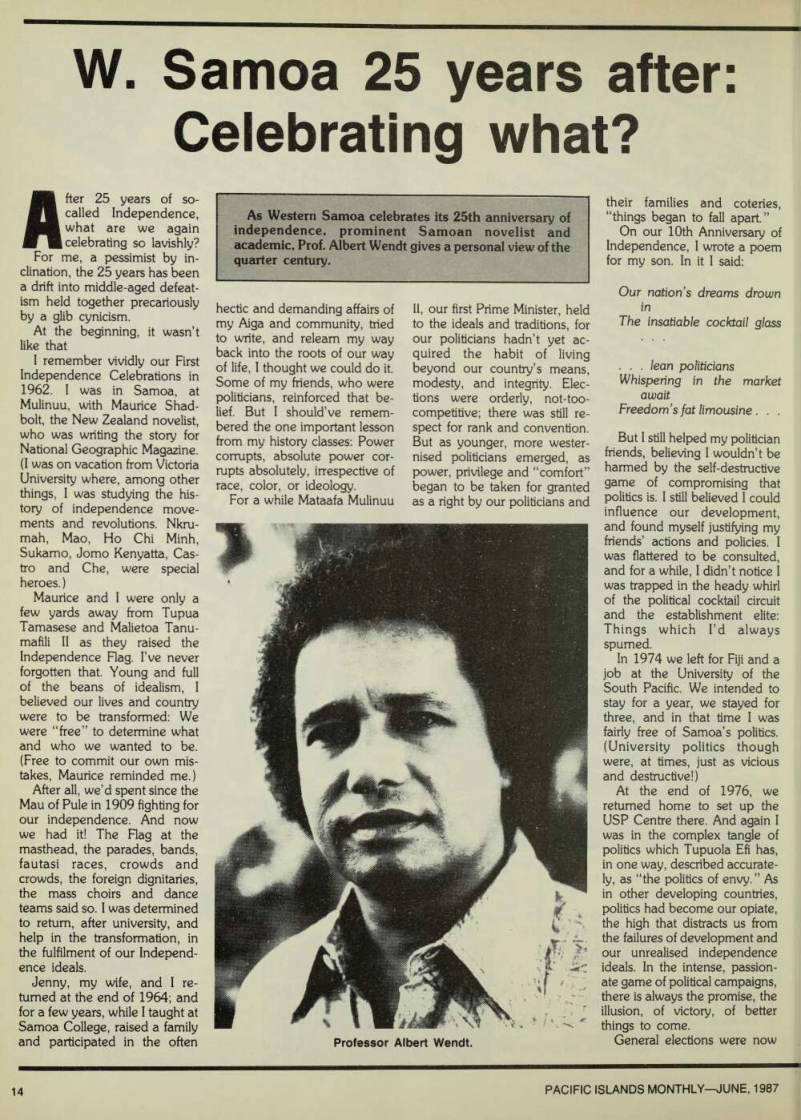
Professor Albert Wendt.
elaborate, wasteful, intensely fought epics that involved even our children. Epics fought be tween “gangs” that changed composition according to who ever offered the highest price.
Thousands of campaign dollars were raised locally, and thousands more slipped in from abroad and used to buy the votes. Cynicism invaded every pore of the electorate, even blood relatives expected to be bought. Candidates who didn’t spread money and patronage didn’t have a hope of getting into Parliament. You also had to use those to hold your “gang” together and buy the “floating” MPs to win the Prime Ministership and become the government.
That is how it has remained, and it is worsening. Even when the corruption of politicians, business people, civil servants, community leaders is exposed, little is done to punish them.
The circle of corruption and cynicism has become a con spiracy of silence: If you tell on me, I’ll tell on you! For instance, our main post office burnt down “mysteriously” just as the inquiry into its affairs got under way. Hundreds of thousands of dollars were unaccounted for.
No one has been arrested for the fire. It isn’t clear whether investigations are still proceed ing. In a more Gilbert-and- Sullivan vein, one of our former Prime Ministers was accused in Parliament by the Finance Minister, who’d once been in his “gang,” of spending $BOOO of government money to clothe himself (for his expensive over seas trips). Nothing was done to the former Prime Minister.
Many of our MPs and civil servants travel abroad often because they make more money in per diems and allow ances (and can feast on more expensive food, wine) than staying home.
Investors, foreign companies, and confidence men buy into our elections to win business concessions, tax free incentives, and contracts. Our native for ests have become payments for campaign contributions. Re cently, some Members of Parliament lobbied to allow an American company to establish
a toxic waste disposal plant in Samoa; we were to become a dump for dangerous wastes the Americans wouldn’t have at home. (Rumor has it that a lot of money changed hands.) Parliament almost agreed to the deal. Fortunately, someone checked up on the American promoters of the deal and discovered they had gangster connections, and the project was dropped.
As this corruption has spread and deepened, our national development has stalled. Our exports continue to fall. Our most lucrative export are our people who emigrate. Last year they remitted far more than we earned from anything else. If New Zealand, Australia and
America opened their doors more, most of our able and adventurous people will emi grate there. Many of my former students have emigrated, many want to. In 1982, disillusioned, we also returned to Fiji.
Poverty is increasing rapidly.
Many of our leaders don’t want to see it we won’t admit to being poor.
Over half our annual budget is from foreign aid (direct and indirect). Like most other Paci fic countries, we’ve become a permanent welfare case. I can’t see us ever getting out of that hole. Many of our leaders don’t want to: Foreign aid is now built into their view of development, into their way of life. It is also in the interests of foreign powers
(our supposed benefactors) to keep us hooked on their aid.
As we plunge deeper into corruption, more frightening illnesses are erupting. For ex ample, our police are becoming more brutal and open about their brutality. In one recent case, they beat up two men one of them died.
So as our Government stages another lavish Independence Celebrations, I recall lines from Ruperake Petaia’s poem, “Freedom Day”: “This day I will hear once more Solemn promises Re-assurances Of Freedom and Unity Of Prosperity and Satisfac tion Of Toleration and Peace I see On the Malae A people misled . . .
And Freedom flies on Way up on a pole Unreachable. ”
But Samoa is still at my centre. She is a love I can’t rid myself of. She is my childhood and my grandmother Mele, and Luisa, my mother, who died when I was 14, my sisters and brothers and Aiga and a father who is nearly 80 and the most enduring plumber (once a great musician) in the world. She is the Vaipe, tha fertile dead water stream in the neighbor hood of my growing up. She is where Jenny and our children and I grew into a family. She is my friends, my former students, fellow poets and writers and artists and Sano Malifa, who are trying to keep the truth alive.
She is the scrumptious smell of hot palusami and taro on Sun day morning, the blue still mountains of the Atuolo, the brooding lava fields of Salafai, the long silent eyes of the tropical rainforest, the wisdom of the sea, and the patient atua who have always lived in the heart of the land. She is the generosity, kindness, alofa and fa’aaloalo which our way of life demands of us.
Samoa is all that and more.
This Independence, if I cele brate anything, I celebrate that, and hope for it to endure.
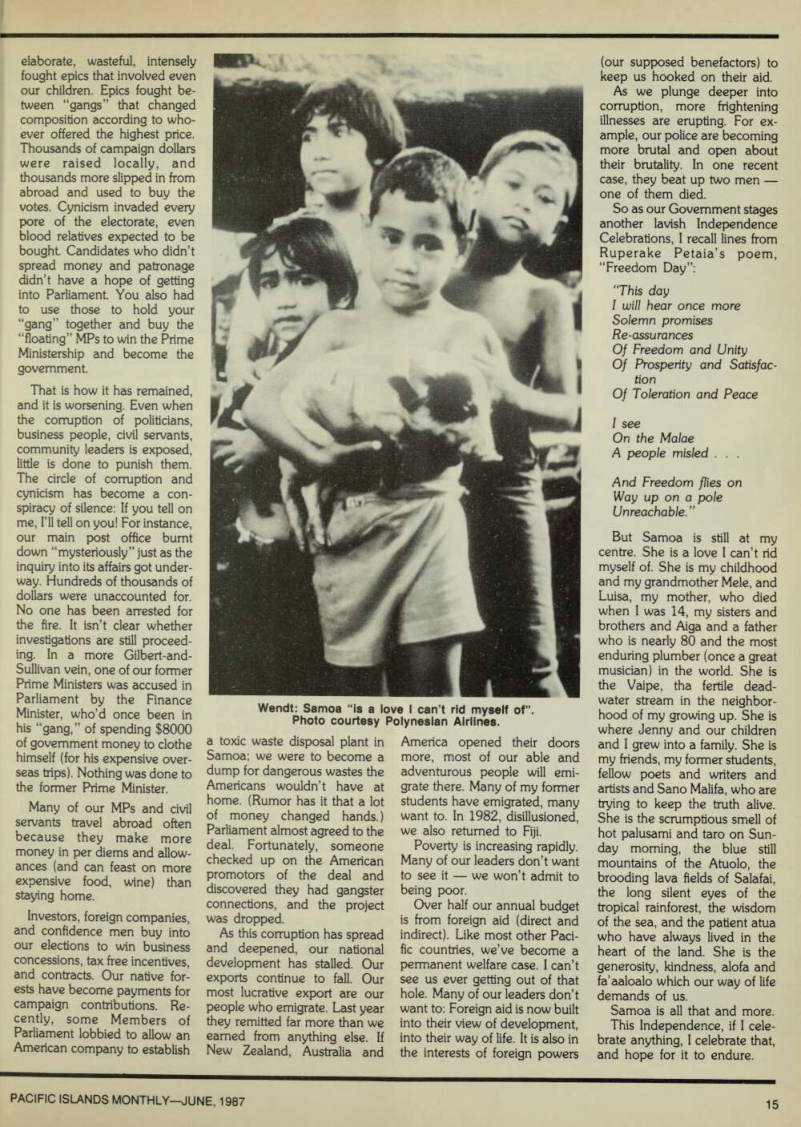
Wendt: Samoa “is a love I can’t rid myself of”.
Photo courtesy Polynesian Airlines.