Marshalls readies
p. 45 · Read in the full issue
for Forum entry
During eight years of self government while still under the United States - administered Trust Territory, the Marshall Islands has moved aggressively to establish its identity interna tionally, while using trade rela tions as a means of diplomatic recognition.
Late last year, the US de clared the Trusteeship ended as it implemented the Compact of Free Association with the Mar shalls and the Federated States of Micronesia. The problem remains that the UN has never been formally advised by the US of the termination, nor has the Security Council - which is mandated to approve any changes in the “strategic” trust agreement with Micronesia dealt with the matter. Although Pacific nations at the UN have lent their backing to the Mar shalls’ Compact, the Soviet Un ion voted against termination of the Trusteeship at last year’s Trusteeship Council meeting, foreshadowing a possible veto in the Security Council if and when the matter comes up.
The lack of UN recognition for the Marshalls’ new status, and the Marshalls’ quasi-inde pendent status under the Com pact (the US controls defence and had a veto over foreign affairs in cases of conflict), are opening some pitfalls for the newly emerging nation.
As the Marshalls prepares to seek full membership in the South Pacific Forum at its meet ing this month in Apia, it finds itself in a delicate position on at least one key regional issue.
The Marshalls was caught off guard by the US rejection of the Nuclear Free Zone Treaty.
According to the Compact, the US and the Marshalls are obli gated to consult on matters affecting defence and foreign policy of the two nations. But, said Marshalls Foriegn Minister
Charles Domnick, “in this case the US did not consult with us.
“On our part when we heard the announcement, we were not very pleased. We sent an urgent telex to Secretary of State George Shultz asking for a consultation.”
In early March, State Depart ment official James Berg visited Majuro and outlined the US position to Marshalls officials.
The Marshalls has yet to take a position on the document which China and the Soviet Union have already endorsed.
“We’re still studying it, “said the Foreign Minister. “We don’t want to jeopardise our position with the US regarding defence issues. On the other hand, we’re independent and sovereign. If it’s good for the region then we want to be part of it.”
The NFZ treaty boundaries do not extend to the islands north of the equator. Neverthe less, the Marshalls is confronted with a decision which will either demonstrate its independence from American foreign policy or oppose the anti-nuclear senti ments of its neighbours in the Pacific - at a time when it is asking the Forum for approval of its membership.
The Marshalls has been most aggressive in developing eco nomic ties with Asian nations.
Aid and trade from Japan and Taiwan account for a small but growing portion of its annual budget. And the islands are courting the People’s Republic of China and South Korea, and eyeing membership in the Asian Development Bank and
Escap.
President Amata Kabua re turned from his first visit to China last November en thusiastic about trade possibili ties for the Marshalls. His visit prompted return visits to Ma juro by a large contingent of Chinese trade officials in Febru-
ary and April. They are considering establishing a bank and selling fuel to the Marshalls.
The President, who is a strong proponent of private sector investment, is arranging a Marshallese trade visit to China la rl th £ ye u r „ • ■ J The Marshalls is interested in diplomatic ties with China and other nations, but its friendly relations with Taiwan would appear to preclude formal relatens with China. The Taiwan government has operated an agriculture station on Majuro for nearly a decade, and there are many joint ventures with Taiwanese businessmen.
Domnick noted that to date all government contact with China has been through trade representatives. He is hoping to arrange talks with Chinese government leaders during the Marshallese trade mission later this year. Federated States of Mcronesia President Tosiwo Nakayama also visited China eadier in the year.
For several years the Marshalls has been an observer at Environmental and Social Council for Asia and the Pacific (ESCAP) meetings and is now seeking full membership with it and the ADB. ESCAP has
helped the Marshalls through encouragement of UN agency aid to the Marshalls. The latter is eager also to tie into the Bank’s low interest, long term loan schemes for development projects.
But there’s a hold up. The ADB has said it must have an official communication from the UN thst the Marshalls’ status as a trust territory has changed before it can accept the Mar shalls as a full member of the organisation.
The Marshalls will likely be present at the May UN Trustee ship Council meeting to address this and other issues, says Dom nick. In addition, he said, “we are looking to the United States to help us.”
“Now that we’ve become a member of the world commun ity, we want the benefits”, said the Foreign Minister.
For the meantime , however, the degree to which the Mar shalls can gain some of the benefits may be determined by its willingness to depart from US foreign policy and its ability to settle the uncertain circumst ances surrounding termination of its trusteeship status. From Giff Johnson, Majuro.
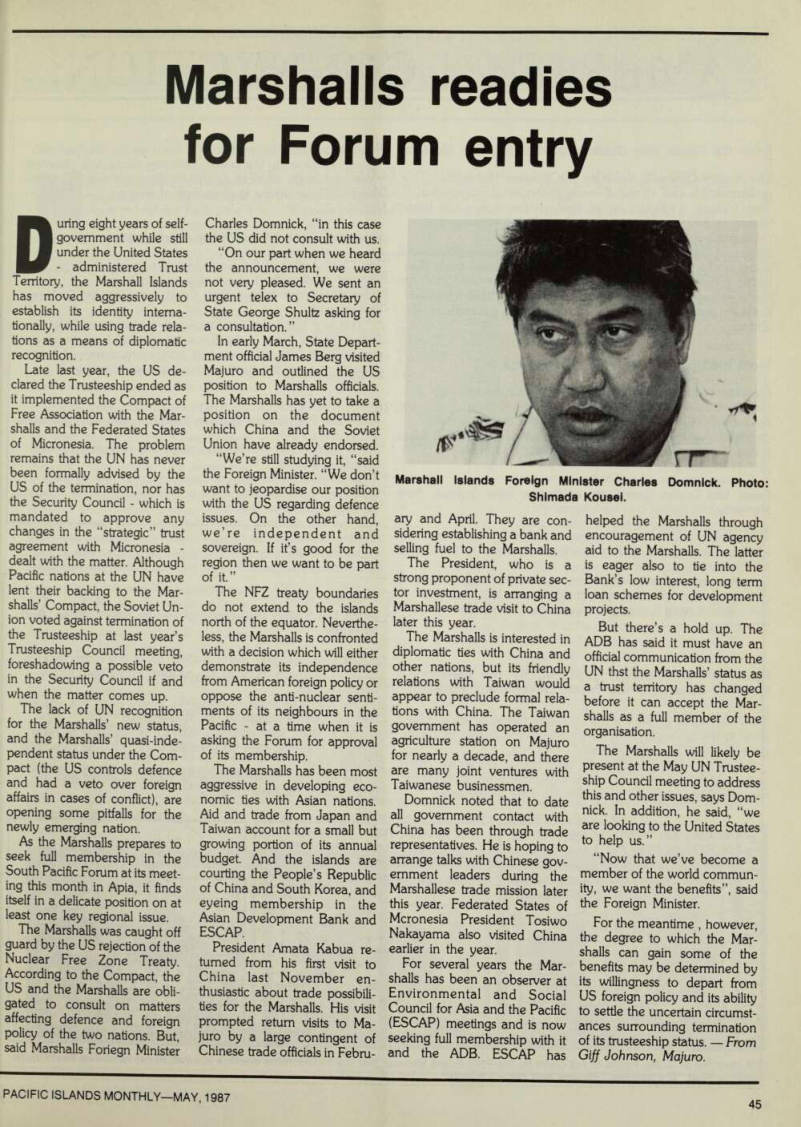
Marshall Islands Foreign Minister Charles Domnick. Photo: Shimada Kousei.