Dramatic shift in Pacific disease patterns
pp. 42-43 · Read in the full issue
Pacific disease patterns
Changes in diet and lifes tyle are leading to an upsurge in the South Pacific of chronic de generative diseases, such as diabetes, heart disease and can cers, normally associated with affluent, industrialised coun tries.
According to a recent review of the current state of health in five Pacific Island nations Fiji, Solomon Islands, Tonga, Vanuatu and Western Samoa the dramatic shift in disease patterns coincides with the adoption of Westernised life styles.
The review entitled, “Health and Nutrition Problems and Policy Issues in the Pacific” by Ms Abby Bloom of the Univer sity of Sydney’s School of Public Health and Tropical Medicine, notes that prevalence rates of diabetes in the Pacific Islands are now among the highest in the world, although as recently as 15 years ago the disease did not constitute a significant problem in the region.
Research indicates a ten-fold increase in diabetes among urban Fijians in a ten-year period between the late 1960 s and late ’7os, while diabetes and cardiovascular disease combined now account for one-third of all deaths in Fiji.
Diabetes also occurs two to six times more frequently among urbanised Polynesians and Melanesians in Fiji and Western Samoa compared with traditio nal rural populations.
Although data on the inci dence of cancer in the South Pacific is sparse, says Ms Bloom, it appears that rates are lowest in “less developed”
Pacific Island countries and highest among more “deve loped” islands. Cancer is the
second leading cause of death in Tonga, accounting for 16 to 18 per cent of all deaths, the third cause among Melanesian Fijians, and the forth among Western Samoans.
Cardiovascular diseases, the most important being coronary heart disease and hypertension, are the leading reported causes of death in three of the five nations reviewed Fiji, Tonga and Western Samoa.
The rates of these diseases and associated major risk fac tors such as lack of physical exercise, smoking, and stress, while varying among nations are rising throughout the region.
Increasingly, the South Paci fic is also falling victim to those other ills of modem society alcoholism, domestic violence, accidents, and suicide. Accor ding to the report, recent evi dence points to a startling in crease in the rate of accidental and intentional death due to drinking paraquat, a commonly available and especially toxic herbicide. The trend is most common among 15 to 25-year old males in Western Samoa and Fiji, although there is a high rate of suicide among young Indian females with the chemical.
Complex social and econo mic factors such as frustration over limited employment opportunities, friction between parents and children, and the “intolerable treatment” of young Indian brides by their in-laws are believed to be the major causes.
A move away from traditio nal food habits particularly in urban areas to a diet heavily reliant on imported and proces sed foods underlies the region’s principal health prob lems, says the report. While
these foods have the advantage of often being more accessible, more convenient to prepare and eat, and cheaper, they have contributed to a serious decline in nutritional standards.
The paper notes that the contemporary diet contains ex cessive animal fat, salt, and calories and that traditional high fibre root vegetables such as taro, sweet potatoes and yams, are being replaced with less beneficial bread, rice, tinned meats and fish.
A 1980 survey in Fiji re vealed that 7.9 per cent of Fijian children and 24 per cent of Indian children under the age of five years suffered protein malnutrition. But among the adult population of Fiji, 40 per cent of males, 20 per cent of Indians of both sexes, and 80 per cent of Melanesian women in Suva were obese. A similar survey in Vanuatu in 1982, showed that 23 per cent of under-fives had protein dificien cies.
A decline in the length of time babies are breastfed and bottlefeeding have contributed to malnourishment of young children. Studies show a correlation between early weaning and malnourishment among children in Western Samoa and the Solomon Is lands, while malnutrition occurs more frequently among bot tlefed Fijian children. Bottlefed children are also more likely to succumb to gastroenteritis.
Among the crucial factors believed to contribute to the deterioration of health are: • A more sedentary life style. • Inadequate housing. • Poor employment oppor tunities. • Expenditure of low in
comes on goods and services other than food. • Emulation of elite cosmo politan lifestyles.
While life expectancy at birth is generally better than the global average and appreciably better than other developing regions, the paper says the five island countries experience poorer health overall than other South Pacific nations. Life ex pectancy ranges from 54 and 56 years among men and women in Vanuatu to 60 and 66.2 in Fiji, compared with an average combined life ex pectancy of 74 throughout the region.
Until 1950 s infectious dis eases, such as measles and influenza, and other diseases associated with inadequate water supplies and unhygienic waste disposal, were the lead ing causes of illness and prema ture death. But the shift since World War 2 from rural, struc tured, homogenous, village based economies to more fluid, heterogeneous cash-based eco nomies has coincided with the emergence of non-communic able degenerative diseases. The paper argues that by the mid 1980s, virtually all island coun tries had been affected by this “evolution” and there is now a perceptible gradient among them from those characterised more by infectious diseases Vanuatu and the Solomon Is lands to those in which non-communicable diseases dominate Fiji, Western Samoa, and Tonga.
According to the review, most of the island nations allo cate between 11 per cent (Vanuatu and Tonga) and 15 per cent (Western Samoa) of government expenditures to health or between $2O and $BO per capita. While this appears
generous relative to other less developed countries, there has been a “distinct urban bias” in the provision of health facilities and personnel. In many cases, the health sector is under funded and there is little money for expansion and innovation or for increased attention to rural health needs, it says.
The paper also points to the scarcity of trained people at all levels of the health systems of the five countries, including “acute shortages” of doctors. In the Solomon Islands the ratio of people per doctor is 6500, Vanuatu 4300, and in Fiji 2200.
Maldistribution of human re sources compounds the prob lem. Of the 31 doctors in Vanuatu, 24 are located in urban centres, while in Tonga 71 per cent of all GPs are employed in a single hospital.
It is critical of the lack of objective, population-based measures of the effectiveness of existing health services which it says are “sorely lacking”. In formation on non-health sector resources which impinge on health was even more limited.
In recommends that at a minimum each nation under takes the analysis required to specify: • Health sector policies re flecting national development priorities. • Actual versus planned public sector health funding levels. • Epidemiological profiles on a regional or district basis • Quantified health objec tives. • Inventories of facilities, personnel and material identify ing deficiencies and future re quirements. • Revised health sector policies and priorities and pro jected foreign aid requirements.
Ms Bloom said one of the most persistent themes to emerge from the review was the need to plan carefully for the use of extremely limited human and financial resources in the health sector.
The confounding trends of population growth and urban concentration, shifting disease patterns and growing depend ence on external influences
made imperative choices among competing objectives and efficient use of domestic and external financing.
“Health investments in the region can be justified on humanitarian and human capi tal grounds, and should accommodate the peculiar balance between diseases of underdevelopment and diseas ses of ‘Westernisation’ found in each island group,” she said.
“But major investments in health and health-related mea sures should be prefaced by a thorough analysis in each set ting of the managerial, admin istrative, and financial founda tions of the health system.”
Dr Richard Taylor, an epidemiologist with the South Pacific Commission, said he
believed there would be prog ressive urbanisation throughout the South Pacific and countries would move through the spec trum of diseases. While readjustment was often painful, he said conditions were not as bad in the Pacific as those in Britain and France during rapid urbanisation last century.
The health status of Pacific countries could be taken as an indicator of its “development”, he said. Papua New Guinea, the Solomon Islands, Vanuatu, and Kiribati were characterised by infectious diseases and nutritional problems and the life expectancy was between 50 and 60. At the other end of the spectrum were American Samoa, Guam, and the Cook Islands with a predominant pat
tern of degenerative diseases, and in the middle Fiji, Western Samoa, and Tonga with a com bination of both.
He considered the undersup ply of trained health workers in rural areas could be overcome by training more Pacific Island doctors and nurses at the Fiji and Papua New Guinea Schools of Medicine, as well as extension of village health worker systems.
While the commission was conducting nutrition education programs, there were a lot of economic and marketing prob lems for governments to over come in order to bring locally produced foods from outlying islands to urban centres more cheaply than imported foods.
Liz Glasgow
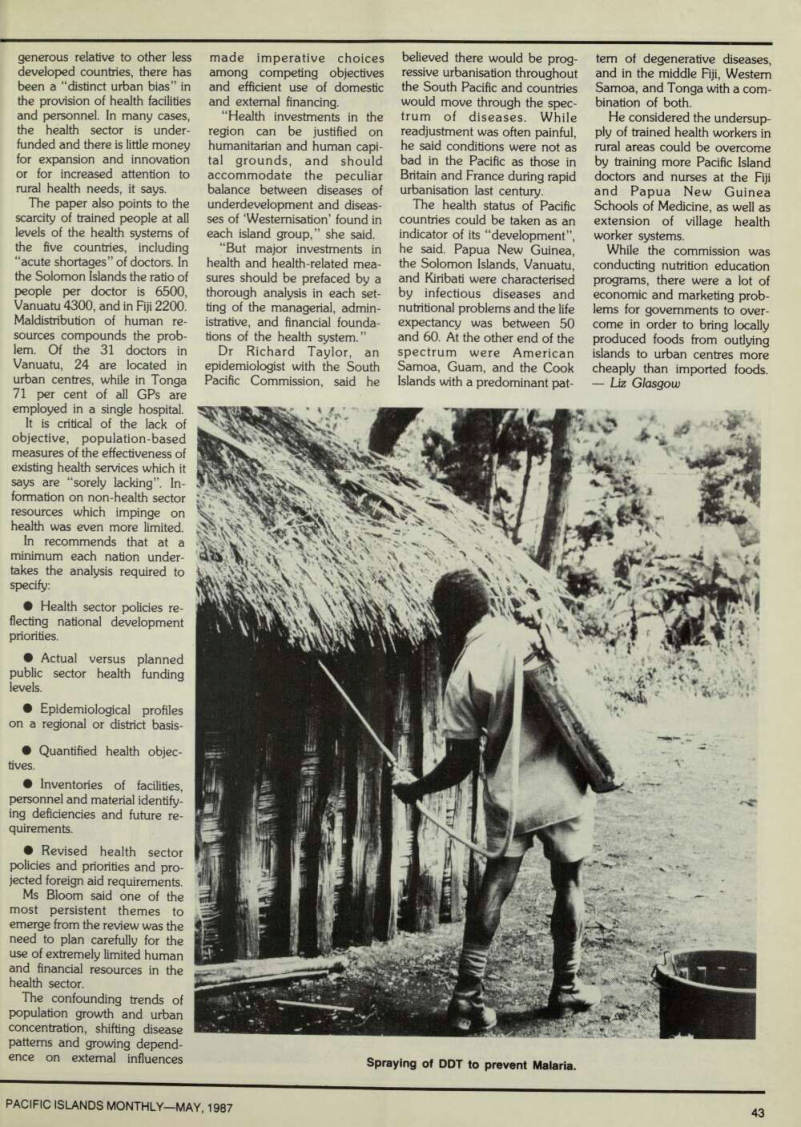
Spraying of DDT to prevent Malaria.