diplomacy
pp. 19-21 · Read in the full issue
New confidence in PNG diplomacy
Papua New Guinea appears to have found a new confidence in its dealings with the world.
One of the areas where the Wingti Government can claim success is on the diplomatic front. In March, Papua New Guinea’s Foreign Minister, Mr Ted Diro, visited both Indone sia and Australia. In Jakarta he exchanged ratification docu ments with Indonesia’s Foreign Minister, Doctor Mochtar, bringing into force an historic Treaty of Mutual Respect, Friendship and Cooperation under which Indonesia pledges never to use force against PNG and to respect its territorial integrity.
In Canberra Mr Diro and Australia’s Foreign Minister, Mr Hayden, agreed on the broad draft of a Statement of Prin ciples to govern the Australia/ PNG relationship. PNG set Canberra on its ear last Decem ber when it dismissed aid talks and said the relationship needed to be put on a more formal basis because Australia’s word could hardly be trusted following cutbacks in Australian aid made not only without consultation but also in breach of the five year aid agreement signed with much pomp by Mr Bob Hawke at PNG’s 10th birthday celebrations in 1985.
The proposals by PNG were for a Joint Statement of Principles Governing the Relationship and an Integrated Development Package that would tie down in writing a whole range of matters including a defence pact.
On Mr Diro’s return to Port Moresby he spoke about the Australian reaction, about Mr Hawke’s Libyan fears, New Caledonia, the New Indonesian relationship and comments on the question of PNG’s member ship of AZEAN at the coming AZEAN Foreign Minister’s Meeting.
Is Papua New Guinea se rious about becoming a mem ber of ASEAN?
As you know PNG wanted to be a signatory to the Treaty of Amity and Cooperation well before my time as Foreign Minister. That request is still being considered by the ASEAN Council. So we have made our interest known to ASEAN countries that we would like to accede to that Treaty, but it is up to the ASEAN Council to either accept or reject. Now whether as a result of that PNG chooses to become a full member of ASEAN is another matter com pletely.
What are the advantages of full membership? 1 think the main advantage is to try and stabilise the situation in the region. As you know Indonesia and Malaysia had problems before. And amongst the other ASEAN countries there were problems. But since the formation of ASEAN as a political entity, countries in the region have come to solve their problems and establish a much better understanding. One can see that there have been tangi ble benefits accruing from ASEAN membership. These benefits could equally flow onto PNG if PNG was to decide to join. But I want to make it quite clear I have not committed PNG to joining ASEAN. The situation is that our request to accede to the Treaty of Amity and Cooperation is being consi dered and that request was put by my predecessor, Mr Legu Vagi.
Would you like to see PNG become a member?
I don’t discuss personal things. I discuss what the posi tion of Cabinet is and 1 wouldn’t want my personal views to influence the outcome of what PNG’s eventual decision may be.
Is PNG drifting away from the South Pacific Forum?
Papua New Guinea’s posi tion is unique. We have one leg in asia. We share a common border with the largest ASEAN country, Indonesia. The other leg, of course, is in the Pacific.
In the past we have identified more with the Pacific. It is now time that we must pursue a foreign policy which safeguards both the longterm and the midterm interests of PNG. You and I do not know what will eventuate in 50 or 100 years time. It is better that we safe guard the interests of our coun try in the longterm.
What economic benefits would flow to PNG from join ing ASEAN?
There is considerable trade within the ASEAN countries.
There are provisions as a mem ber to engage in technical cooperation and there are other benefits to be derived. But 1 emphasise once again that PNG has not committed itself at this point.
How close did you and Australia’s foreign Minister, Mr Hayden, get to agreeing on a draft statement of Prin ciples governing the Austra lia/PNG relationships?
I think that there is a general feeling amongst Australian Ministers that the relationship ought to be a bit more formal ised. As a result of this visit I think the Australian Govern ment will consider the matter at Cabinet level to get Cabinet’s endorsement of the proposal that PNG put up. That is, that there be a joint declaration of Principles to guide the relation ship between PNG and Aus tralia.
What about the Integrated Package?
The Integrated Package appears to pose some problems
on the Australian side. It is a new concept. It’s an innovation.
It is not the practice of the Australian Public Service to try to put all the agreement with one country under one umbrel la. I think the Australians do need time to consider our in novative approach.
But you haven’t dropped the idea?
We have not dropped it at this stage. We have certain positions which we could take to accommodate the Australian viewpoints but at this stage we have not dropped it. We are persisting so that they see our line of argument.
How did your talks go with Mr Hawke?
Mr Hawke was more in terested in the bilateral and regional issues particularly New Caledonia. He was more in terested in regional security matters particularly the involve ment of the Libyans in the Pacific. I think this matter is of particular concern to the Aus tralian authorities and Mr Hawke raised it. Mr Hawke devoted a lot more time than was allowed for. As a result I almost missed my aeroplane but it was a very good discus sion.
I’m told you had ten mi nutes scheduled and it turned into 50?
That’s roughly correct It was very, very fruitful and very worthwhile.
What particular concerns did he raise about the Li byans?
It’s not only Mr Hawke. I think it is a concern throughout The Pacific that the presence of the Libyans in Vanuatu could destabilise the region. Shortly we will be flying Air Niugini aircraft to Port Vila and it should be a concern for us. I think that if the Libyans are
going to be involved either directly or indirectly in the New Caledonia issue then it could affect the stability of the region to a large extent.
Have you raised this issue directly with Father Lini?
The Forum meeting is sche duled for May 29th in Apia and I think that the concerns of the Forum member countries will be raised there. I will be briefing our Prime Minister fully on the sentiments expressed by both Mr hayden and Mr Hawke on the security situation here in the Pacific.
Does Papua New Guinea regard the Libyans as a secur ity risk?
If you go by the experience of what they have been up to in recent years then you must be concerned.
What exactly are you fear ing? Terrorism or what?
You name it.
If the Libyans become established in Vanuatu would you consider cancelling Air Niugini’s proposed services to Port Vila?
I think our relationship with Vanuatu is too deeply involved, far too complex, far too strong to be affected by Libyan in volvement.
It’s obviously bothering you!
It does bother me. But I get bothered with other things too but that doesn’t mean we break diplomatic relations. I don’t think we would stop the Air Niugini flights.
What about the Melanesian Spearhead Group and New Caledonia?
The problem of New Caledo nia is too big for the Spearhead Group alone to handle. Forum unity must be maintained over the New Caledonian issue be cause the Forum as a group, as a regional organisation, has a much greater impact. Whatever strategy you adopt to see the decolonisation process in New Caledonia, it must be done through the Forum. I believe it is essential that the Committee of 24, which is comprised of countries a long, long way from
the region be fully briefed. We have sent a representative to speak to the committee of 24 and support the forum repre sentatives there.
In Jakarta you exchanged ratification instruments bring ing the new PNG/lndonesia Treaty into effect. How did your talks there go?
There is an atmosphere of goodwill, an atmosphere of genuine friendship amongst the leaders of Indonesia. I think in the past we have tended to allow the border issues to dic tate the relationship between the two countries. The border is one issue, one aspect of our relationship. I think it is now time to look to Indonesia and try and encourage the growth of our relationship in different areas. For instance, technical assistance, cultural exchange, matters of trade particularly cross border trade. These are very, very important I think the treaty of Friendship, Coopera tion and Mutual Respect is a visible demonstration of the will and the desire of prominent Indonesian leaders to see genu ine cooperation between our two countries. We have to cultivate a desire to make this treaty work because PNG has now committed itself to being friends with Indonesia. We have each committed ourselves to respect each others integrity and sovereignty. I think that in the past there has been some damage done to our relations by the media presenting far too negative aspects of our relation ship. We have a free press in PNG, something we ought to be thankful for but there are positive sides too to our rela tions which must be reported.
An Irianese man, Mekky Salossa, is now subject to deportation. If court action prevents that deportation going through do you see a hiccup in the relationship with Indonesia?
I know the man you are referring to. I think he is a criminal. He has been to gaol in PNG. But I have just returned home and have yet to be briefed on the details so I’d rather wait ’till I’m fully in the picture.
Have you worked out any specifics of trade with In donesia?
The Treaty is a document which needs a lot of action on the part of individual depart
merits to translate it into more tangible avenues of coopera tion. For instance, in trade, Indonesia has a surplus of rice, Indonesia has an abundance of calico and fabrics that we would
import. Indonesia could supply some of the domestic goods in cross border trade, say between Jayapura and Vanimo. It will take time to translate the policy agreements into action. I hope that will not be too far away, The defence treaty that you want with Australia. Can you see that upsetting Indonesia?
I don t think so. We have a cordial and friendly relationship with Indonesia. I have just come back from Jakarta, from signing a friendship freaty It is a document that says PNG and Indonesia are now friends. We must stick up for one another in times of trouble. Talking in day-to-day language that is what the Treaty means. We have to understand each other, respect each others territory.
We have to consult one another on sensitive issues. That s what it means. Now, in trying to extract some form of defence arrangement with Australia, this is an expansion of what we tried to do in 1977 after Independence. Because our military doc-
trine, our military tactics, our strategy is based on Australian defence strategy and concepts, we have to try to maintain some compatibility. We have to main tain liaison and dialogue. That is one aspect of this defence arrangement that we are seek ing Australia. The other, of couree js tha , because there is so much Australian investment j n thi s country, in the event that Papua New Guinea be threatened by a country, I don’t have a country in mind what i am is that in the uniike ] y event that PNG is threatened by anybodyi it cou id be the RussianSi someo ne faroff like that In that event and the appears t 0 be or hap . to be a common threat p NG and Australia must coopera t e , That’s common sense isn - t it? So we want t 0 formalise that into a defence arrangemen t You don’t have Indonesia in mind as a threat?
You ask me if I have Indone sia in mind. The answer is No!
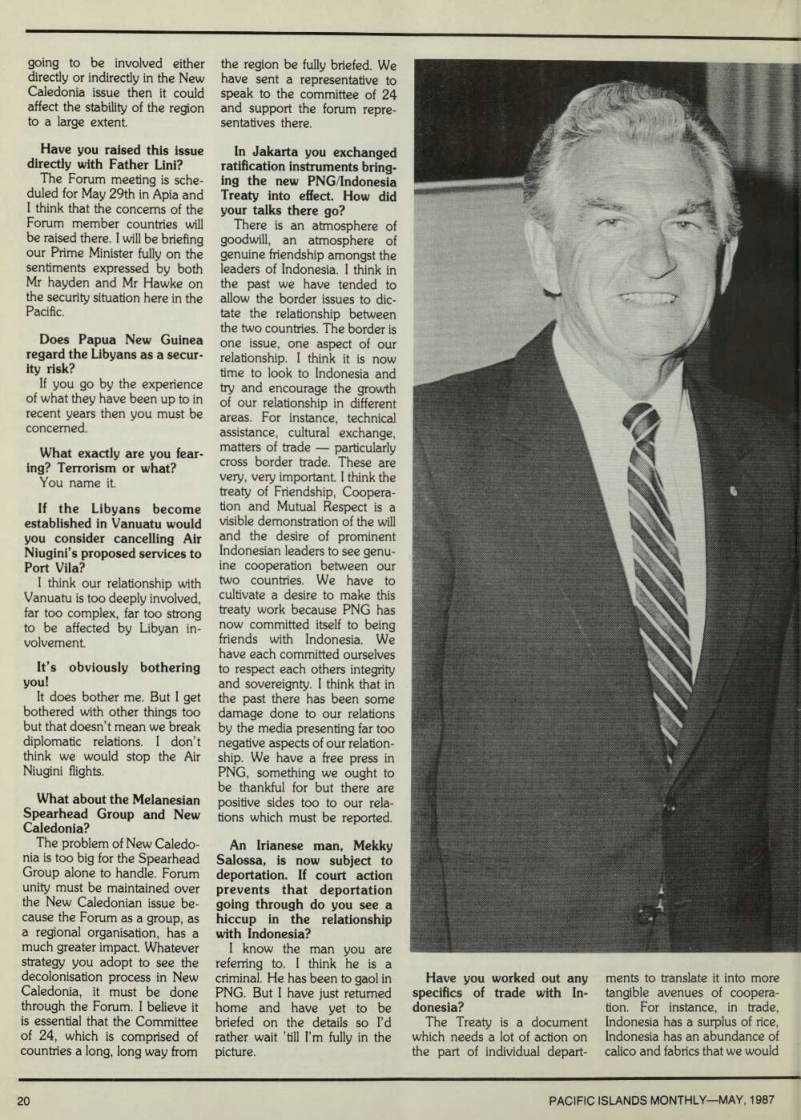
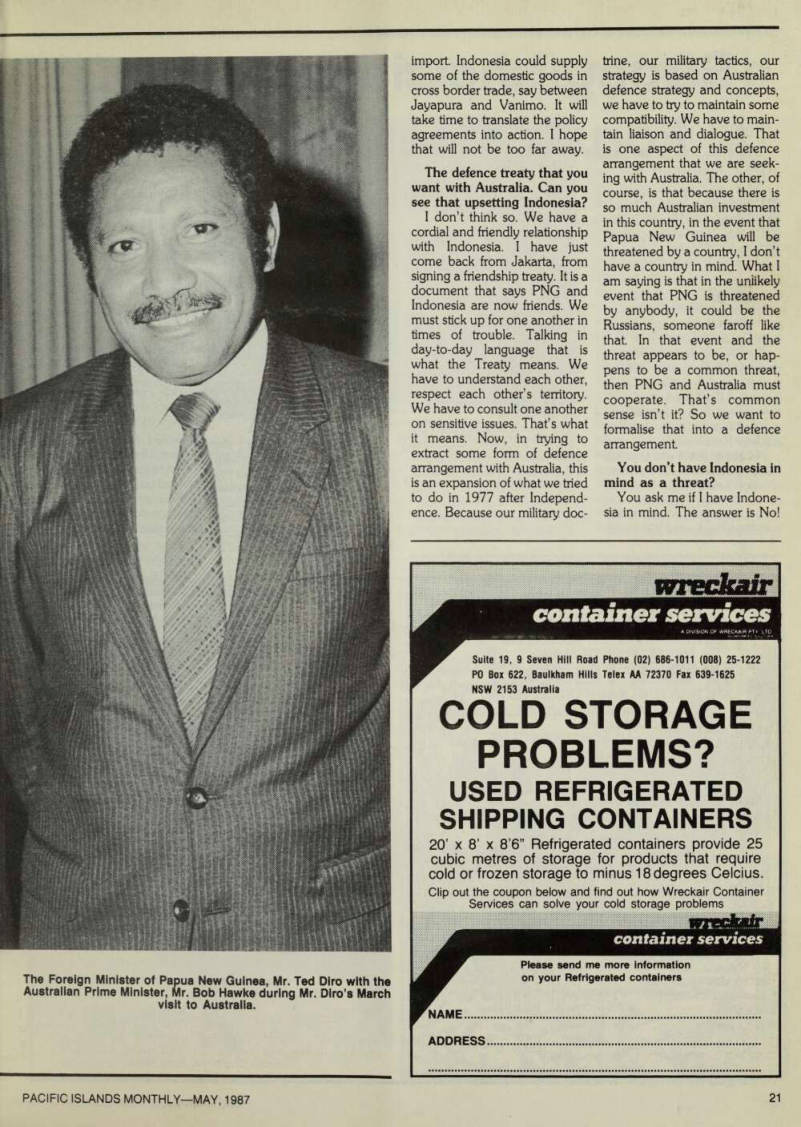
The Foreign Minister of Papua New Guinea, Mr. Ted Diro with the Australian Prime Minister, Mr. Bob Hawke during Mr. Diro’s March visit to Australia.