A day trip to gas mask island
pp. 43-46 · Read in the full issue
gas mask island
Rarely-visited, security-sensitive
Johnston Island was recently the subject of an unusual visit by a prominent and opinionated Amer ican.
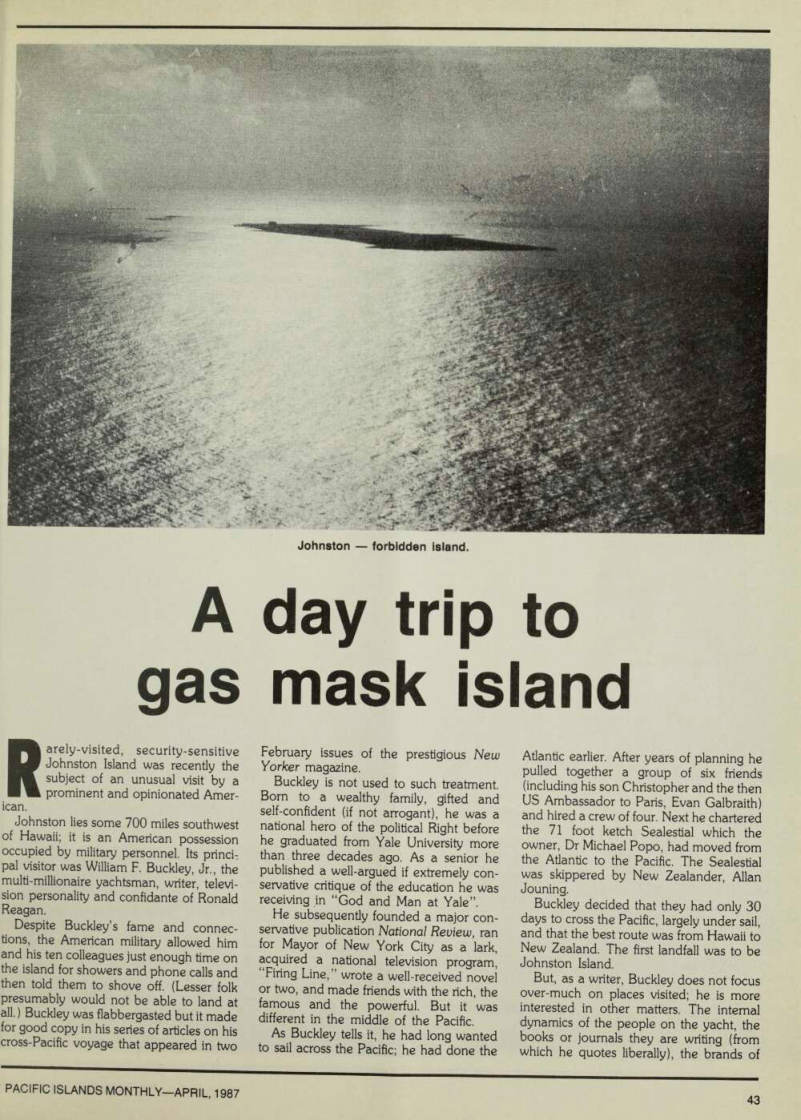
Johnston lies some 700 miles southwest of Hawaii; it is an American possession occupied by military personnel. Its princi pal visitor was William F. Buckley, Jr., the multi-millionaire yachtsman, writer, televi sion personality and confidante of Ronald Reagan.
Despite Buckley’s fame and connec tions, the American military allowed him and his ten colleagues just enough time on the island for showers and phone calls and then told them to shove off. (Lesser folk presumably would not be able to land at all.) Buckley was flabbergasted but it made for good copy in his series of articles on his cross-Pacific voyage that appeared in two
February issues of the prestigious Yorker magazine.
Buckley is not used to such treatment.
Born to a wealthy family, gifted and selt-confident (if not arrogant), he was a national hero of the political Right before he graduated from Yale University more th w. l hr ! e decades a9 °- As a senior he published a well-argued if extremely conservative critique of the education he was linI in “God and Man at Yale”.
He subsequently founded a major conservative publication Nationa Review, ran for Mayor of New York City as a lark, acquired a national television program, T* ” 3we "- receiv ed novel T tW °’ and made fnends w** th e rich, the famous and the powerful. But it was different in the middle of the Pacific.
As Buckle V tells it, he had long wanted to sail across the Pacific; he had done the
Atlantic earlier. After years of planning he pulled together a group of six friends (including his son Christopher and the then
US AmbassadortoPaKtang2£S)
and hired a crew of four Next he chartered the 71 foot ketch Sealestial which the
owner, DrNfcSi^^m^^
the Atlantic to toe Pacific. The Sealestial was skippered by New Zealander Allan Jouning Zealander, Allan recvvine Buckley decided that they had only 30 days to cross the Pacific, largely under sail, and that the best route was from Hawaii to New Johnston Island Tt But, as a writer, Buckley does not focus over-much on places visited; he is more interested in other matters The internal dynamics of the people on''thewhtSS books or journals they are writing (from which he quotes liberally), the brands of
Johnston forbidden island.
wine they brought, the movies they watched, the David Niven recordings they heard, and Buckley’s inability to convince the others to pay serious attention to the music he favoured. It is half way through the first New Yorker article before we learn about Johnston Island, or, as he prefers it, Johnston Atoll. Buckley writes: “Even from 15 or 20 miles away, one sensed the heavy placidity of the place. We would learn that the highest differential in temperature ever recorded at Johnston was 27 degrees. Before the World War 2, Johnston Atoll was a mere sixty-odd acres.
It was placed under the United States Navy in 1934 by Franklin Delano Roosevelt in an early reaction to Japanese aggressiveness, and has been landfilled so that it is now 690 acres. It became the central control point for atomic testing in 1958 and again in 1962 ... it is (one is not quite permitted to gather) the place where unused supplies of poison gas are stored
. . . and one supposes, because of the heavy secrecy that shrouds the area, that there are other things at Johnston that go unpublicised.” (Emphasis in the original).
As they approached Johnston all on board the Sealestial were looking forward to a well-deserved night on shore. They radioed ahead to tell the island of their needs for fuel and ice. They located the gas masks that they had brought along for the occasion, or as Buckley writes: “... protective devices without which, we had been told, one was not permitted to land on that mephitic island.” (Buckley likes obscure words: mephitic means “having an offensive smell, noxious.”) Buckley describes their reception: “. . .
Van [Ambassador Evan Galbraith] and I jumped ashore and extended a hand of greeting to a lieutenant colonel, a trim gentleman in his early forties who turned out to be the base commander, and to two civilian aides by his side. . . I asked our host whether this was the slip where Sealestial would be spending the night.
This, it became obvious, was the colonel’s big moment.
“ ‘No, sir, you can’t spend the night here.’
“Van’s smile ended. ‘I thought you knew we were coming?’ he said.
“ ‘Yes, sir, Mr Ambassador, but you can’t stay. In fact, we intended to bring you the fuel and ice offshore, but the winds were too heavy’.”
Buckley and the Ambassador decided not to fight the decision, but not necessarily to forgive either. Buckley’s report con tinues: [The phone calls revealed] “. .. that Vice-President Bush’s advance man earn estly hoped that Van would be back in Paris in time to be with the Vice-President on the second of July, when Mr Bush would be spending the night at Van’s residence . . . that my wife, Pat, had not left on a trip as had been planned for the night before because Nancy Reagan had called. The conversation had evidently gone about as follows: ‘“Nancy; You know, dear, I can’t stay at the Waldorf because of the strike? The New York hotel workers were on strike.
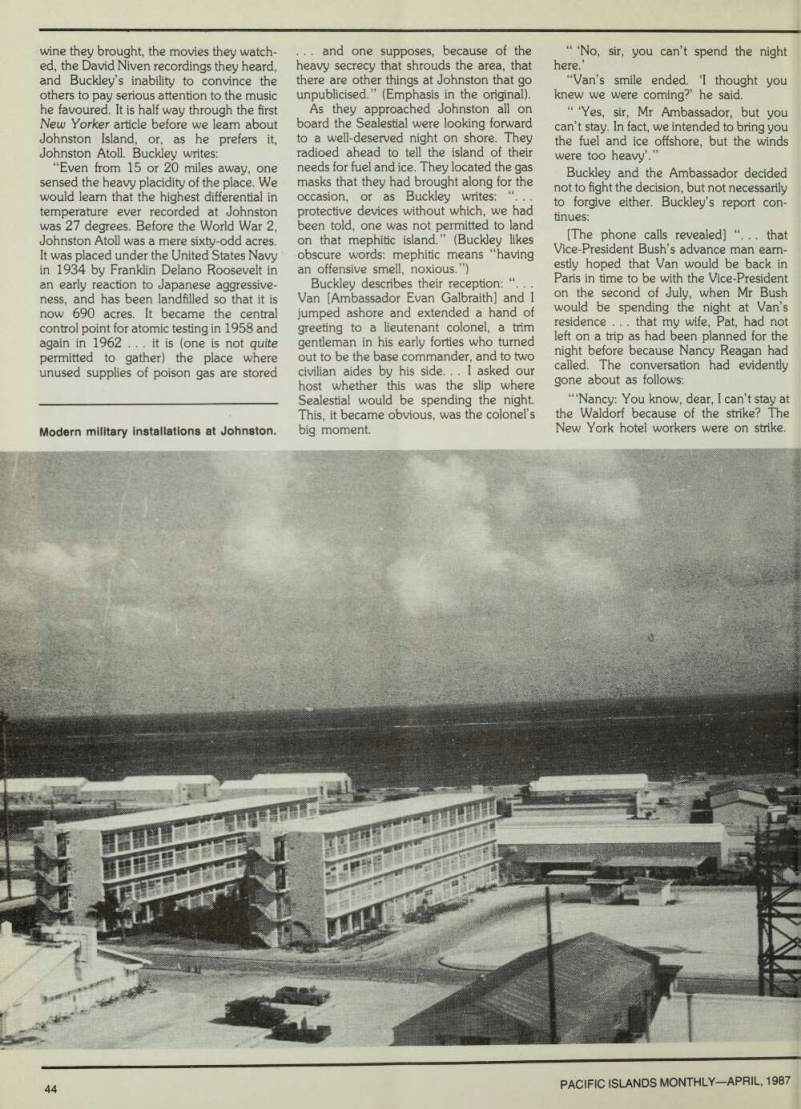
Modern military installations at Johnston.
‘“Pat: Ah, but you can stay at the Plaza Athenee the employees there aren’t union. ‘“Nancy: Dear, I can’t stay in a non union hotel when there’s a strike on. (pause) ‘“Pat: Do you want to stay at our place?
“‘Nancy: Would that really be conve nient Buckley’s final comment on the John ston incident was: “Simultaneously, (1) strict exclusionary rules were being applied against (2) a crew two members of which, were simultaneously engaged in adjusting schedules to accommodate the Vice- President and the wife of the Commander in-Chief. Late that evening the boys would hoot a little at the piquancies.”
It turned out that the gas masks were not needed; the visitors saw none being worn or carried by the military on the island.
The next stop was Majuro in the Marshalls and the reception was much more welcoming: “Standing there in the sunshine to greet us was a genial young foreign-service officer Michael Senko, United States
Status Liaison Officer in Majuro. He was dressed in neat shorts and a strawish hat, and had been expecting us, and drove (us) off in his jeep.”
When people are good to Buckley he gives them names, when they are not he does not.
Buckley and his colleagues were happy with Majuro. They found newspapers there, the Marshall Island News and a two-week-old Newsweek; they spent the night in an austere but clean hotel, The Marshall Sun; and they were able to get loads of laundry done overnight for what they regarded as a bargain SUS2O. They were impressed by the “huge modem shopping centre.”
They set sail again, deliberately skirting Ailinglapalap Atoll, arguing about a stop at Fonape or Kosrae, eventually arriving at the latter. Buckley did not like the island: “. . . I wondered when I had spent a more boring, uncomfortable day than in Kosrae, Caroline Islands.”
While there the visitors encountered what they regarded as another govern ment-imposed indignity, a customs inspec
tor who wanted to seize the ample supply of liquor and the two guns on board until the Sealestial set sail the following day.
Buckley, who had met the attorney general (presumably of the state), set about some string pulling to maintain the status quo: . The attorney general said that it would be tactful to call on the lieutenant governor, the governor being away from the island at the time.
“Van is awfully good at that kind of thing. John Kenneth Galbraith, in his memoirs as Ambassador to India, some where says that he does not believe in using pull unless it is convenient. Lieute nant Governor Mose Mackwelung was ever so attentive and showed an interest in our journey, and so we passed a few pleasant minutes. Along the way, Ambas sador Evan Galbraith mentioned that although he would be giving up his post in government the following month, he had been asked informally whether he would
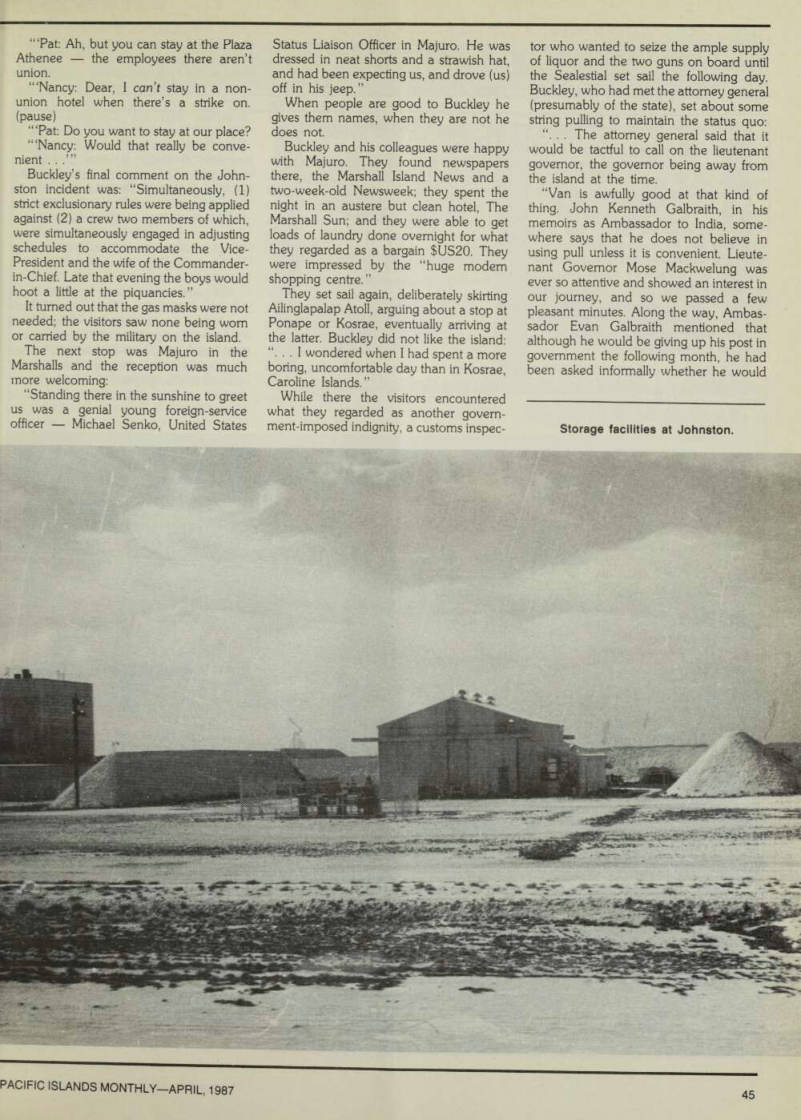
Storage facilities at Johnston.
agree to serve as a director of the Overseas Private Investment Corporation. It’s a government agency that surveys underdeveloped countries, evaluating their economic climate ... I think it is fair to say that any prospective director of OPIC will be treated well by any country desiring the favourable attention of American capital, and it was a matter of minutes before customs lost all interest in inhibiting our access to our wine or in walking off with our firearms ...” . . , . ...
The next stop, and the last one in he Carolines was Kapingamarangi where the Sealestal was guided through treacherous reefs by a pilot named Salter and three assistants. There Buckley encountered, among others an American saenhst who had the good taste to show up for dinner on the yacht carrying a copy of one of Buckley s books, Airborne.
Kapinga was the least developed of the islands visited and everyone had a good time. As one of his colleagues wrote; “.. .
It was sad to consider that probably none
of us would ever return here, but alas, such is the nature of paradise ...”
The ship, nearing its final destination, made a number of gifts to the island, including a ping-pong table, a jumping rope, two dozen T-shirts, two cases of beer, seven bottles of shampoo, candy, matches, whisky and wine.
The final stop was Kavieng, at the north western tip of New Ireland, in Papua New Guinea. They rushed a bit, for they wanted the Ambassador to catch a flight to Paris so that he could meet the Vice-President on schedule H e made it> but only after chartering a light plane for the SUSI9OO to Port Moresby.
Buckley, among other things a widelyc i rcu i a ted political columnist on the maini a]nd> is strangely silent in these articles adout the politics of the Pacific. There is more materia i on f ood t h an on gove mment. (Buckley adored the dinners prepared by the cook, Liz Wheeler, always comparing Micronesian cooking unfavourably to hers, and often describing her meals in detail.)
Although the ship stopped at several islands in the Republic of the Marshall Islands, the Federated States of Micronesia and in Papua New Guinea none of those terms is used; he writes about the Marshalls and the Carolines instead, Although there are a few references to Japan’s wartime presence, there is no mention of earlier Spanish or German occupations. At one point during the stop at Majuro he told his colleagues that he was going to meet with the President and the Cabinet but we are neither told what they were President and Cabinet of, nor about what happened at the meeting.
Perhaps Buckley does not believe in busman’s holidays, His one commentary, at Majuro, is sharp, however; “... The Marshall Islands are indeed a welfare project of the United States. One construction engineer who had been around for a while said he had no confidence that anyone would ever get around to changing the oil in the generator
he had just finished installing...”
David
S. North.
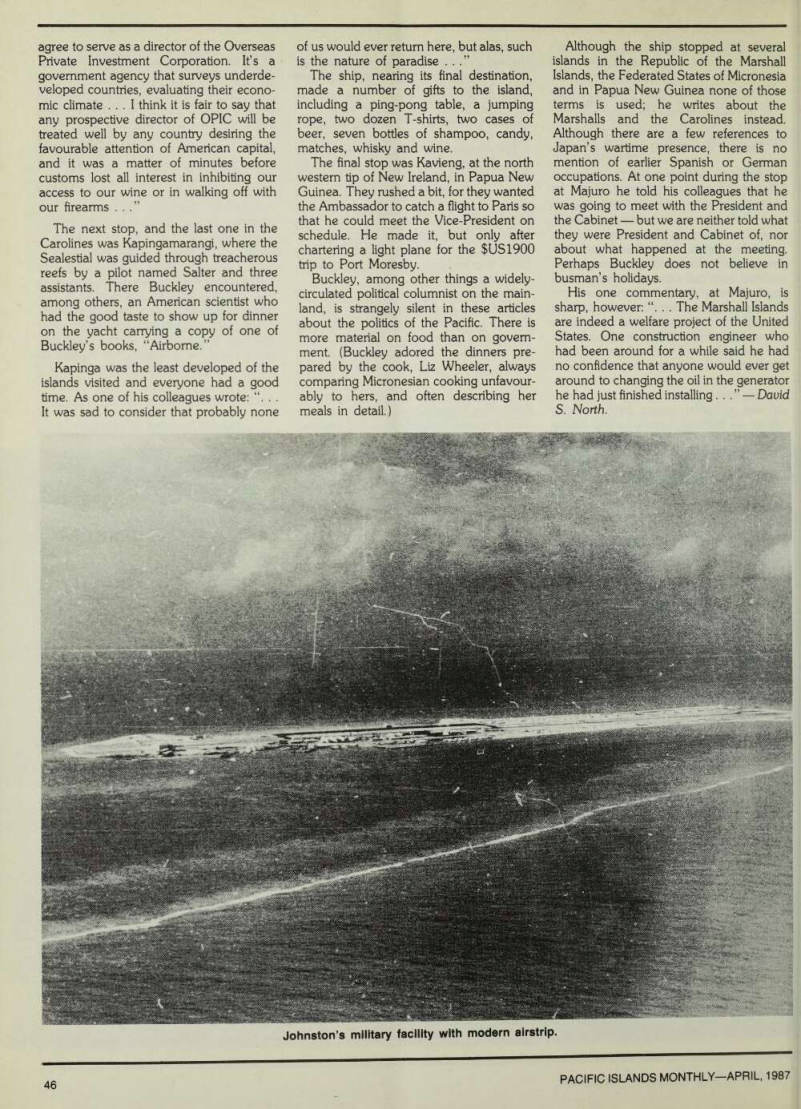
Johnston's military facility with modern airstrip.