Tabai faces the final test
p. 42 · Read in the full issue
final test
After last month’s general election, Kiribati is pre paring for the presi dential national election in the third week of May.
From February 5 to February 26, registration of voters took place in the republic, where only Kiribatese of 18 years or over are eligible to register.
Politial experts say the con troversial Soviet fishing deal which was signed by the Tabai Government, and expired after one year last October, will have an important impact on the outcome.
President leremia Tabai’s Government and the Opposi tion Christian Democratic Party (CDP) have been contradicting each other in parliament, claim ing that they both have the majority of the people on their side.
Mr Tabai said most Kiribatese favored his fishing deal with the Russians. CDP on the other hand said this was not true.
President Tabai and some of his supporting ministers claim they have proved to the nation that
the fishing deal was harmless.
“We have cleared thoughts, worries and fears amongst the people. Our year-long agree ment expired without a single shot from the Russians or any thing that will make the Kiri batese feel unsafe with the Russians roaming our 200-mile EEZ,” said one minister.
A CDP spokesman coun tered “This may be so for the time being but in the long run the Russians have been known for their economic ties that always ended up with politics.
Look at Afghanistan.”
During the Soviet fishing cri sis two things became apparent.
Firstly there was a difference of views between the two major churches in Kiribati, the Catho lics and the Protestants.”
Although the head of the Catholic Church in Kiribati, Bishop Paul Mea and the Pro testants’ secretary-general paid a visit to the president express ing their concerns, the two churches seemed to take sepa rate courses later on.
The Catholics were against
and seemed to support the CDP, while the Protestants were for and seemed to favour the government.
At the same time islands in northern Kiribati which are pre dominantly Catholic were against the fishing deal, while those in the Protestant domin ated south agreed with the Government.
At one stage, at the peak of the crisis, CDP leaders were talking about splitting Kiribati in two the pro and the anti Russians.
The Kiribati 1985 census re veals that there are about equal numbers of Catholics and Pro testants. President Tabai is a Protestant, but he always made sure that his Cabinet had a balance of north and south and church representatives.
His popularity is clear on the outer islands. If the Catholics on Nonouti, his constituency, select a strong contender against Mr Tabai (backing the interests of Catholics through out Kiribati who hated the
Russians), there is a possibility that he may lose.
But, again, if the whole Pro testant population on Nonouti still favours Mr Tabai, he will make an easy return.
If he wins next month it will be his last time in office as the constitution of Kiribati limits presidents to three successive terms.
Meanwhile, the number of parliamentarians in the House has increased with the introduc tion of three new constituencies Abaiang, Maiana and Niku nau islands as a result of popu lation increases.
This brings the total number of elected MPs to 39. The constitution also allows the attorney general to be an ex officio member and also invites a nomination from the Rabi Council of Leaders in Fiji where the Banaban community lives.
The House was dissolved at the end of January; President Tabai and his ministers main tain their status as caretakers during the transitional period.
Batiri I. Bataua.
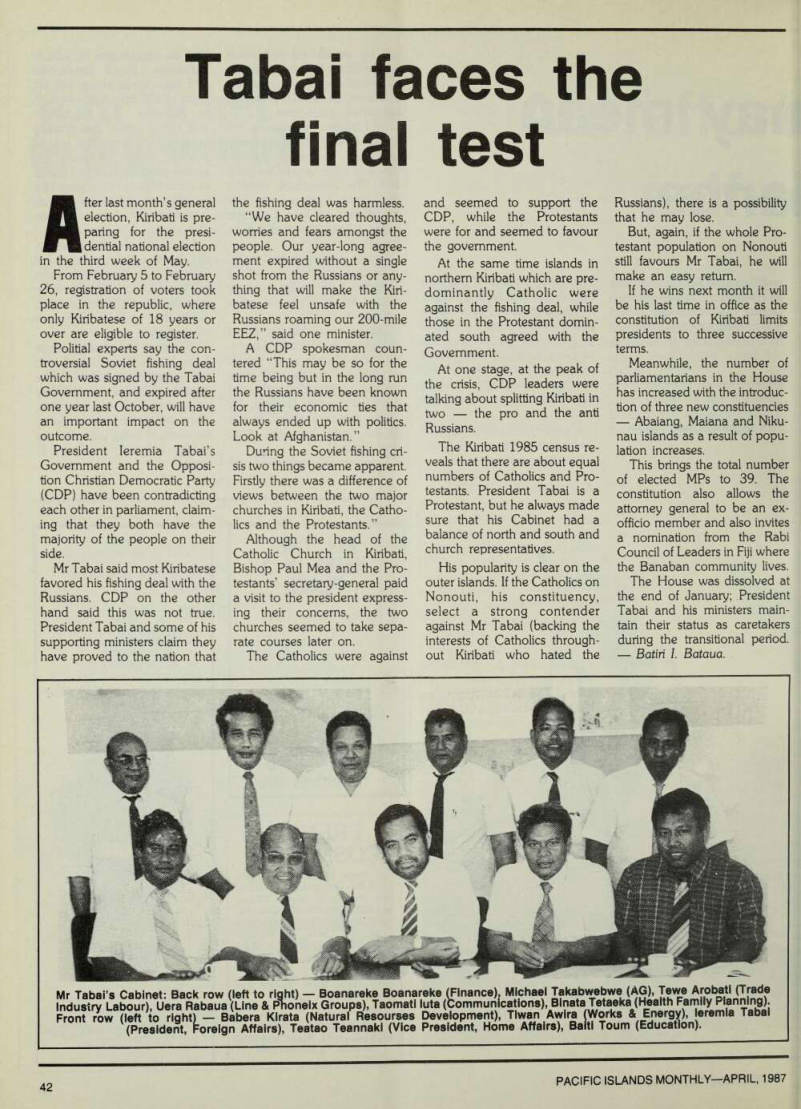
Mr Tabai’s Cabinet: Back row (left to right) - Boanareke Boanareke (Finance). Michael Takabwebwe (AG). Tewe Arobatl (Trade Industry Labour), Uera Rabaua (Line & Phoneix Groups), Taomati luta (Communications), Binata Tetaekai (Health Family Planning).
Front row (left to right) Babera Klrata (Natural Resourses Development), Tiwan Awira Works & E nergy), leremia Tabai (President, Foreign Affairs), Teatao Teannaki (Vice President, Home Affairs), Baiti Toum (Education).