How the Russians
p. 26 · Read in the full issue
view the threat
The view of the South Pacific from Moscow is, not unnaturally, diametrically opposed to that from Washington. The Russians see themselves as surrounded by a ring of steel and claim they are merely reacting to that threat.
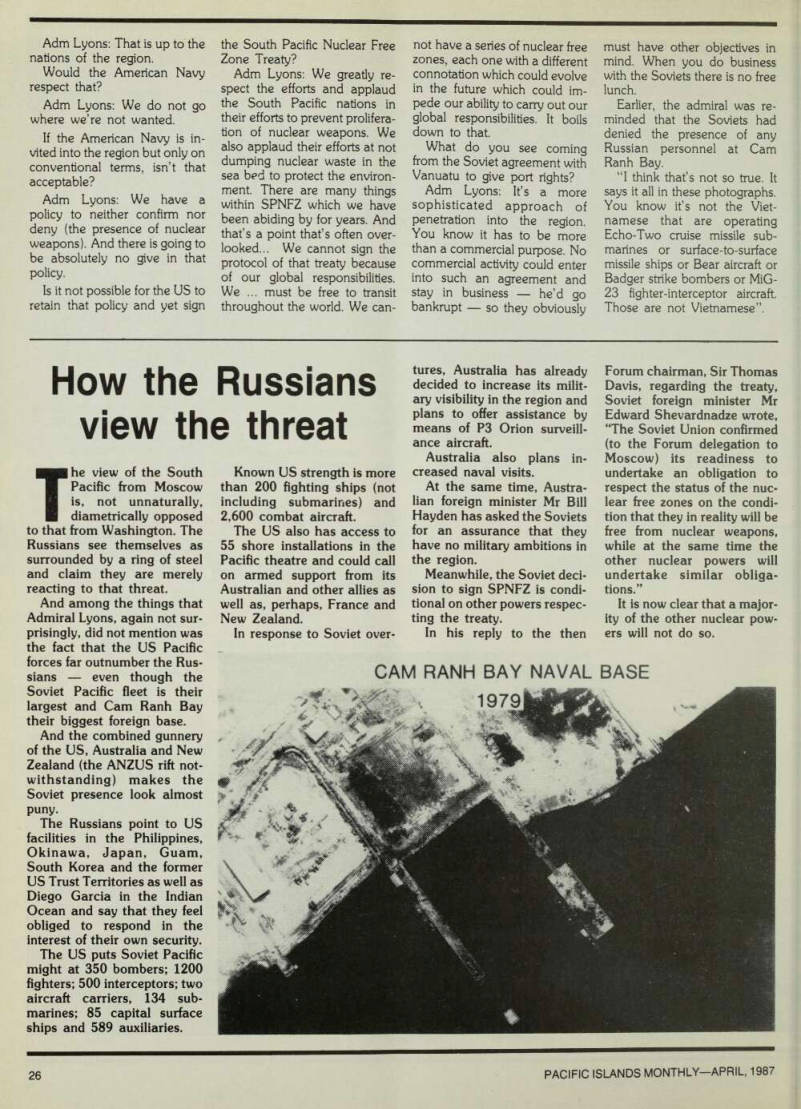
And among the things that Admiral Lyons, again not sur prisingly, did not mention was the fact that the US Pacific forces far outnumber the Rus sians even though the Soviet Pacific fleet is their largest and Cam Ranh Bay their biggest foreign base.
And the combined gunnery of the US, Australia and New Zealand (the ANZUS rift not withstanding) makes the Soviet presence look almost puny.
The Russians point to US facilities in the Philippines, Okinawa, Japan, Guam, South Korea and the former US Trust Territories as well as Diego Garcia in the Indian Ocean and say that they feel obliged to respond in the interest of their own security.
The US puts Soviet Pacific might at 350 bombers; 1200 fighters; 500 interceptors; two aircraft carriers, 134 sub marines; 85 capital surface ships and 589 auxiliaries.
Known US strength is more than 200 fighting ships (not including submarines) and 2,600 combat aircraft.
The US also has access to 55 shore installations in the Pacific theatre and could call on armed support from its Australian and other allies as well as, perhaps, France and New Zealand.
In response to Soviet over
tures, Australia has already decided to increase its milit ary visibility in the region and plans to offer assistance by means of P 3 Orion surveill ance aircraft.
Australia also plans in creased naval visits.
At the same time, Austra lian foreign minister Mr Bill Hayden has asked the Soviets for an assurance that they have no military ambitions in the region.
Meanwhile, the Soviet deci sion to sign SPNFZ is condi tional on other powers respec ting the treaty.
In his reply to the then
Forum chairman, Sir Thomas Davis, regarding the treaty, Soviet foreign minister Mr Edward Shevardnadze wrote, “The Soviet Union confirmed (to the Forum delegation to Moscow) its readiness to undertake an obligation to respect the status of the nuc lear free zones on the condi tion that they in reality will be free from nuclear weapons, while at the same time the other nuclear powers will undertake similar obliga tions.”
It is now clear that a major ity of the other nuclear pow ers will not do so.
Cam Ranh Bay Naval Base
19791