of increased Soviet power
pp. 23-26 · Read in the full issue
Pictures tell the story of increased Soviet power
The Pacific theatre in the US-Soviet war of words is seeing unprecedented action with the release of satellite photographs of the Soviets’ Cam Ranh Bay base by Admiral James A Lyons, Commander of the US Pacific Fleet.
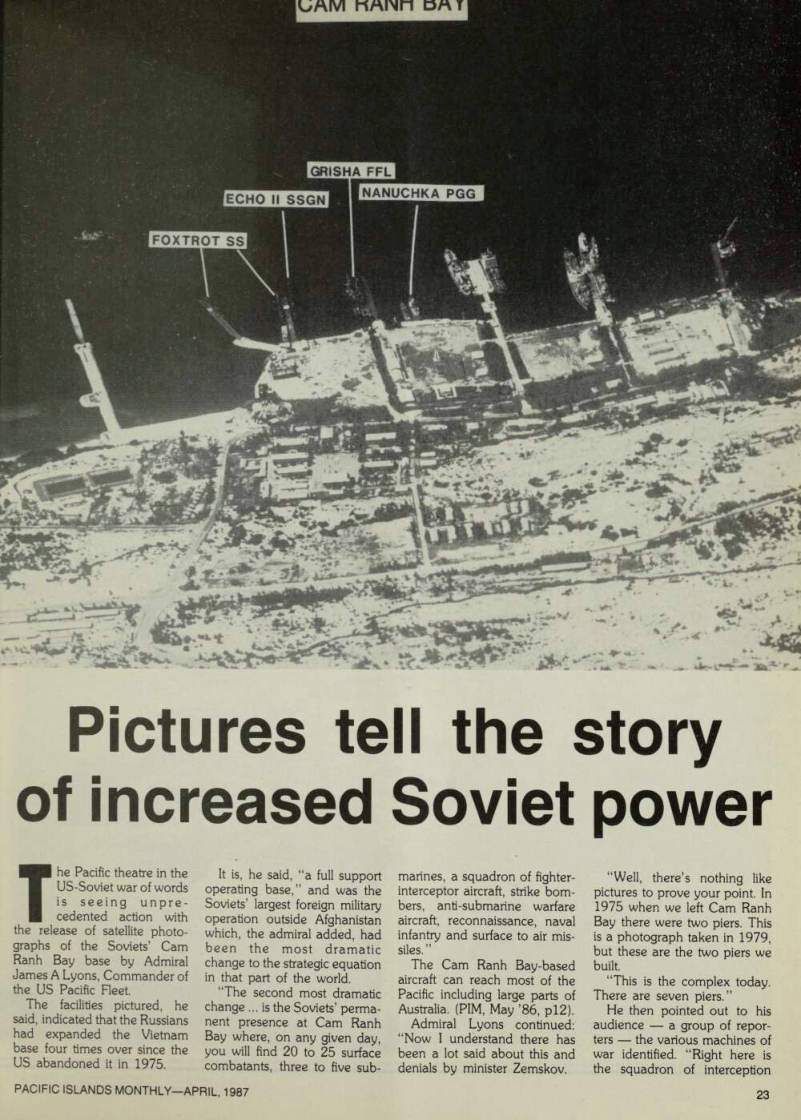
The facilities pictured, he said, indicated that the Russians had expanded the Vietnam base four times over since the US abandoned it in 1975.
It is, he said, “a full support operating base,” and was the Soviets’ largest foreign military operation outside Afghanistan which, the admiral added, had been the most dramatic change to the strategic equation in that part of the world, “The second most dramatic change... is the Soviets’perma nent presence at Cam Ranh Bay where, on any given day, you will find 20 to 25 surface combatants, three to five sub
marines, a squadron of fighterinterceptor aircraft, strike bombers, anti-submarine warfare aircraft, reconnaissance, naval infantry and surface to air missites-”
The Cam Ranh Bay-based aircraft can reach most of the Pacific including large parts of Australia. (PIM, May ’B6, pl 2).
Admiral Lyons continued: “Now I understand there has been a lot said about this and denials by minister Zemskov.
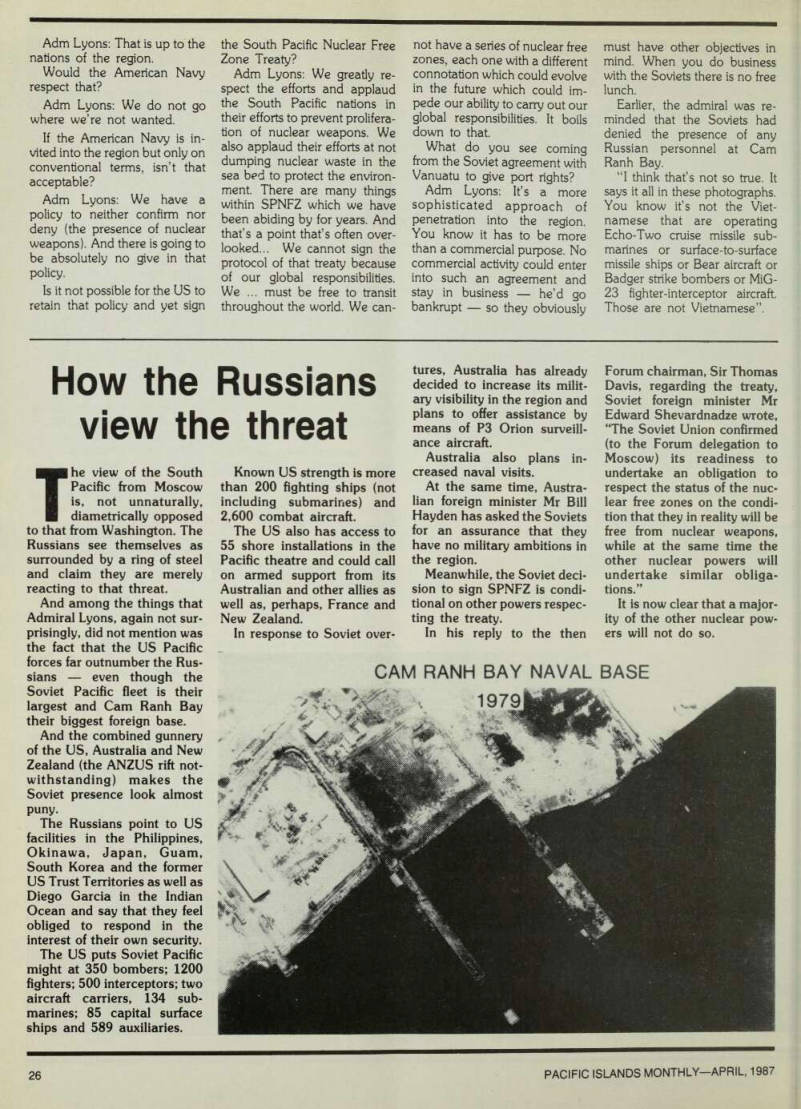
“Well, there’s nothing like pictures to prove your point. In 1975 when we left Cam Ranh Bay there were two piers. This is a photograph taken in 1979, but these are the two piers we built, “This is the complex today.
There are seven piers.”
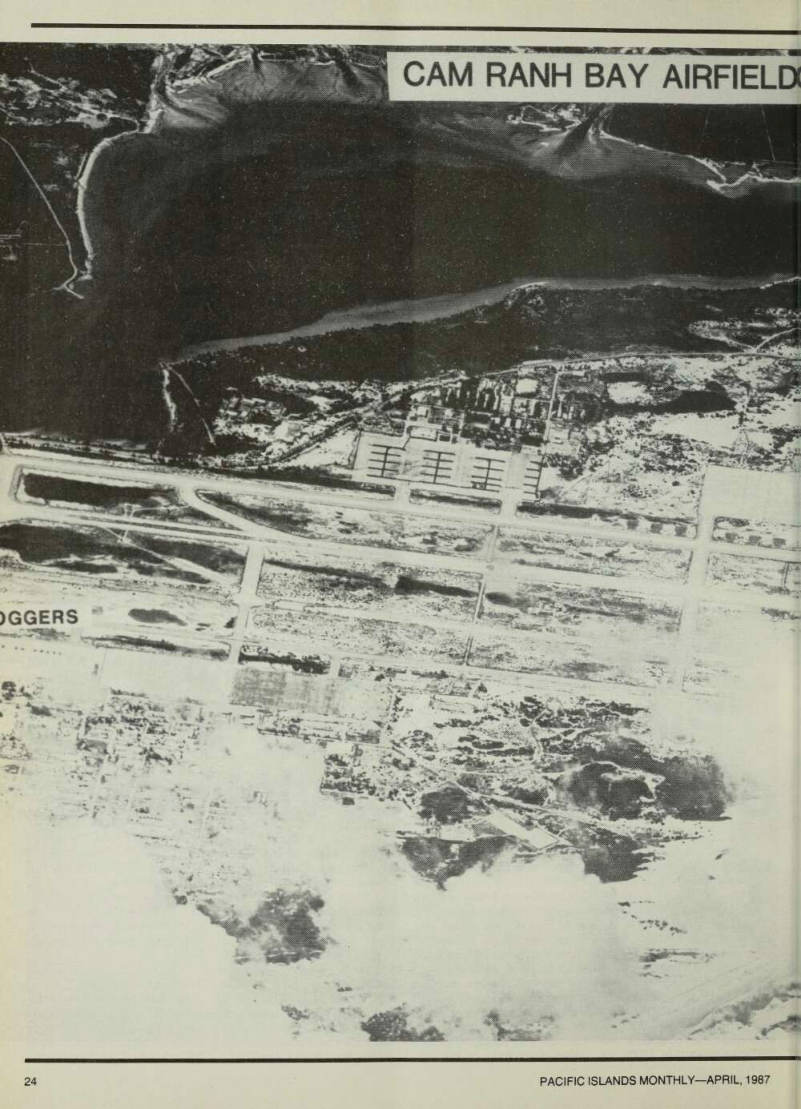
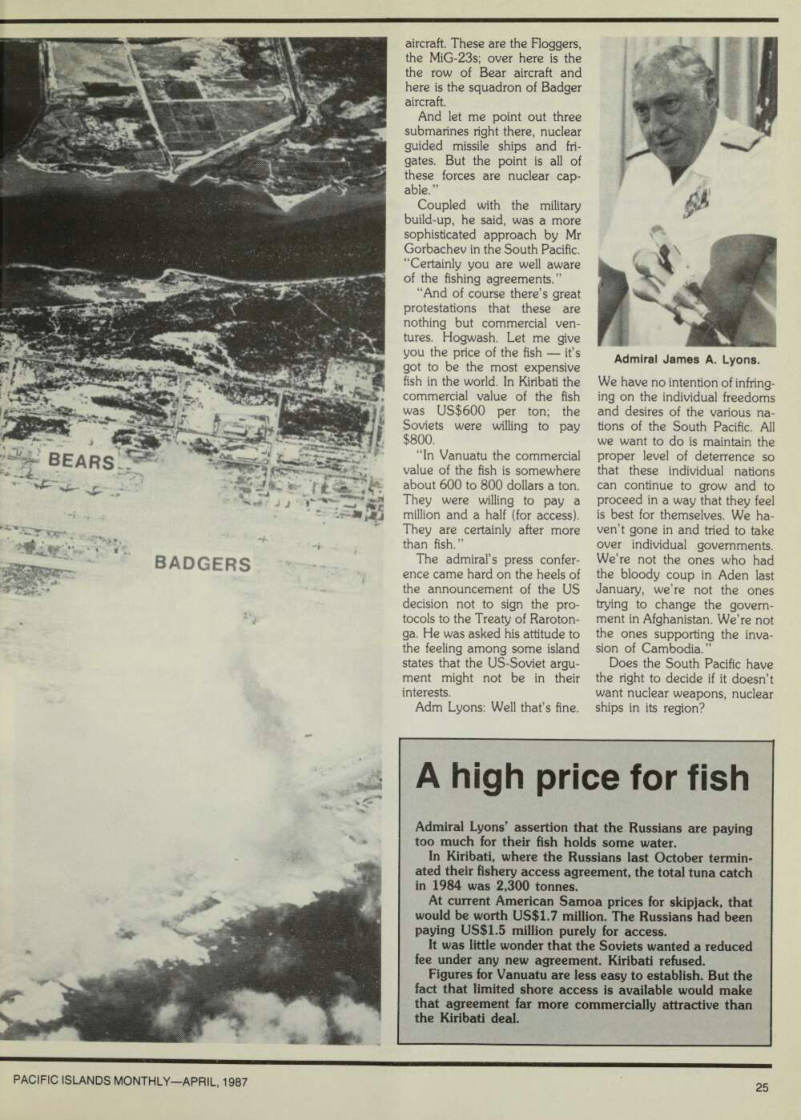
He then pointed out to his audience a group of repor ters the various machines of war identified. “Right here is the squadron of interception
aircraft. These are the Floggers, the MiG-235; over here is the the row of Bear aircraft and here is the squadron of Badger aircraft.
And let me point out three submarines right there, nuclear guided missile ships and fri gates. But the point is all of these forces are nuclear cap able.”
Coupled with the military build-up, he said, was a more sophisticated approach by Mr Gorbachev in the South Pacific.
“Certainly you are well aware of the fishing agreements.”
“And of course there’s great protestations that these are nothing but commercial ven tures. Hogwash. Let me give you the price of the fish it’s got to be the most expensive fish in the world. In Kiribati the commercial value of the fish was US$6OO per ton; the Soviets were willing to pay
$Boo.
“In Vanuatu the commercial value of the fish is somewhere about 600 to 800 dollars a ton.
They were willing to pay a million and a half (for access).
They are certainly after more than fish.”
The admiral’s press confer ence came hard on the heels of the announcement of the US decision not to sign the pro tocols to the Treaty of Raroton ga. He was asked his attitude to the feeling among some island states that the US-Soviet argu ment might not be in their interests.
Adm Lyons: Well that’s fine.
We have no intention of infring ing on the individual freedoms and desires of the various na tions of the South Pacific. All we want to do is maintain the proper level of deterrence so that these individual nations can continue to grow and to proceed in a way that they feel is best for themselves. We ha ven’t gone in and tried to take over individual governments.
We’re not the ones who had the bloody coup in Aden last January, we’re not the ones trying to change the govern ment in Afghanistan. We’re not the ones supporting the inva sion of Cambodia.”
Does the South Pacific have the right to decide if it doesn’t want nuclear weapons, nuclear ships in its region?
Admiral James A. Lyons.
Adm Lyons: That is up to the nations of the region.
Would the American Navy respect that?
Adm Lyons: We do not go where we’re not wanted.
If the American Navy is in vited into the region but only on conventional terms, isn’t that acceptable?
Adm Lyons; We have a policy to neither confirm nor deny (the presence of nuclear weapons). And there is going to be absolutely no give in that policy.
Is it not possible for the US to retain that policy and yet sign
the South Pacific Nuclear Free Zone Treaty?
Adm Lyons; We greatly re spect the efforts and applaud the South Pacific nations in their efforts to prevent prolifera tion of nuclear weapons. We also applaud their efforts at not dumping nuclear waste in the sea bed to protect the environ ment. There are many things within SPNFZ which we have been abiding by for years. And that’s a point that’s often over looked... We cannot sign the protocol of that treaty because of our global responsibilities.
We ... must be free to transit throughout the world. We can
not have a series of nuclear free zones, each one with a different connotation which could evolve in the future which could im pede our ability to carry out our global responsibilities. It boils down to that.
What do you see coming from the Soviet agreement with Vanuatu to give port rights?
Adm Lyons: It’s a more sophisticated approach of penetration into the region.
You know it has to be more than a commercial purpose. No commercial activity could enter into such an agreement and stay in business he’d go bankrupt so they obviously
must have other objectives in mind. When you do business with the Soviets there is no free lunch.
Earlier, the admiral was re minded that the Soviets had denied the presence of any Russian personnel at Cam Ranh Bay.
“I think that’s not so true. It says it all in these photographs.
You know it’s not the Viet namese that are operating Echo-Two cruise missile sub marines or surface-to-surface missile ships or Bear aircraft or Badger strike bombers or MiG -23 fighter-interceptor aircraft.
Those are not Vietnamese”.