and influences people
pp. 20-22 · Read in the full issue

Molisa wins friends and influences people
Sela Molisa, Vanuatu’s Foreign Minister, per formed well under diffi cult circumstances on his first visit to Washington.
At 5 am on the first business day of the visit his leader, Prime Minister, Walter Lini, suffered a mild stroke and was hospital ised.
That morning the Washing ton Post carried the story that Vanuatu had signed a $1.5 million fisheries deal with the Soviet Union, which reminded some observers of Vanuatu’s establishment of diplomatic re lations with Libya.
And that morning both Fr Lini and Mr Molisa had an appointment with George
Shultz, the US Secretary of State. Mr Molisa was, under standably, a few minutes late for the appointment, having just left the George Washington University hospital. It was not an auspicious start to the week.
By the end of the week, however, the prime minister was recovering and his foreign minister had scored a number of points for his country.
The stroke hit the left side of Fr Lini’s brain, initially slurring his speech and limiting move ment of his right arm, but his speech was normal and his right arm much stronger a week later.
Though remarkably young to suffer a stroke he is 42
any such event requires more than a few days in hospital.
The Prime Minister, inci dentally, had followed the medical footsteps of President Reagan. Both had experienced a major medical problem at the Washington Hilton Hotel, and then both were rushed to the same hospital, a mile or so away. In the case of the Presi dent, it had been the assassina tion attempt early in his first term.
But by the end of the week, Sela Molisa had touched many important bases in Washington, and had impressed many sea soned observers. His was not an easy task. Uncle Sam is not happy with small nations that
deal with Libya and accept Soviet fishing deals.
Mr Molisa won friends by being open, warm, modest, and accessible he met with the media on at least three occa sions during the week. He stated the needs and the poli cies of his country with under statement and only obliquely criticised the Reagan Adminis tration.
Mr Molisa (using a schedule laid out earlier for Fr Lini) also reached out in all directions, to Democrats and to Republicans, to members of both the Con gress and the Executive, to the press and to intellectuals.
In contrast, Fiji’s Prime Minis ter, Ratu Mara, on his last trip
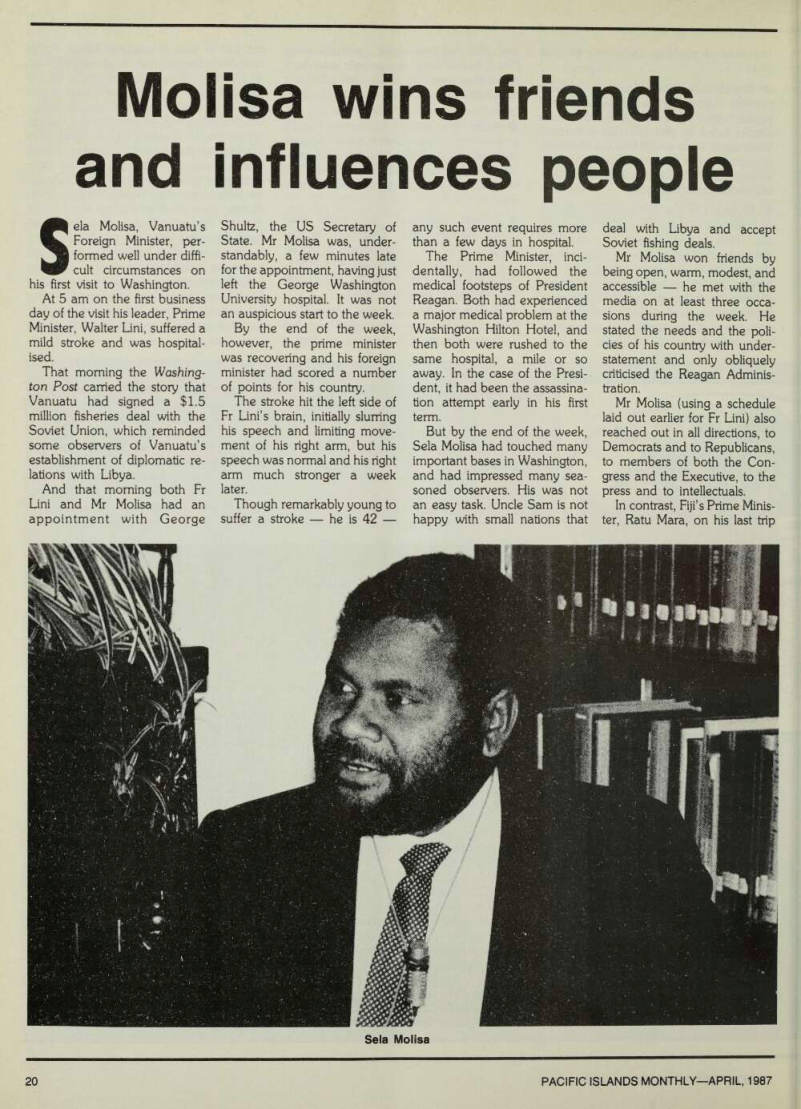
Sela Molisa
here focused his attention solely on the Reagan Administration, seeing no-one in the legislative branch, and granting no inter views.
On that Monday morning, Mr Molisa told the US Secretary of State that the fishing agreement with the Soviets was “a purely commercial and economic deal” which was not designed to increase the USSR’s influ ence in the Pacific.
Mr Shultz had expressed his concern about the fishing agreement during the session.
Afterwards a State Department spokesman called the session “cordial” and Mr Molisa said that he felt that it had “created a greater understanding of Vanuatu’s motives” at the de partment; it sounds as if the meeting went well.
Mr Molisa told PIM in an interview later he had been very impressed with Mr Shultz’s depth of knowledge about the Pacific.
Mr Molisa also attended a somewhat peculiar, annual event the National Prayer Breakfast. It is peculiar because
it is put together on an ad hoc basis by a group of conservative Americans who shun publicity.
It is significant because there are often leaders of several nations attending it, and be cause Ronald Reagan is routinely present. (This year, for example, the King of Tonga was one of the guests. His trip to Washington lasted only a couple of days, and was not covered by the media).
Mr Molisa spent a consider able amount of time on Capitol Hill, talking with a number of members of Congress. He saw, for example, Congressman Stephen Solarz (D-NY) chair man of a key subcommittee of the House of Representatives Committee on Foreign Affairs.
He visited Senator Bill Brad ley (D-NJ), the former Rhodes Scholar and professional bas ketball player (an unusual com bination) who is deeply in terested in the Third World and is regarded as a possible future Democratic candidate for presi dent.
Mr Molisa is probably the first Melanesian leader to seek out
the leaders of the black caucus in the US House of Representa tives; he saw Congressmen Walter Fauntroy (D-DC) and Melvyn Dymally (D-Cal.).
Mr Molisa and Mr Dymally have something in common; both experienced British colo nial rule as children, Mr Dymal ly being a native of the island of Trinidad.
The black caucus has about 5 per cent of the membership of the House; their numbers have been increasing, slowly but surely, and will continue to do so. The caucus will be even more important two years from now if, as expected, a Demo crat becomes president. (All blacks in the House are Demo crats. ) Also in the course of the week Mr Molisa, between visits to Fr Lini in the hospital, man aged to be interviewed by the nation’s most significant net work radio news-and-analysis program “All Things Consi dered.”
Among Fr Lini’s aides was Robert F. Van Lierop, who plays an interesting role for
Vanuatu.
Mr Van Lierop is an Amer ican citizen and a New York attorney who speaks and votes for Vanuatu at the United Na tions. (He tells me he is one of two non-diplomats working there and that the other one is a dentist who speaks for the Caribbean island of Grenada, which the US invaded a few years ago.) Mr Molisa told one gathering of his country’s experience dur ing and after colonial rule. He talked quietly about the particu lar problems of having two colonial masters, not one. “We were kicked around like a ball. ”
He said Vanuatu, bearing this experience in mind, determined that after independence “we would do it our own way.”
Mr Molisa said that three issues were more non-self gov erning entities in the Pacific than anywhere else in the world. He was particularly criti cal of France, who he said had dragged its feet on independ ence for his nation, worrying that it might set a precedent for New Caledonia, French
Polynesia and Wallis and Futuna.
He also said, without elaborating, that his country was the only one in the Pacific in which troops had to be used in the process of securing inde pendence when PNG’s Kumul Force put down the Jimmy Stevens secessionist move ment.
On the nuclear issue he said: “We all eat fish from the Paci fic” stressing a concern about food chain contamination, rather than the nuclear destruc tion which is foremost in the minds of many Westerners.
His comments on economic difficulties and depressed com modity prices led him into a discussion of his country’s budget deficit and of the need for foreign aid. “Vanuatu has a budget of US$3B million and a deficit of $6.5 million” he said, suggesting that these numbers were tiny by American stan dards.
He was, however, too much of a diplomat to point out that his country’s budget is, both absolutely and proportionately, much closer to balance than that of the United States.
To put the Russians’ $1.5 million in context, he talked of the $6.5 million deficit, and the
$120,000 or so a year from the United States that the tuna treaty will bring to Vanuatu. (He said that the only other aid that the U.S. provides will be a single computer, of unknown size and power, for use with the nation’s fishing industry this is a by-product of the tuna treaty.) Of the Russian payment he said “this is the first time that we have received a fair price for our fish.”
He noted that once New Caledonia was reinscribed on the United Nation’s list of non self-goveming territories France dropped budgetary aid to his country, and cut back sharply on development aid and techni cians as well.
When that happened Vanuatu went to the British for help, and that, as a result, the Brits are now providing $750,000 in budget assistance plus larger amounts for deve lopment projects.
He said that Japan was also providing substantial deve lopment assistance, approx imately US$2 million in the current year. Canada, Australia and New Zealand also provide development assistance.
Perhaps the most moving moment of Mr Molisa’s stay in Washington came when he was
asked what he would like from the United States if he had a single wish.
“We would like some help with our education system. We have increased the number of secondary schools from three at independence to eight now. We had just six university graduates at Independence, and now have only 20,” he said.
“We have 300 people atten ding university now, but not one of them is in the United States. ”
In our interview he had re plied to questions about Vanuatu’s far-flung, if minimal ly staffed, foreign relations. The nation has formal relations with the members of the European community, with the USSR and the U.S., with Singapore, Thai land and Malaysia, with Austra lia and New Zealand, and with Cuba and Libya.
They have no resident ambassadors with the excep tion of Mr Van Lierop; as a result Mr Molisa and Nikenike Vurobaravu, the Secretary of Foreign Affairs, do a lot of travelling.
Mr Molisa was open in his response to my questions about Libya. Yes, he had been there, once, in April of 1986, days before American warplanes bombed the place.
He said that he spent some time with Libyan leader Muam mar Gaddafi. “He’s a human being, he speaks nicely.”
The conversation was in Eng lish, without an interpreter, and in it, Mr Molisa said: “Col.
Gaddafi showed an extensive knowledge of the Pacific. He knew about the French and New Caledonia, he knew what Australia and New Zealand were doing, and he knew about us.”
Washington observers, out side the Reagan Administration, have noted that little Vanuatu’s relations with the likes of the USSR and Libya have been open and above board, unlike the cover up which has sur rounded America’s convoluted and unsuccessful relations with Iran.
PIM: Vanuatu presents a strange mix to some. It seeks to attract off-shore banking and tourists, on one hand, and yet deals with the Soviets and Libya on the other. Does this mix create any discomfort to the government?
Molisa; “No, it is no problem, and as for tourists what we really need is an airport which could handle a 747 then all 2500 hotel rooms in Vanuatu would fill quickly.” From David S. North in Washington.