Mexican stand off
pp. 18-19 · Read in the full issue
as law takes its course
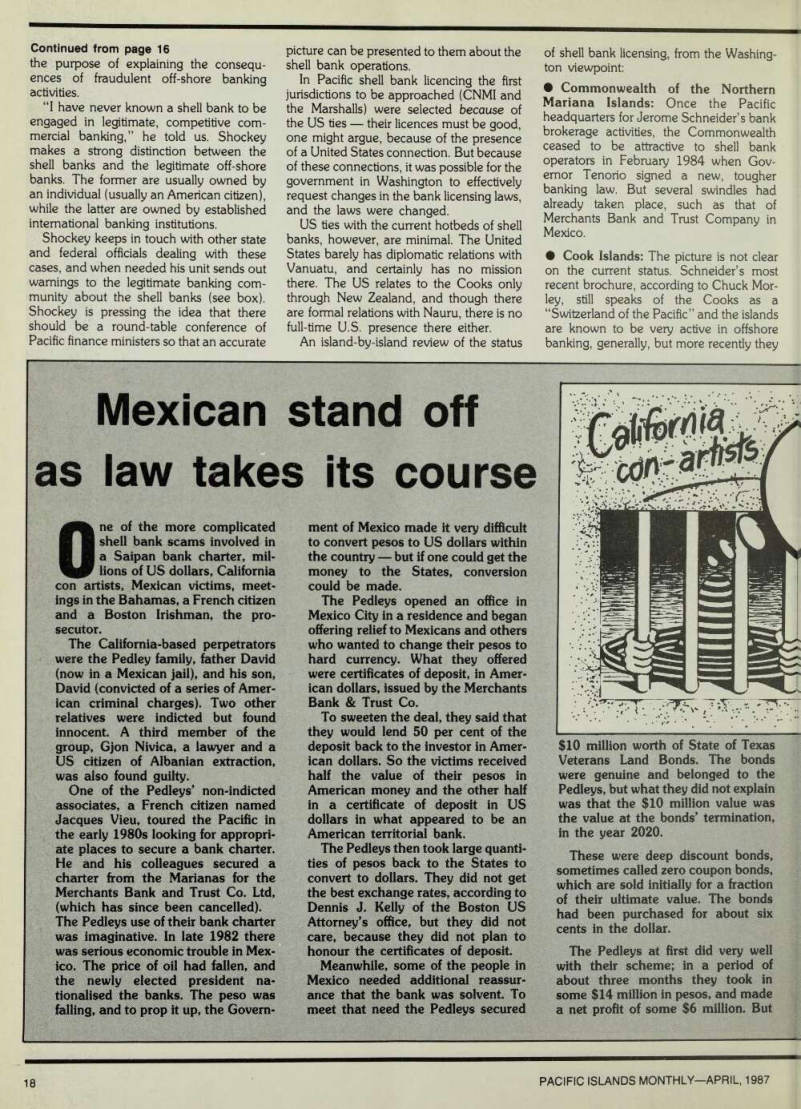
One of the more complicated shell bank scams involved in a Saipan bank charter, mil lions of US dollars, California con artists, Mexican victims, meet ings in the Bahamas, a French citizen and a Boston Irishman, the pro secutor.
The California-based perpetrators were the Pedley family, father David (now in a Mexican jail), and his son, David (convicted of a series of Amer ican criminal charges). Two other relatives were indicted but found innocent. A third member of the group, Gjon Nivica, a lawyer and a US citizen of Albanian extraction, was also found guilty.
One of the Pedleys’ non-indictcd associates, a French citizen named Jacques Vieu, toured the Pacific in the early 1980 s looking for appropri ate places to secure a bank charter.
He and his colleagues secured a charter from the Marianas for the Merchants Bank and Trust Co. Ltd, (which has since been cancelled).
The Pedleys use of their bank charter was imaginative. In late 1982 there was serious economic trouble in Mex ico. The price of oil had fallen, and the newly elected president na tionalised the banks. The peso was falling, and to prop it up, the Govern
ment of Mexico made it very difficult to convert pesos to US dollars within the country but if one could get the money to the States, conversion could be made.
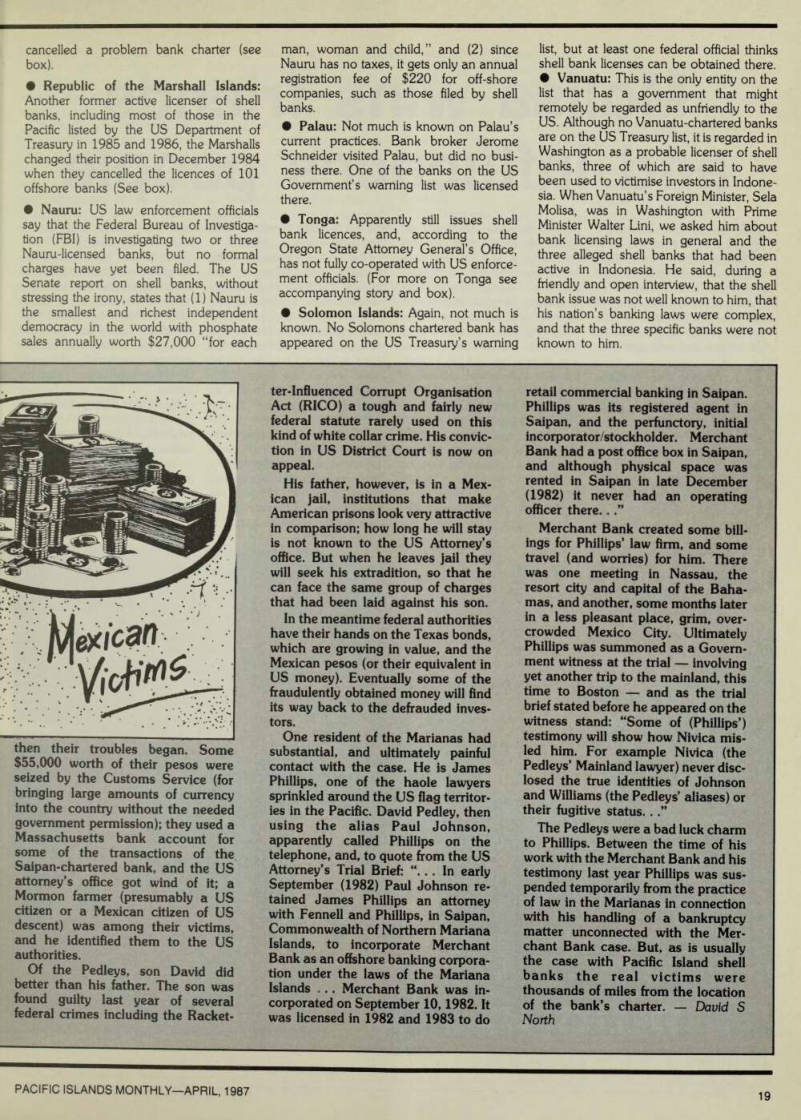
The Pedleys opened an office in Mexico City in a residence and began offering relief to Mexicans and others who wanted to change their pesos to hard currency. What they offered were certificates of deposit, in Amer ican dollars, issued by the Merchants Bank & Trust Co.
To sweeten the deal, they said that they would lend 50 per cent of the deposit back to the investor in Amer ican dollars. So the victims received half the value of their pesos in American money and the other half in a certificate of deposit in US dollars in what appeared to be an American territorial bank.
The Pedleys then took large quanti ties of pesos back to the States to convert to dollars. They did not get the best exchange rates, according to Dennis J. Kelly of the Boston US Attorney’s office, but they did not care, because they did not plan to honour the certificates of deposit.
Meanwhile, some of the people in Mexico needed additional reassur ance that the bank was solvent. To meet that need the Pedleys secured
$lO million worth of State of Texas Veterans Land Bonds. The bonds were genuine and belonged to the Pedleys, but what they did not explain was that the $lO million value was the value at the bonds’ termination, in the year 2020.
These were deep discount bonds, sometimes called zero coupon bonds, which are sold initially for a fraction of their ultimate value. The bonds had been purchased for about six cents in the dollar.
The Pedleys at first did very well with their scheme; in a period of about three months they took in some $l4 million in pesos, and made a net profit of some $6 million. But
then their troubles began. Some $55,000 worth of their pesos were seized by the Customs Service (for bringing large amounts of currency into the country without the needed government permission); they used a Massachusetts bank account for some of the transactions of the Saipan-chartered bank, and the US attorney’s office got wind of it; a Mormon farmer (presumably a US citizen or a Mexican citizen of US descent) was among their victims, and he identified them to the US authorities.
Of the Pedleys, son David did better than his father. The son was found guilty last year of several federal crimes including the Racket
ter-lnfluenced Corrupt Organisation Act (RICO) a tough and fairly new federal statute rarely used on this kind of white collar crime. His convic tion in US District Court is now on appeal.
His father, however, is in a Mex ican jail, institutions that make American prisons look very attractive in comparison; how long he will stay is not known to the US Attorney’s office. But when he leaves jail they will seek his extradition, so that he can face the same group of charges that had been laid against his son.
In the meantime federal authorities have their hands on the Texas bonds, which are growing in value, and the Mexican pesos (or their equivalent in US money). Eventually some of the fraudulently obtained money will find its way back to the defrauded inves tors.
One resident of the Marianas had substantial, and ultimately painful contact with the case. He is James Phillips, one of the haole lawyers sprinkled around the US flag territor ies in the Pacific. David Pedley, then using the alias Paul Johnson, apparently called Phillips on the telephone, and, to quote from the US Attorney’s Trial Brief: “... In early September (1982) Paul Johnson re tained James Phillips an attorney with Fennell and Phillips, in Saipan, Commonwealth of Northern Mariana Islands, to incorporate Merchant Bank as an offshore banking corpora tion under the laws of the Mariana Islands ~. Merchant Bank was in corporated on September 10,1982. It was licensed in 1982 and 1983 to do
retail commercial banking in Saipan.
Phillips was its registered agent in Saipan, and the perfunctory, initial incorporator/stockholder. Merchant Bank had a post office box in Saipan, and although physical space was rented in Saipan in late December (1982) it never had an operating officer there.. .”
Merchant Bank created some bill ings for Phillips’ law firm, and some travel (and worries) for him. There was one meeting in Nassau, the resort city and capital of the Baha mas, and another, some months later in a less pleasant place, grim, over crowded Mexico City. Ultimately Phillips was summoned as a Govern ment witness at the trial involving yet another trip to the mainland, this time to Boston and as the trial brief stated before he appeared on the witness stand: “Some of (Phillips’) testimony will show how Nivica mis led him. For example Nivica (the Pedleys’ Mainland lawyer) never disc losed the true identities of Johnson and Williams (the Pedleys’ aliases) or their fugitive status. ..”
The Pedleys were a bad luck charm to Phillips. Between the time of his work with the Merchant Bank and his testimony last year Phillips was sus pended temporarily from the practice of law in the Marianas in connection with his handling of a bankruptcy matter unconnected with the Mer chant Bank case. But, as is usually the case with Pacific Island shell banks the real victims were thousands of miles from the location
of the bank’s charter.
David S
North