big fish
pp. 14-19 · Read in the full issue
Shell banks make waves among the big fish
Shell banks in the Pacific islands are coming under increasing scrutiny from US law enforcement agencies. These banks have nothing to do with the legitimate offshore financial institutions operating in the region. They usually are owned by an individual have little paid up capital and, as DAVID S NORTH reports, at least a few of them have been involved in shady activities.
The trouble starts when the Pacific island government issues the bank licence, usually to an American.
For although issuing the licence is not, in itself, illegal, its existence permits the owner to engage in a wide variety of schemes, sometimes criminal in nature.
Months to years later the island govern ment gets a black eye for licensing the bank.
These are the so-called “shell” or “brass plate” banks. “Shell” because they rarely have any assets, only a licence. “Brass plate” because sometimes the only physi cal presence in the islands is a brass plate attached to the door of the registered representative.
The operators of some of these shell banks have used them for a multitude of illicit activities almost exclusively outside the islands where they are chartered. They launder money secured in the drug trade or other criminal activity, help evade taxes of various nations, hide transactions from government regulators, and perpetrate many other fraudulent schemes.
These are not penny-ante operations those that have been brought into US courts have defrauded hundreds of inves tors of millions of dollars.
Licensing these shell banks is not a Pacific monopoly; in fact Pacific island governments entered this business only after most of the previous sites of licensing, former British colonies in the Caribbean, changed their laws, and forced the con artists to get their bank licences elswhere.
A number of Pacific island jurisdictions have licensed shell banks. The Common
wealth of the Northern Marianas Islands and the Republic of the Marshalls formerly issued such licences in bulk registrations, but no longer do so. Palau has issued at least one licence to a shell bank regarded dimly by the US Government.
Tonga and Nauru are still in the business of issuing licences, according to American law enforcement officials. Other island governments apparently approached by off-shore bank operators include the Cooks (once touted as one of the “Switzer lands” of the Pacific by one of the bank brokers), and the Solomons. Tuvalu’s prime minister, Tomasi Puapua, however, is given high marks by the US State Department for preventing even a discus sion of such activity.
In order to facilitate shell banks, island laws need to have two major provisions: it must be easy to get the licence and there must be a commercial secrecy regulation that shroud’s the bank’s activities.
In contrast, securing a bank charter in most other states requires substantial paid in cash capital and legitimate banking experience on the part of at least some of the incorporators.
Once the bank is organised, it is tightly regulated by several state and/or federal agencies; the secret bank account, which we associate with Swiss banks, is not one of the services available from American banks. (Although Switzerland has a bank ing secrecy law it is tough to get a bank charter in that nation; further, the Swiss secrecy rules are softening, as the US Justice Department learned when it sought
information on some aspects of the sales of arms to Iran, and the subsequent dispatch of the profits to the anti-communist revolu tionaries in Nicaragua.) In addition to easy registration of licences and the assistance of secrecy laws, the Pacific island shell banks have some thing else in common: they usually can not do business with the real banks of the islands where they are located.
The islands usually have two classes of banks, Class A, which are like legitimate,
competitive banks elsewhere in the world, accepting local currency deposits and making loans, and Class B, which can only operate outside the licensing jurisdiction.
A creative swindler, however, can per form a wide variety of mischief with his class B bank. US and European banks
have had serious problems with cashier’s cheques issued by some of these banks, for example. Such cheques are regarded as the equal of cash, if written on a “real” bank, but the cashiers’ cheques issued by some of the shell banks have been sold by scheming operators to scheming customers sometimes at ten cents in the dollar.
Given the slow clearance processes involved, there is a considerable time gap between the date when the “cheques” are entered into the payment system and when it becomes apparent that they are worthless.
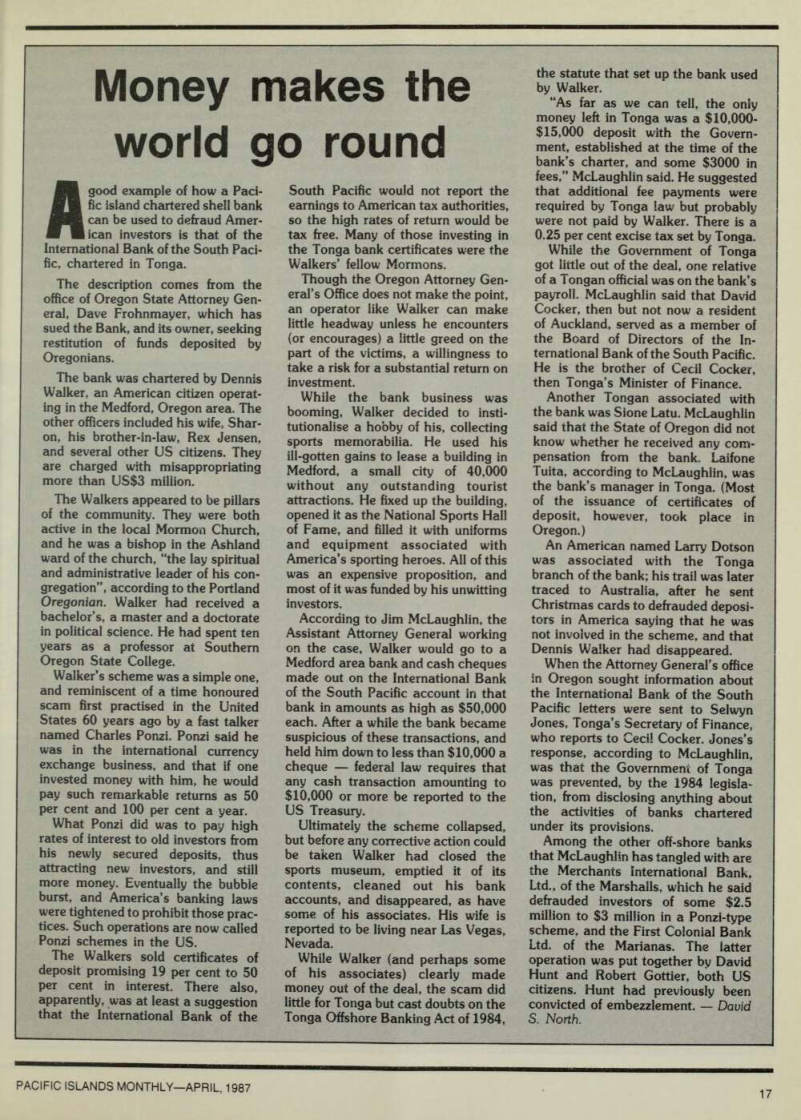
In addition to bilking real banks, the shell banks can be used to defraud individual investors. One such operator, a Morman bishop in Oregon, Dennis Walker, alleged ly used his Tonga banking licence to defraud fellow Oregonians (many of them fellow Mormons) of millions of dollars as he promised them remarkably high interest for their deposits and then absconded with their money.
Similarly, a California family named Pedley set up business in Mexico City after the nation’s banks were nationalised following the drop in oil prices. They defrauded desperate Mexicans of millions of dollars, by offering to convert otherwise frozen pesos into US dollar deposits in a bank in the Marianas.
The Pedleys and Walker are essentially retail operators. But there is at least one wholesaler as well. He is Jerome Schneid er, the principal owner and president of WFI Corporation of Los Angeles. His business, which is legal if not commend able, is to register bank licences in bulk in the islands and then sell these principally to people in the United States.
According to a report by the Permanent Subcommittee on Investigations of the United States Senate, Schneider first used WFI in the 1970’s to “establish corpora tions in the Cayman Islands (in the Caribbean) to resell to clients interested in that island’s tax and secrecy laws.” Later he had to leave the Caymans and moved his activities to nearby St Vincent and Montserrat for similar purposes.
Registration fees reportedly for many of these bank licences cost approximately $lOO each. Then he resold them for as much as $37,000. Back in the States he held conferences for prospective clients, giving them numbered tags rather than name tags to underline the importance of secrecy.
Schneider’s method of operation was simple, according to the Senate report. He looked for people who wanted to own a bank, for whatever reason, and then sold it to them without asking too many ques tions.
The subcommittee report suggested a wide range of motives for people who
wanted to own their own bank. Some had a strong ideological bent, feeling that once they had their own, non-regulated bank they could be independent and make substantial sums of money. Others were interested in tax avoidance, and still others in using the banks to secure money fraudulently.
By January 1982 Schneider, apparently having worn out his welcome in the Caribbean, turned his eyes to the Pacific for new places to licence shell banks. He visited Palau, the Marshalls and the Com monwealth of the Northern Mariana Islands. (CNMI).
According to the Senate report, he liked the CNMI best; “In an interview with (subcommittee) staff Schneider stated that he chose CNMI as his principal Pacific location because of its close ties with the United States and because the government of the CNMI responded well to his proposals to encourage offshore “brass plate” banks. In March, 1982, emergency rules and regulations for licensing of offshore banking corporations were issued by the government of the Marianas . . .
“The regulations provided for capitalisa tion of an off-shore bank with $lO,OOO cash, did not require the owners or operators of an offshore bank to have prior banking experience and provided a certain level of secrecy for the banks’ operations Schneider then incorporated 50 banks, and sold 38 of them. The Marianas bagan to worry about these activities, and subse quently raised the minimum capitalisation to $50,000 and then to $250,000. This apparently has shut off the creation of new shell banks in these islands, but as the story about the Pedleys’ scam in Mexico City shows, much harm had already been done. We asked Chuck Morley, who had been chief investigator for the Senate subcommittee, why the Marianas and most of the Caribbean island governments changed their minds about bank licensing.
“Some tightened their laws because either the (British) Home Office, in the case of some of the Caribbean islands, or the US Government pressured them to do so,” he said. “I think that the subcommittee staff turned around the government of the Marianas on this issue; they had gone into shell bank licensing without much sophistication, and when they saw the results they changed their laws. They wanted to do the right thing.”
Schneider had seen laws change before.
By 1984 he had checked out opportunities elsewhere in the Pacific and was telling his potential customers in a brochure that “Four Pacific islands are quietly emerging as the next major banking/tax haven centres of the world. These ‘Switzerlands of the Pacific’ as they are becoming known are Vanuatu . . . The Marshall Islands . . .
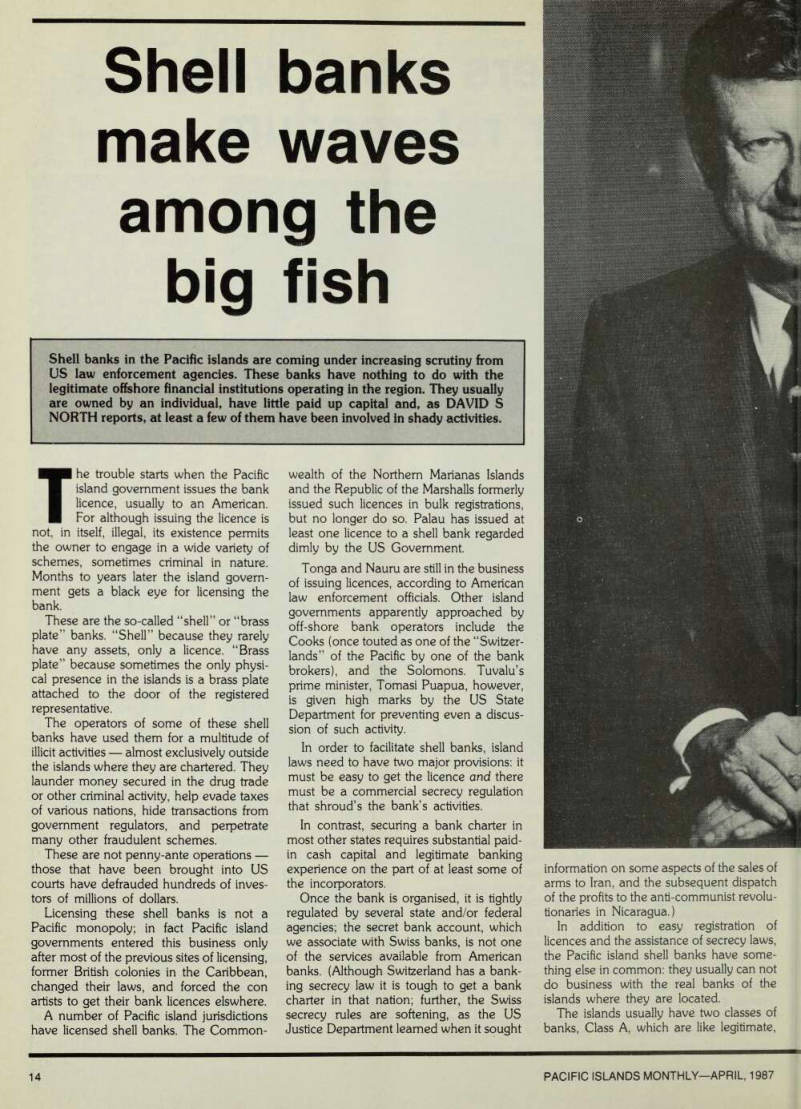
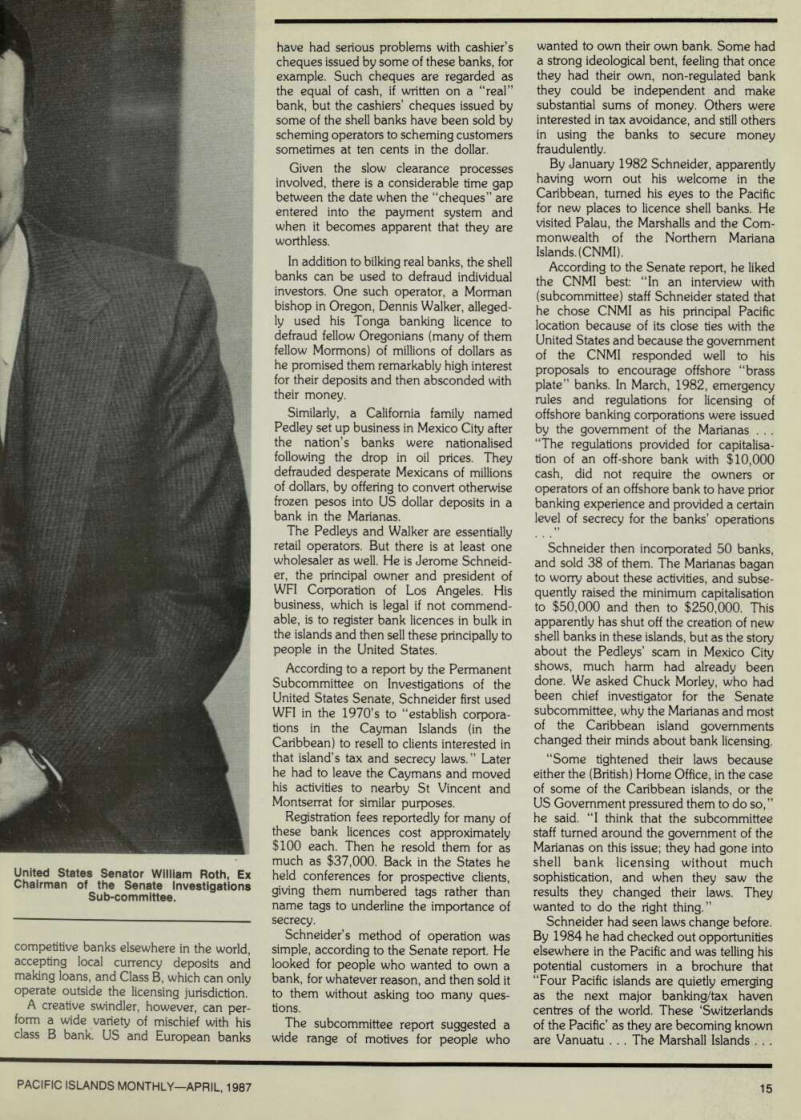
United States Senator William Roth, Ex Chairman of the Senate Investigations Sub-committee.
Naum . . . and the Cook Islands. They offer you the stability and secrecy of Swiss banks, while paying far higher interest. In fact, their banking secrecy laws are stricter and less penetrable than Switzerland’s.”
Several widely scattered American law enforcement agencies have taken action against individual operators of Pacific shell banks. In the Dennis Walker case in Oregon, the state Attorney General, Dave Frohnmayer, sued the bank operator and his Tonga-chartered bank to restore ill gotten funds to defrauded investors. Mean while, in Boston, the United States Attor ney obtained criminal convictions against the Pedley gang, the Californians who had used a Saipan bank charter to defraud millions of dollars from unsuspecting resi dents of Mexico City.
While the prosecutors are working case by case, some people in Washington are approaching the problem on a wholesale basis. They include a number of the US Senate and a federal executive agency, that of the Comptroller of the Currency.
The Senator is William Roth, Republican of Delaware, who has been fascinated with and concerned about off-shore banking for years. During much of this time he was chairman of the previously mentioned Senate Permanent Subcommittee on In vestigations which investigates just about anything, and which chose to spend considerable time and energy on the off-shore banks.
The subcommittee held hearings in 1982 on the subject, but there is hardly a mention of the Pacific. By the late summer of 1985 when it issued another report the one cited earlier in this article there are pages and pages of material on the role of the Pacific islands governments in the licensing of shell banks.
Will the subcommittee continue to pay attention to shell banks? Recently Roth lost his chairmanship (as did all Republicans) because of the Democratic victory in November. The new chair is Senator Sam Nunn (Democrat of Georgia), who also heads the even more prestigious Armed Forces Committee. Since the staff mem bers who did the work on the shell banks have left the subcommittee, it is unlikely that there will be more investigations.
Meanwhile, one of the numerous bank regulating agencies in the U.S. system, the Office of the Comptroller of the Currency, monitors shell bank scams so that it can warn legitimate US banks of the dangers of doing business with these entities. The Comptroller of the Currency, a presidential appointee, is Robert L. Clarke, and his principal staff man on this front is John W.
Shockey, a veteran federal civil servant who has travelled throughout the indepen dent nations of the South Pacific at the request of officials of those countries for Continued on page 18
Continued from page 16 the purpose of explaining the consequences of fraudulent off-shore banking activities.
“I have never known a shell bank to be engaged in legitimate, competitive commercial banking,” he told us. Shockey makes a strong distinction between the shell banks and the legitimate off-shore banks. The former are usually owned by an individual (usually an American citizen), while the latter are owned by established international banking institutions.
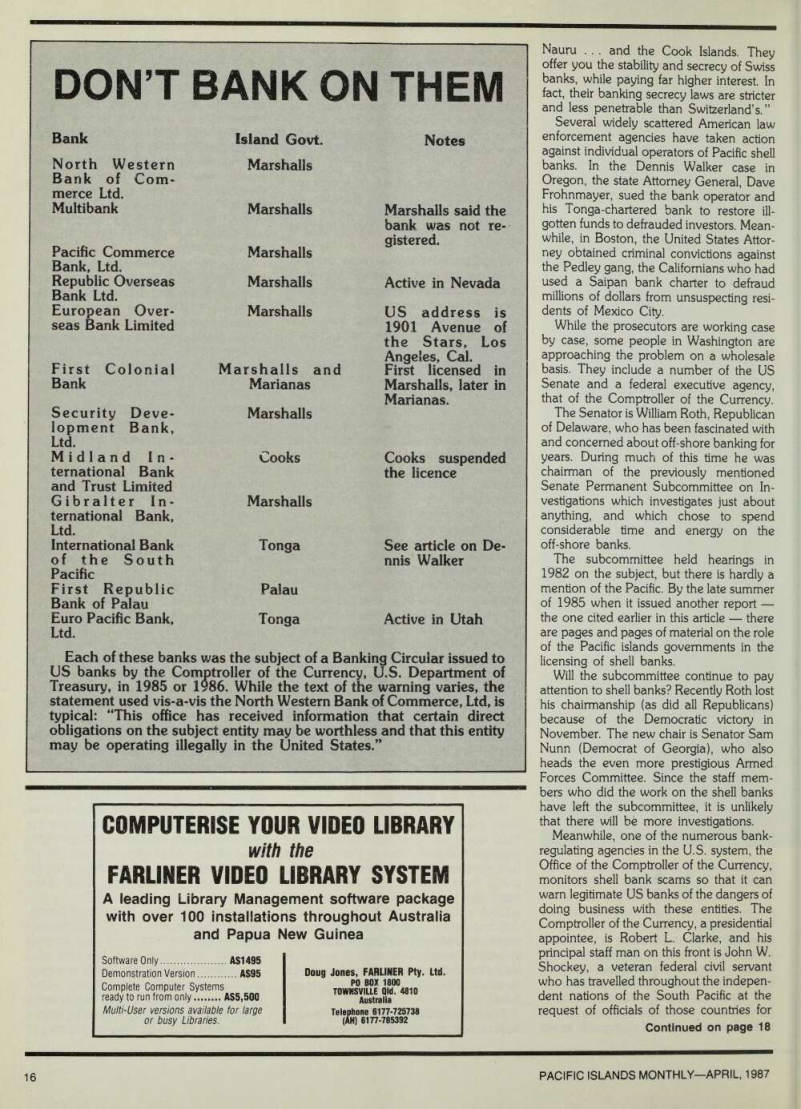
Shockey keeps in touch with other state and federal officials dealing with these cases, and when needed his unit sends out warnings to the legitimate banking community about the shell banks (see box).
Shockey is pressing the idea that there should be a round-table conference of Pacific finance ministers so that an accurate
picture can be presented to them about the shell bank operations.
In Pacific shell bank licencing the first jurisdictions to be approached (CNMI and the Marshalls) were selected because of the US ties their licences must be good, one might argue, because of the presence of a United States connection. But because of these connections, it was possible for the government in Washington to effectively request changes in the bank licensing laws, and the laws were changed.
US ties with the current hotbeds of shell banks, however, are minimal. The United States barely has diplomatic relations with Vanuatu, and certainly has no mission there. The US relates to the Cooks only through New Zealand, and though there are formal relations with Nauru, there is no full-time U.S. presence there either.
An island-by-island review of the status
of shell bank licensing, from the Washing ton viewpoint: n . Ai t •Commonwealth of the Northern f/ a * iana Islands. Once the Pacific headquarters for Jerome Schneider s bank broke^ag e activities, the Commonwealth cease< T to . attractive to shell bank °P era tors in February 1984 when Govf rn ? r Tenono Sl 9 ned a new tougher hanking law. But several swindles had already o n i P j’ as at Merchants Bank and Trust Company in
exico '
• Cook Islands: The picture is not clear on the current status. Schneider’s most recent brochure, according to Chuck Mor ley, still speaks of the Cooks as a “Switzerland of the Pacific” and the islands are known to be very active in offshore banking, generally, but more recently they
cancelled a problem bank charter (see box). • Republic of the Marshall Islands: Another former active licenser of shell banks, including most of those in the Pacific listed by the US Department of Treasury in 1985 and 1986, the Marshalls changed their position in December 1984 when they cancelled the licences of 101 offshore banks (See box). • Nauru: US law enforcement officials say that the Federal Bureau of Investiga tion (FBI) is investigating two or three Nauru-licensed banks, but no formal charges have yet been filed. The US Senate report on shell banks, without stressing the irony, states that (1) Nauru is the smallest and richest independent democracy in the world with phosphate sales annually worth $27,000 “for each
man, woman and child,” and (2) since Nauru has no taxes, it gets only an annual registration fee of $220 for off-shore companies, such as those filed by shell banks. • Palau: Not much is known on Palau’s current practices. Bank broker Jerome Schneider visited Palau, but did no busi ness there. One of the banks on the US Government’s warning list was licensed there. • Tonga: Apparently still issues shell bank licences, and, according to the Oregon State Attorney General’s Office, has not fully co-operated with US enforce ment officials. (For more on Tonga see accompanying story and box). • Solomon Islands: Again, not much is known. No Solomons chartered bank has appeared on the US Treasury’s warning
list, but at least one federal official thinks shell bank licenses can be obtained there. • Vanuatu: This is the only entity on the list that has a government that might remotely be regarded as unfriendly to the US. Although no Vanuatu-chartered banks are on the US Treasury list, it is regarded in Washington as a probable licenser of shell banks, three of which are said to have been used to victimise investors in Indone sia. When Vanuatu’s Foreign Minister, Sela Molisa, was in Washington with Prime Minister Walter Lini, we asked him about bank licensing laws in general and the three alleged shell banks that had been active in Indonesia. He said, during a friendly and open interview, that the shell bank issue was not well known to him, that his nation’s banking laws were complex, and that the three specific banks were not known to him.