Voters must wait
p. 13 · Read in the full issue
for referendum
Guam’s two-part referen dum, on common wealth status and on a budget-cutting propo sal, have been postponed from the scheduled April date until at least June.
The postponement reflected widespread concern that the island was heading for a perhaps needless clash with the mainland Congress over the status question. Guam is not a self-governing territory, and any basic governmental arrangement needs to be negotiated with the Congress, because legally the Congress could impose any system it wanted on the island (although such unilateral action is highly unlikely.) The draft Commonwealth Act, if approved by Guam’s voters, then would have to be submitted to the US Congress for final action. There are seve ral clauses in the draft which mainland observers regard as likely to encounter stiff Con gressional opposition, which might lead to a rejection of the whole document.
Perhaps the most trouble some of these is section 103 of the Act: “(a) The Congress recognises that the indigenous Chamorro people of Guam, who are all those born on Guam before August 1, 1950 and their de scendants, accept Common wealth under United States sovereignty. The Congress fur ther recognises that Common wealth does not limit the pursuit by the Chamorro people of any ultimate status which they may seek in their progress toward fulfillment of their inherent right of self-determination ...”
This clause suggests that, in the future, the Chamorros of Guam (but not all residents or citizens of Guam) can vote to change their status, perhaps to independence. The Congress is regarded as being unlikely to
give a single ethnic group such powers it certainly would run counter to several decades of civil rights legislation which have sought to extend powers to all citizens, and not to restrict them to a single group.
The drafters of the Act, the members of the Commission on Self-Determination, had tried to skate around the prob lem by defining Chamorro as they did basing the definition on Guam birth before a given date rather than using an ethnic definition but the problem remains.
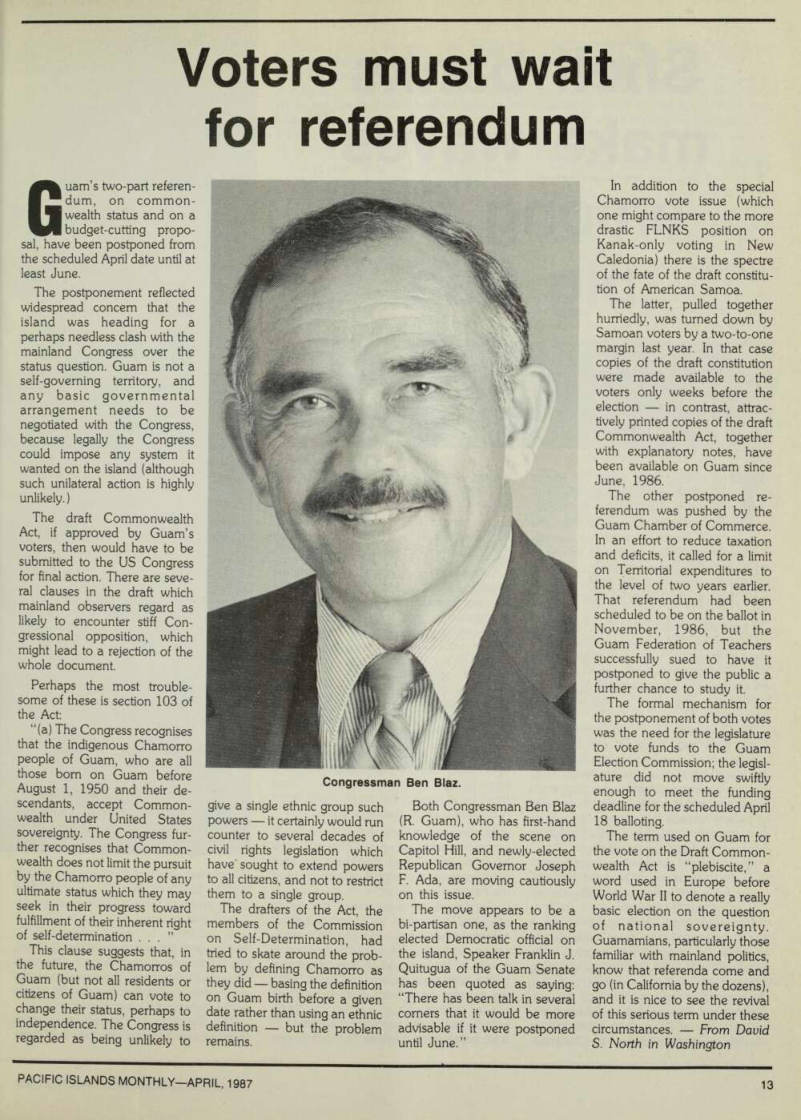
Both Congressman Ben Blaz (R. Guam), who has first-hand knowledge of the scene on Capitol Hill, and newly-elected Republican Governor Joseph F. Ada, are moving cautiously on this issue.
The move appears to be a bi-partisan one, as the ranking elected Democratic official on the island, Speaker Franklin J.
Quitugua of the Guam Senate has been quoted as saying: “There has been talk in several corners that it would be more advisable if it were postponed until June.”
In addition to the special Chamorro vote issue (which one might compare to the more drastic FLNKS position on Kanak-only voting in New Caledonia) there is the spectre of the fate of the draft constitu tion of American Samoa.
The latter, pulled together hurriedly, was turned down by Samoan voters by a two-to-one margin last year. In that case copies of the draft constitution were made available to the voters only weeks before the election in contrast, attrac tively printed copies of the draft Commonwealth Act, together with explanatory notes, have been available on Guam since June, 1986.
The other postponed re ferendum was pushed by the Guam Chamber of Commerce.
In an effort to reduce taxation and deficits, it called for a limit on Territorial expenditures to the level of two years earlier.
That referendum had been scheduled to be on the ballot in November, 1986, but the Guam Federation of Teachers successfully sued to have it postponed to give the public a further chance to study it.
The formal mechanism for the postponement of both votes was the need for the legislature to vote funds to the Guam Election Commission; the legisl ature did not move swiftly enough to meet the funding deadline for the scheduled April 18 balloting.
The term used on Guam for the vote on the Draft Common wealth Act is “plebiscite,” a word used in Europe before World War II to denote a really basic election on the question of national sovereignty.
Guamamians, particularly those familiar with mainland politics, know that referenda come and go (in California by the dozens), and it is nice to see the revival of this serious term under these circumstances. From David S. North in Washington
Congressman Ben Blaz.