pacific report
pp. 6-7 · Read in the full issue
Vanuatu, Soviets
In Fishing Deal
Soviet tunaboats have been given the right to fish in Vanuatu’s EZ under an agreement signed in Port Vila. They will also be given access to shore facilities in the one-year agreement under which Russia will pay US$l.5 million. However, the Soviet fleet will not be permitted to fish in Vanuatu’s 12-mile territorial zone and the Soviet airline Aeroflot will not be given landing rights for crew changes, though officials said this could be consi dered in future agreements. Under the agreement a Soviet fleet of eight vessels will have access to Vanuatu’s 200nautical mile economic zone and will have, at extra cost, access to ports for buying bait and supplies or for repairs. A spokesman for prime minister, Fr Walter Uni, stressed that the agreement was purely commercial and that it helped Vanuatu to exploit one of its major resources, tuna. The United States, Australia and New Zealand had all expressed concern at the agreement.
President Deroburt
Back In Power
President Hammer De Roburt announced his four-man cabinet after being re-elected in Nauru’s second general election in seven weeks. The cabinet is unchanged from that which governed before the second election. Mr •e Robert's group won 11 of the 18 seats in the island’s parliament. After a previous election in early December, both sides held nine seats, leading to a short-lived government led by opposi tion leader Mr Kennan Adeang. Current finance minister Mr Kinze Clodumar was instrumental in bringing down the days old Adeang regime when he crossed the floor to join Mr De Robert’s group.
Soviets ’Will
Increase Influence’
The annual congress of the Australia and New Zealand Association for the Ad vancement of Science was told that the Soviet Union considered itself a Pacific power and that Moscow would in future adopt a more visible posture in the region. Dr Sandy Crosbie, head of the Department of Geography of Edinburgh University in Scotland, told the meeting this could lead to counter actions by the United States. He said the SPNFZ was
generally welcomed by the super-powers as a mechanism to reduce uncertainty in the region in that it could help contain the spread of nuclear weapons to known areas. Dr Crosbie also saw decreased involvement in the region for Australia a trend that bewildered many people outside the region. The reasons, he said, were largely economic, claiming that the small island states would be a continuing charge on Australia for very little return. However, other countries such as Japan recognised the region’s strategic importance and were moving to increase their involvement and influence. ici Aivir\c nm adcd a
Islands Declared A
Disaster Zone
President Reagan declared the islands of American Samoa a disaster zone after Cylone Tusi caused widespread damage, particularly on the outlying island of Tau in the Manu’a chain. The declaration permitted the use of federal funds for relief work and supplies were already on the way from Hawaii. Damage was estimated at US$BO million and medical supplies and doctors were being ferried to the islands to the west of Pago Pago.
Officials said more than a hundred people had been injured and about two thousand left homeless. rnrxT o„ nAI
French Policies
R Indfr Fire
Solomon Islands prime minister, Mr Ezekiel Alebua, strongly criticised the government of France over what he
described as France’s continued colo nial attitude and lack of respect for the interests of Pacific people. Mr Alebua said France was arrogant and reaction ary and had degraded its international image. He said actions such as the expulsion of Australia’s consul-general from New Caledonia only caused more trouble for France which, he said, had failed in its attempts to divert attention from the issues of New Caledonian independence and the nuclear testing program at Moruroa. Mr Alebua said Solomon Islands remained committed to independence for New Caledonia and that Forum leaders were of one mind on the issue. However, former French prime minister, Mr Raymond Barre, told an audience in New Delhi, while on a private visit, that France had a right to conduct tests in the Pacific. He said security had always been France’s aim an d that it had built a nuclear force that cou ld face any threat, cvnci . „
Diplomat Expelled
From New Caledonia
K( .
Australia’s consul-general in New Cale donia, Mr John Dauth, was expelled. No official reason was given, but it was understood that this reflected French anger at Australia’s role in the remsenp tion of the territory with the UN decol onisation committee. French officials said he had been interfering in internal affairs. Australian foreign minister Mr Bill Hayden said Mr Dauth had maintained contact with all groups in New Caledonia as he had been asked to by his department. Mr Hayden said this was normal diplomatic behaviour.
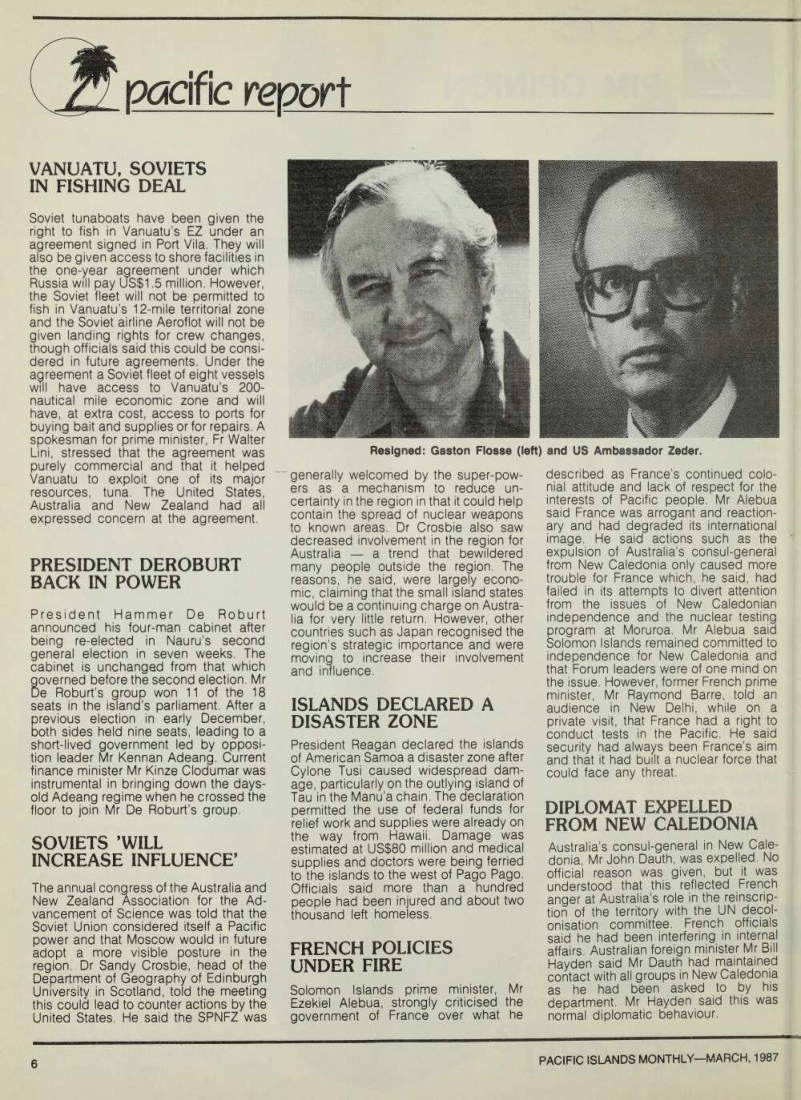
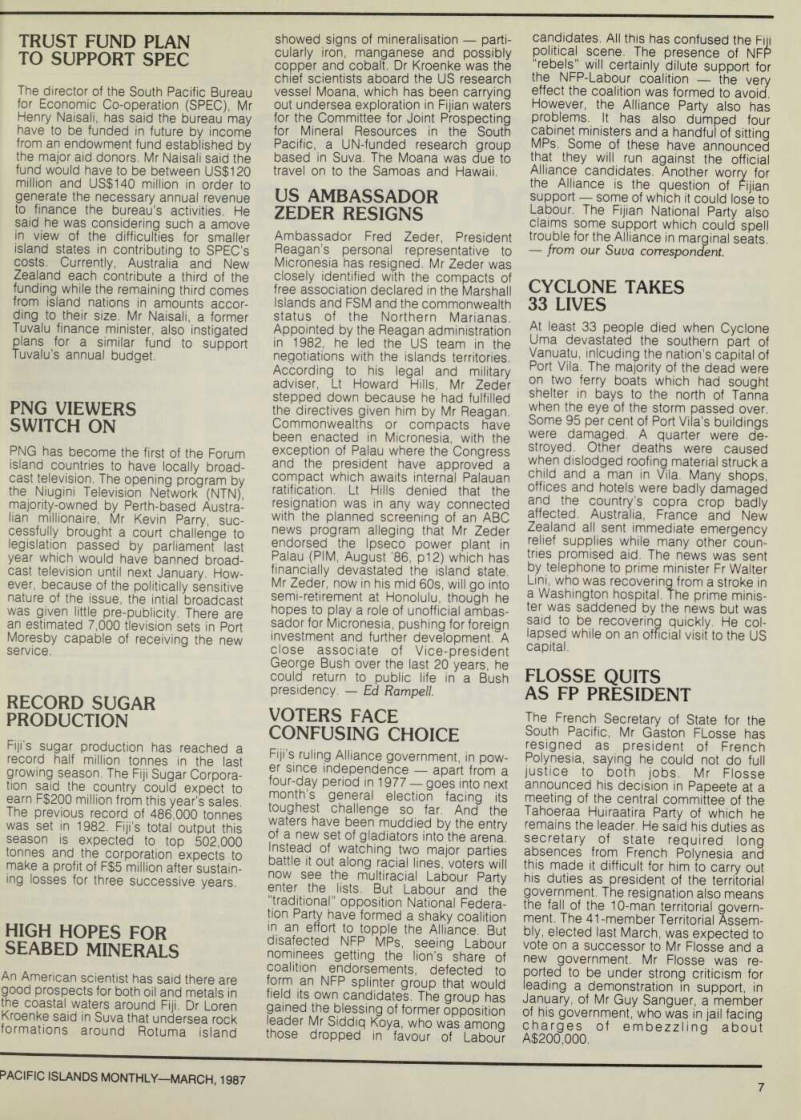
Resigned: Gaston Flosse (left) and US Ambassador Zeder.
Trust Fund Plan
To Support Spec
The director of the South Pacific Bureau for Economic Co-operation (SPEC), Mr Henry Naisali, has said the bureau may have to be funded in future by income from an endowment fund established by the major aid donors. Mr Naisali said the fund would have to be between US$l2O million and US$l4O million in order to generate the necessary annual revenue to finance the bureau’s activities. He said he was considering such a amove in view of the difficulties for smaller island states in contributing to SPEC’s costs. Currently, Australia and New Zealand each contribute a third of the funding while the remaining third comes from island nations in amounts accor ding to their size. Mr Naisali, a former Tuvalu finance minister, also instigated plans for a similar fund to support Tuvalu’s annual budget.
Png Viewers
Switch On
PNG has become the first of the Forum island countries to have locally broad cast television. The opening program by the Niugini Television Network (NTN), majority-owned by Perth-based Austra lian millionaire, Mr Kevin Parry, suc cessfully brought a court challenge to legislation passed by parliament last year which would have banned broad cast television until next January. How ever, because of the politically sensitive nature of the issue, the intial broadcast was given little pre-publicity. There are an estimated 7,000 tlevision sets in Port Moresby capable of receiving the new service,
Record Sugar
Production
Fiji’s sugar production has reached a record half million tonnes in the last growing season. The Fiji Sugar Corpora tion said the country could expect to earn Fs2oo million from this year’s sales.
The previous record of 486,000 tonnes was set in 1982. Fiji's total output this season is expected to top 502,000 tonnes and the corporation expects to make a profit of Fss million after sustain ing losses for three successive years.
High Hopes For
Seabed Minerals
An American scientist has said there are good prospects for both oil and metals in the coastal waters around Fiji. Dr Loren Kroenke said in Suva that undersea rock formations around Rotuma island
showed signs of mineralisation parti cularly iron, manganese and possibly copper and cobalt. Dr Kroenke was the chief scientists aboard the US research vessel Moana, which has been carrying out undersea exploration in Fijian waters for the Committee for Joint Prospecting for Mineral Resources in the South Pacific, a UN-funded research group based in Suva. The Moana was due to travel on to the Samoas and Hawaii.
Us Ambassador
Zeder Resigns
Ambassador Fred Zeder, President Reagan’s personal representative to Micronesia has resigned. Mr Zeder was closely identified with the compacts of free association declared in the Marshall Islands and FSM and the commonwealth status of the Northern Marianas.
Appointed by the Reagan administration in 1982, he led the US team in the negotiations with the islands territories.
According to his legal and military adviser, Lt Howard Hills, Mr Zeder stepped down because he had fulfilled the directives given him by Mr Reagan.
Commonwealths or compacts have been enacted in Micronesia, with the exception of Palau where the Congress and the president have approved a compact which awaits internal Palauan ratification. Lt Hills denied that the resignation was in any way connected with the planned screening of an ABC news program alleging that Mr Zeder endorsed the Ipseco power plant in Palau (PIM, August ’B6, pl 2) which has financially devastated the island state.
Mr Zeder, now in his mid 60s, will go into semi-retirement at Honolulu, though he hopes to play a role of unofficial ambas sador for Micronesia, pushing for foreign investment and further development. A close associate of Vice-president George Bush over the last 20 years, he could return to public life in a Bush presidency. Ed Rampell.
Voters Face
Confusing Choice
Fiji’s ruling Alliance government, in pow er since independence apart from a four-day period in 1977 goes into next month’s general election facing its toughest challenge so far. And the waters have been muddied by the entry of a new set of gladiators into the arena.
Instead of watching two major parties battle it out along racial lines, voters will now see the multiracial Labour Party enter the lists. But Labour and the “traditional” opposition National Federa tion Party have formed a shaky coalition in an effort to topple the Alliance. But disafected NFP MPs, seeing Labour nominees getting the lion’s share of coalition endorsements, defected to form an NFP splinter group that would field its own candidates. The group has gained the blessing of former opposition leader Mr Siddiq Koya, who was among those dropped in favour of Labour
candidates. All this has confused the Fiji political scene. The presence of NFP “rebels” will certainly dilute support for the NFP-Labour coalition the very effect the coalition was formed to avoid.
However, the Alliance Party also has problems. It has also dumped four cabinet ministers and a handful of sitting MPs. Some of these have announced that they will run against the official Alliance candidates. Another worry for the Alliance is the question of Fijian support some of which it could lose to Labour. The Fijian National Party also claims some support which could spell trouble for the Alliance in marginal seats. from our Suva correspondent.
Cyclone Takes
33 Lives
At least 33 people died when Cyclone Uma devastated the southern part of Vanuatu, inlcuding the nation’s capital of Port Vila. The majority of the dead were on two ferry boats which had sought shelter in bays to the north of Tanna when the eye of the storm passed over.
Some 95 per cent of Port Vila’s buildings were damaged. A quarter were de stroyed. Other deaths were caused when dislodged roofing material struck a child and a man in Vila. Many shops, offices and hotels were badly damaged and the country’s copra crop badly affected. Australia, France and New Zealand all sent immediate emergency relief supplies while many other coun tries promised aid. The news was sent by telephone to prime minister Fr Walter Lini, who was recovering from a stroke in a Washington hospital. The prime minis ter was saddened by the news but was said to be recovering quickly. He col lapsed while on an official visit to the US capital.
Flosse Quits
As Ff President
The French Secretary of State for the South Pacific, Mr Gaston FLosse has resigned as president of French Polynesia, saying he could not do full justice to both jobs. Mr Flosse announced his decision in Papeete at a meeting of the central committee of the Tahoeraa Huiraatira Party of which he remains the leader. He said his duties as secretary of state required long absences from French Polynesia and this made it difficult for him to carry out his duties as president of the territorial government. The resignation also means the fall of the 10-man territorial govern ment. The 41-member Territorial Assem bly, elected last March, was expected to vote on a successor to Mr Flosse and a new government. Mr Flosse was re ported to be under strong criticism for leading a demonstration in support, in January, of Mr Guy Sanguer, a member of his government, who was in jail facing charges of embezzling about A 5200,000.