Confrontation: The politics
pp. 10-13 · Read in the full issue
politics of dissent
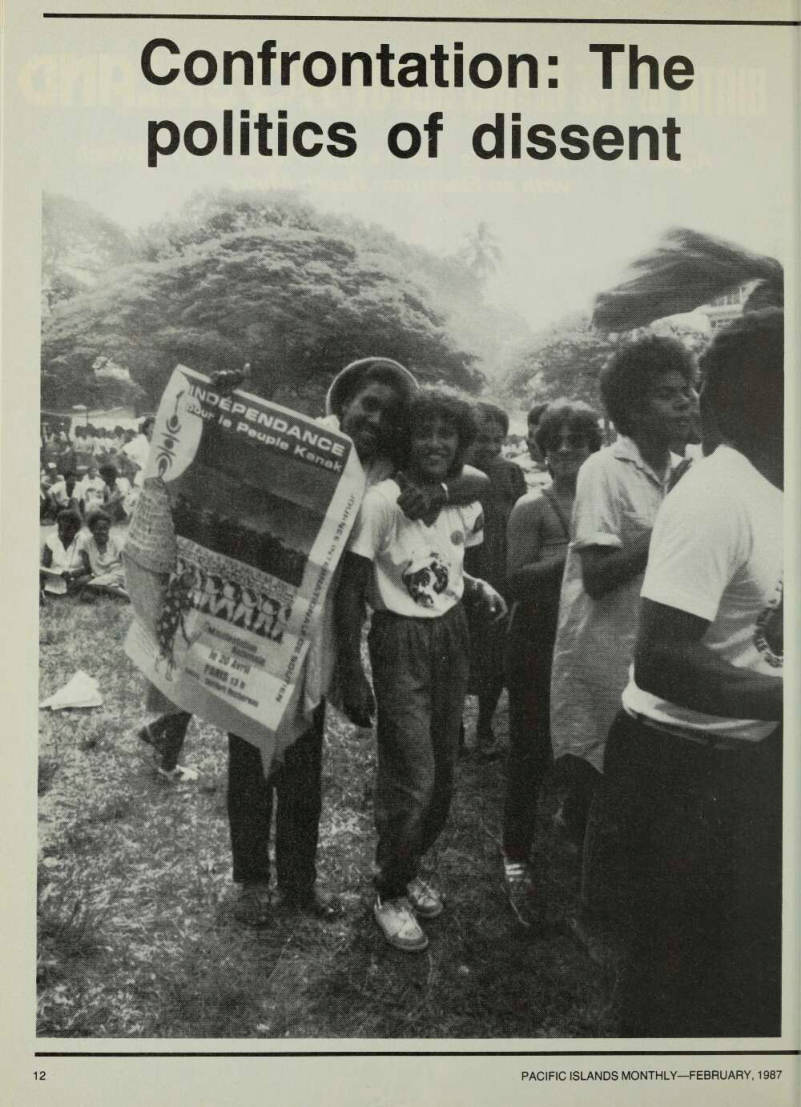
The French government is lining up for direct confrontation with Kanaks and South Pacific Forum states over the issue of independence for New Caledonia. French Overseas Territories Minister Bernard Pons has pushed talks with the FLNKS to the point of rupture, while French tactics at the UN demonstrated the Chirac gov ernment’s ire at international interest in the decolonisation of New Caledonia.
The UN general assembly voted overwhelmingly in De cember (89 votes to 24) in support of the South Pacific Forum resolution to relist New Caledonia with the UN decol onisation committee but the Chirac government has said it won’t co-operate.
The resolution affirmed the inalienable right to self-de termination and independence of the people of New Caledonia and France would now be required to furnish reports to the UN on moves towards self-rule and on the economic and social well-being of New Caledonians.
French Ambassador to the UN, Mr Claude de Kamoularia described the resolution as “un justifiable” but the general assembly vote was hailed as a victory by South Pacific leaders.
Vaunuatu’s Prime Minister Father Walter Lini applauded the vote as “a victory for the people of New Caledonia and the South Pacific against col onialism” and Papua New Guinea PM Paias Wingti said this “major diplomatic triumph” was due to “the tireless efforts by Forum members, especially the spearhead partners” - PNG, Vanuatu and the Solomon Is lands.
New Solomon Islands PM Ezekiel Alebua said the vote was a “landmark achievement in South Pacific diplomacy and regional co-operation”.
The Forum resolution was adopted despite a strong cam paign of economic pressure by France against small UN coun tries likely to support New Cale donia’s relisting. (The territory was originally listed with the decolonisation committee in the general post World War 2 de colonisation push, but was un
laterally withdrawn by France in 1947).
Antigua was threatened with the deferral of a French loan for airport extensions, Zimbabwe was told that the development of a Peugeot plant was at risk, while Nigeria was warned that France would not co-operate with debt rescheduling.
At the same time France circulated a document at the
UN before the vote which strongly attacked the credibility of Australia and New Zealand in an unsuccessful attempt to drive a wedge between these and other Forum members.
The encouragement of migration to New Caledonia by past conservative governments in the face of growing Kanak independence claims is de scribed as the the encourage
ment of “a certain balance among the populations of va rious origins by promoting the development of the early Melanesian settlers as much as that of other ethnic groups so that today the two largest groups are roughly equal in number.” Kanaks are now a minority (43 per cent) in New Caledonia.
The memo condemned Aus
tralia and New Zealand for their treatment of Aborigines and Maoris and declared “Caledo nian society is hence just the opposite of the distorted picture painted by some in order to better serve their own pre judices and interests”.
And speaking during the UN debate on the Forum resolution Ambassador de Kemoularia said Australia and New Zealand had poor records in administer ing multi-racial societies and should refrain from giving les sons to France.
Australian Ambassador to the UN, Mr Richard Woolcott told the General Assembly the French argument that New Caledonia was an integral part of France was “myth and legal fiction”.
Woolcott added that France had previously used the same argument about Algeria and could not indefinitely resist the decolonisation of New Cale donia.
After the vote Mr Chirac warned that his government would not forget Australia’s sponsorship of the UN moves for New Caledonia’s decol onisation - a threat which Aus tralian Foreign Minister Bill Hayden said he took seriously.
Australia told France the document, which refers to Aus tralia as “manipulating and pernicious” was incorrect and insulting and urged France to pursue dialogue and a factual approach to the matter.
Following the UN decision Overseas Territories Minister Pons flew to Noumea for talks with political leaders and to announce new French auton omy plans to be put at next year’s referendum.
The four regional councils would be kept (three are con trolled by the FLNKS at pre sent) but boundaries would be redrawn sources in Noumea said the effect would be to minimise the FLNKS vote and to place key resources and installations in areas under loyalist control.
Pons also announced a 3
i/ear residency requirement for
the referendum in a manoevre ntended to appear as a “a big :oncession to the FLNKS”.
The FLNKS said after leaders met with Mr Pons that this was
unacceptable and that the FLNKS insisted in line with UN resolution 1514 that only the Kanaks as colonised people and perhaps others with one parent born in the territory should take part in the referen dum.
Noumea sources described Mr Pons as having “moved away from seeking compromise to a hard-line position”. The FLNKS announced the rupture of dialogue with Pons and called on President Mitterrand to dismiss him as Overseas Territories Minister.
Spokesman Mr Yeiwene Yeiwene said Pons had become the mouthpiece of the anti independence forces. On his return to the territory FLNKS President Jean-Marie Tjibaou
stressed that dialogue had not been severed with the French Government and that he hoped to deal with “someone less partisan and more serious”.
FLNKS leaders are due to meet with the French government early in 1987 and they are calling for the involvement of UN observations with France on terms and conditions for the referendum.
While in Noumea Pons announced that the referendum would be advanced from July 87 to April 87 in what was seen as a move to hold the poll before the UN decolonisation committee could act. However Pons learned a short time later that the French parliamentary timetable had been changed following the Chirac govem
merit’s strife over the education reform bill — making it more likely the referendum would be held as planned in the middle of the year.
Forum Chairman Ratu Sir Kamisese Mara has written to the decolonisation committtee chairman urging prompt con sideration of the New Caledo nia question when the committ tee of 24 meets this month.
As reports from Paris indicate a slump in popularity of the Chirac government and with more challenges to government plans forecast by student and union movements it appears their New Caledonia policies will only add to the govern
ment’s troubles.
Helen
Fraser.
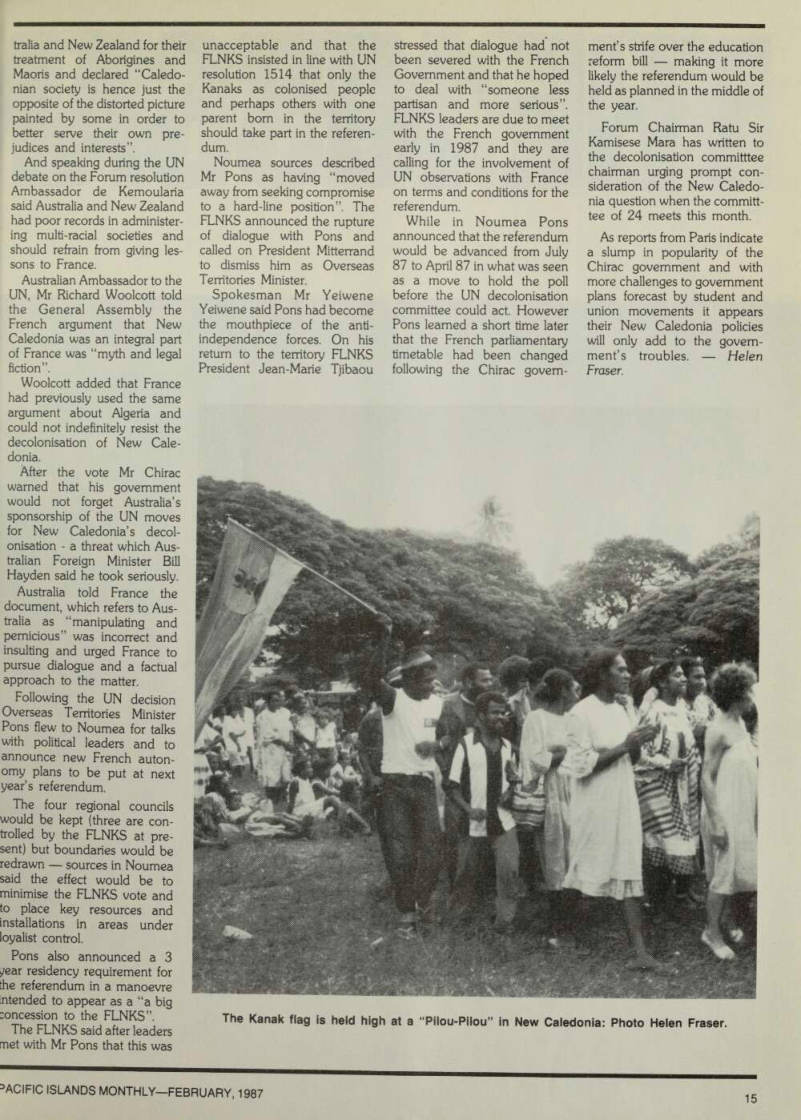
The Kanak flag is held high at a “Pilou-Pilou” in New Caledonia: Photo Helen Fraser.