spending protest
Churchman leads spending protest
Supreme Court judge, Mr Geoffrey Martin, has ruled that the Tongan High Court has jurisdic tion in an action brought by a private citizen against members of parliament (December PIM page 13) for alleged misuse of public money.
The judge said the action by Ipeni Siale raised the issue of whether members of the legisla tive assembly are subject to the court’s jurisdiction.
In a written opinion, he said the court is entitled to ascertain whether there was a collective decision of the house on allow ances. The court can then in vestigate whether the allow ances paid to each member were calculated correctly.
He added that the actions of individual members in claiming and receiving their allowances has nothing to do with the basic functions of the house.
These matters, he said, are open to investigstion by the court and are not subject to parliamentary privilege.
The Siale case is likely to be heard next month.
Interest in the cases is run ning at peak tide in the islands community. At least one Free Wesleyan Church minister has asked the church to take a formal stand.
In the church’s quarterly meeting Dr Mohe Noa Puloka asked the church to endorse and promote a peace and jus tice march to demonstrate the people’s concern for the in tegrity and honesty of their leaders.
That integrity, accepted over the years almost as an article of faith by the majority of the people, is under real scrutiny.
Revelations in the newspaper Kele’a and the two court cases have honed interest to a razor’s
edge. Puloka, who has studied in America and Italy, has argued vigorously from the pul pit against the church remaining silent on the issues.
The Kele’a allegations have devastated many people as traditional Tongan culture teaches abhorrence of disres pect for authority.
“I was taught not to question God in heaven or the nobles on Earth,” said Puloka who was principle of Tupou College for nearly five years.
“That clashes with modem education. As principle I taught kids to think critically. Thinking clashes with the old culture.”
That almost childlike faith in government leaders has been washed away like a sandcastle on the beach.
For example, legislators have been accused of submitting a combination of vouchers to the treasury that were paid to re staurants in Nukualofa. Kele’a was moved to inquire why the “Honourable members of parliament, who led the fonos (public meetings to explain new tax laws) in Tongatapu, slept in restaurants and not in their nice government-paid homes. ”
Puloka and Roman Catholic Bishop Patrick Finau have been the most vocal critics among the religious ranks. Puloka said his whole motivation in speaking
out was his faith “in the life death and resurrection of my lord Jesus Christ”.
He said, “I’m a simple Christ ian pastor. That’s why I’m speaking out.”
However not only the clerics have been voicing their critic isms. The people themselves are becoming disenchanted.
A subsistence farmer on Ton gatapu talked of his frustrations and those of his colleagues.
Short, spare but well muscled through hard physical effort, he grows root crops and other food for his family on his bush allotment. He hopes to augment his small income by growing tomatoes and carrots for sale at the local market.
“People are angry,” he said.
“Prices are high in the market for people who don’t have land. Labour wages are now just four pa’anga (about As 4) a day. That 20 pa’anga doesn’t go very far to buy food for a family,” said the man who requested that his identity be kept secret “Our leaders are supposed to look out for the people. They look out for themselves. People now say bad words when they see these legislators in public.”
Kele’a also published a letter submitted to the police minister requesting his resignation.
The newspaper ran details of
the payment each member re ceived for fonos attended in Tongatapu, Ha’apai and Vava’u. Members were credited for working from 55 to 181 days according to the paper and received sums ranging from P 10.529 to P 1,356. The fonos ran for 12 days.
Total expenses for parlia ment topped $2 million, Kele’a alleged, more than double the government’s expenditure esti mate of $758,000.
Publishing continues to be a booming cottage industry in Tonga. The latest entrant is Ipeni Siale, the plaintiff in one of the court actions. His news paper, called Fetu’uesiafi or Shooting Star, debuted with several analysis articles by staff of the US Peace Centre in Tonga and ’Atenisi College assessing current deve lopments.
The crux of the cases before the Supreme Court is whether or not the parliament is answer able to anyone during its activi ties.
In submissions before Mr Justice Martin, plaintiffs’ lawyer, Laki Niu argued that the Supreme Court has constitutio nal jurisdiction in all cases.
The defendents, however, represented by Auckland-based solicitor Clive Edwards and David Tupou, Tonga’s solicitor general, argued that the legisla ture is operated under par liamentary privilege because of constitutional guarantees.
The controversy will have a significant effect on this month’s people’s representative elec tions. There is a heavy slate of candidates and the allegations against current legislators have not helped their re-election campaigns.
This year marks the 112th year of Tonga as a constitutio nal monarchy. And it is likely to be one of the most significant years in the nation’s rich his tory.
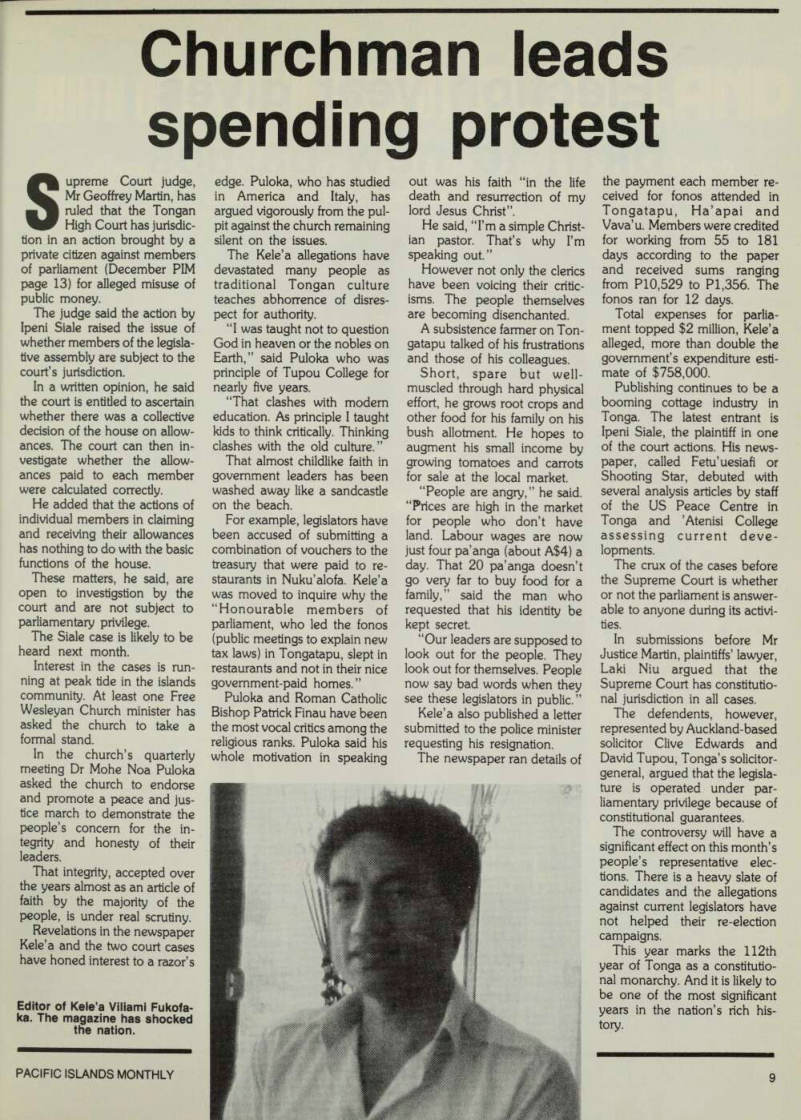
Editor of Kele’a Viliami Fukofa ka. The magazine has shocked the nation.