considerable proportion of the colony’s
p. 45 · Read in the full issue
revenues; that the Government tried, insofar as was consistent with other poli cies, to meet its wishes in regard to labour, land, communications and other matters; that on the local level there were many opportunities for the company’s officers to influence government officials (intentional ly or unintentionally) . . . Still, the extent of the company’s power should not be overestimated . . . The company was interested in its profits, not in running the colony, and was prepared to work within conditions laid down by the Government.
The Government in its turn, recognising the important part played by the Company in the prosperity of Fiji, tried to meet its wishes unless these conflicted with the interest of the colony generally. (Gillion, 1962).
Government assistance in organising native labor for laboring duties, the de spatch of police reinforcements, general concern over the actions of Sanday and the concept of unionism, and the close liaison of CSR officers with colonial offi cials, does not contradict the general thrust of Gillion’s anaylsis. The degree and form of involvement do not demonstrate a superior and inferior partner in this re lationship, and actions appear best inter preted in the light of this perspective.
Commercial interests and government shared a common interest in the preserva tion of law, order and the status quo.
Action was in such joint interests, but one price was an interpretation or frame of reference recognising paternalism as the appropriate form of control of the native population. A further price involved the suppression of individualism and chal lenge, either individual or collective.
Despite conceding general agreement with Gillion, it can be argued that the actions and respones of District Commis sioner Scott, at Lautoka, indicate that, at least the local interface level, a more rigid, or perhaps righteous, acceptance of gov erning in the interests of commercial needs.
In 1916 the linkage between colonial officials and commercial operations in the administration of native affairs for a “com mon good” involved the suppression of “unionism” and associated actions. Later the thrust would change and positive encouragement to unionism would deve lop as the basis of colonial policy.
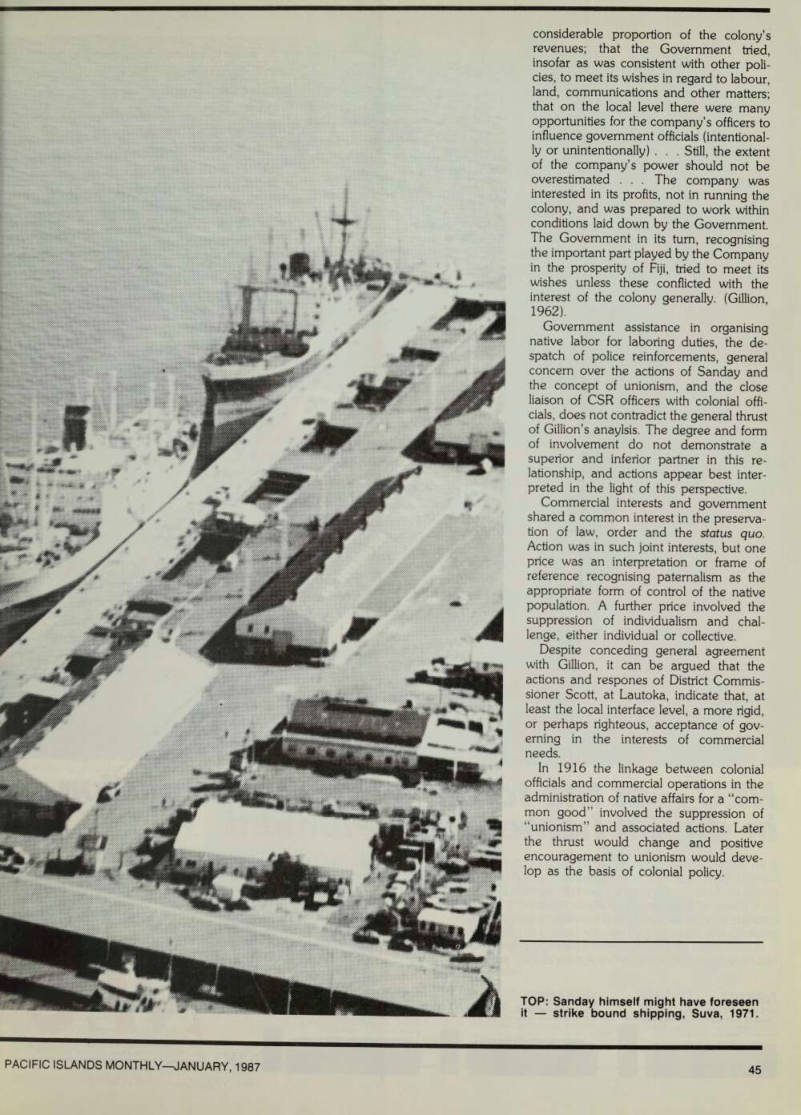
TOP: Sanday himself might have foreseen it - strike bound shipping, Suva, 1971.