mission
pp. 40-44 · Read in the full issue

Man with a mission
Agitator, social reformer, radical, conservative, worthless loafer are all descriptions applied from time to time to Edward Sanday, one of the early trade union organisers in Fiji. In this abridged version of his article from the New Zealand Journal of Industrial Relations, Professor Kevin Hince of Victoria University, Welling ton, traces the history of the man and the controversy that surrounded him.
The old people of Ba, Tavua and Vatukoula remember the name of Edward Sanday. He was not a native Fijian nor an indentured labourer like their ancestors, but they remember him and they, and their chil dren, know his descendents.
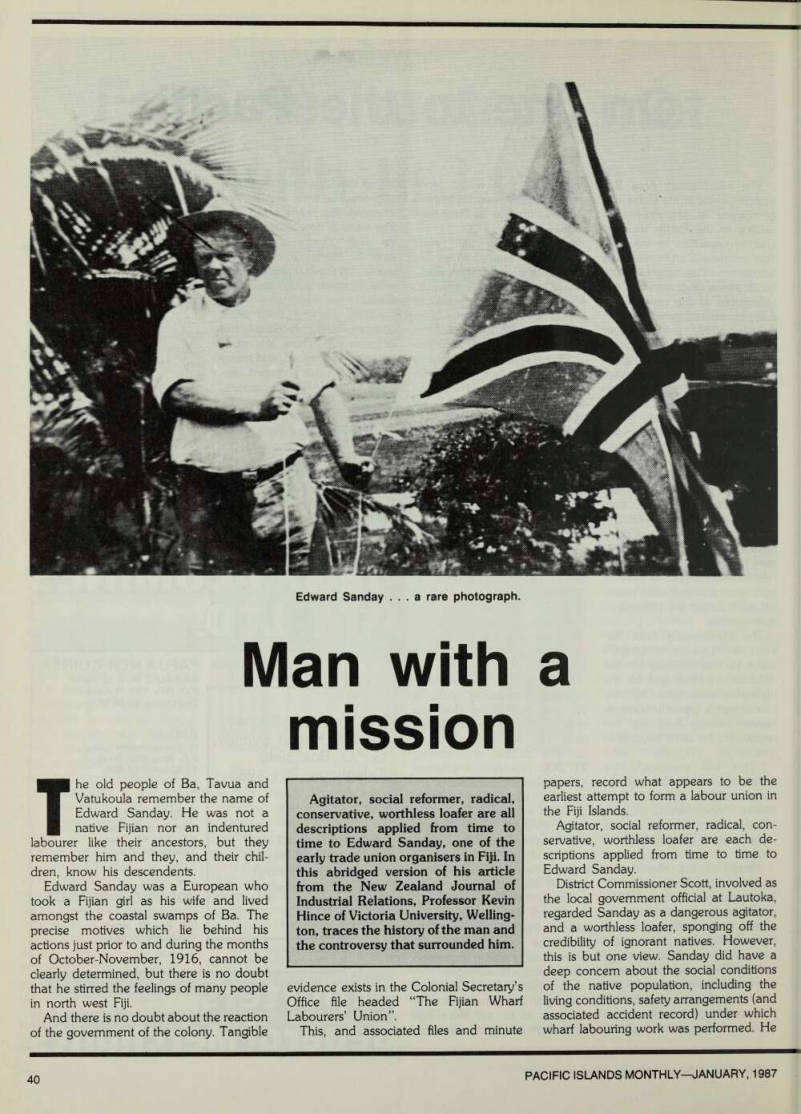
Edward Sanday was a European who took a Fijian girl as his wife and lived amongst the coastal swamps of Ba. The precise motives which lie behind his actions just prior to and during the months of October-November, 1916, cannot be clearly determined, but there is no doubt that he stirred the feelings of many people in north west Fiji.
And there is no doubt about the reaction of the government of the colony. Tangible
evidence exists in the Colonial Secretary’s Office file headed “The Fijian Wharf Labourers’ Union”.
This, and associated files and minute
papers, record what appears to be the earliest attempt to form a labour union in the Fiji Islands.
Agitator, social reformer, radical, con servative, worthless loafer are each de scriptions applied from time to time to Edward Sanday.
District Commissioner Scott, involved as the local government official at Lautoka, regarded Sanday as a dangerous agitator, and a worthless loafer, sponging off the credibility of ignorant natives. However, this is but one view. Sanday did have a deep concern about the social conditions of the native population, including the living conditions, safety arrangements (and associated accident record) under which wharf labouring work was performed. He
Edward Sanday ... a rare photograph.
was also concerned about the abuse of authority?-including the abuse of native custom to create conformity and obedi ence by native labour.
Sanday sought to form a union, a “Fiji Wharf Labourers Union”. He was a member of the Australian Workers’ Union.
However, he placed limits to his radicalism by refusing to accept the association with that “inexpressible 1.W.W.”, and by indi cating that he would only assist the Fijians if they would, “ ... do things in a white man’s way (i.e.) no angry or unpleasant conversations no talk about punching etc. as is their usual old custom”
Personal characteristics of Sanday which are documented in the Colonial Office records suggest that he was born in Fiji of European parentage. Sanday was, in fact, bom in 1884 in the lower Hawkesbury River region of New South Wales. He was christened Edwin, although sometimes cal led Edward.
He joined his father, William Frederick Sanday in Fiji in 1900, and married a Fijian girl in 1908. He worked for the Colonial Sugar Refining Company (CSR) at Labasa and Ba (and had been discharged from the latter), had lived for some time in the Yasawas and was, in late 1916, living with his Fijian wife at the island of Nanuya in the mangroves near Ba.
On 19 October, 1916, a telephone message was received at the office of the Colonial Secretary in Suva from the District Commission, Lautoka, referring to “trouble” among wharf labourers em ployed by CSR and the Union Steamship Company (USS) as a result of “ . . . actions of a man Sanday”. The report suggested that the wharf may be paralysed, that the labourers were forming a union and demanding 4 shillings for an 8 hour day (the then current rate was 3 shillings a day, 5 shillings night plus provisions for a 12 hour day).
A letter from Sanday (dated 26 October, 1916) to the Governor amplified these complaints and demands as: unwhole some and insufficient food, dangerous working conditions, a request for a lean-to (shed), long tables and forms on the wharf as an eating place, and 4 shillings for 8 hours work.
The District Commissioner also asked for an examination of cables by Sanday from Lautoka to Sydney on 17 October, 1916. This request was then made to the acting superintendent of telegraphs, and the text delivered to the colonial secretary.
The relevant cable was addressed, “Secre tary, Trades Hall, Goulbum Street Syd ney”, and read “Have formed Fiji Wharf Labourers Union. Eight Hours. Can I receive recognition. Sanday.”
On 21 October, 1916 Mr Eva, manager of USS, after receiving a telephone report of a “strike of wharf labourers” loading
sugar on the SS Kauri requested govern ment permission to send 50 labourers from Suva to Lautoka on thr government launch Ranadi (which was scheduled to travel there for other reasons). The Colo nial Secretary advised the Governor that such permission be given, provided the USS Company agree to pay passage money.
In such a way the government could, the Colonial Secretary advised, avoid the accusation of giving direct government assistance to employers of labour. The Colonial Secretary also advised that 6 constables under a non-commissioned officer be sent at the same time by that launch, as temporary reinforcements for the Lautoka police. The Governor agreed.
The police on the Ranadi carried arms but no ammunition. Advice communicated to Inspector Stanlake of Lautoka was that the police should exercise care, that their foremost duty was to preserve peace and good order, but that upon “ . . . any glaring violation of the law the ringleaders should be arrested and the remainder dispersed”
On October 23 the District Commission er, Lautoka, advised the Colonial Secre tary by telegram that the ship was working satisfactorily, and everything was quiet.
That same day District Commissioner, Lautoka, advised the Colonial Secretary to place on record his complaints about Edward Sanday. Scott wrote that Sanday approached the SS Kauri when she arrived on the Saturday evening and a section of the Namoli men refused to work. Sanday, so Scott wrote, induced the men from Nadroga village to return to their village without working. Scott had, he states, advised the men to disregard Sanday, to let communal work stand for the time and to work the vessel.
Given the text of the telegram sent by Scott it appears that at this time the advice of the District Commissioner was accepted; although herein, perhaps lies one basis for the accusation by Sanday of an abuse of native customs by the District Commis sioner.
A memorandum titled “Disaffection amongst the Polynesian and Fijian Labour ers at Lautoka”, dated 8 November 1916, was hand delivered from CSR to the Governor. The memorandum indicated that the company had been paying the “Polynesians” 2 shillings a day for the hours worked on the steamers, and that when no vessels were in port some were offered other work under similar condi tions. The company also provided hut sites and paid the associated hut tax.
Sanday had organised workers to de mand 4 shillings per day, the company had offered 3 shillings but the men did not respond due to, the company asserted, Sanday’s influence. The company had
contemplated evicting the labourers from the huts because they were not working, but feared resistance.
Government response was to telegram the District Commissioner, Lautoka, to instruct him to offer his services to the manager of CSR, Lautoka, as a mediator with the “Polynesians. ” The District Com missioner confirmed that he would act accordingly, but the “Solomon Islanders” adhered to their demands.
In response to the telegram from the Colonial Secretary, the District Commis sioner’s offer of assistance was made, and accepted, by Mr Farquhar, Lautoka mana ger of CSR. The men had “scattered” so Scott sent a “tabua” (whale’s tooth) by “mata” (messenger) to the headman of the Solomon Islanders, asking the headman to come to see Scott the following day. The Bilosi (headman) and 6 others came.
Yagona was presented and Scott pointed out that it was best to work for 3 shillings a day (ss-6d a night), and referred to the threat of eviction. The Bilosi, according to Scott, was prepared to accept but stated a need to see his people.
Sanday, at this time, wrote to Scott asking the (rhetorical) question, “. . . why are you employing so much of the Government time trying to coerce Fijians ... to work for CSR Company 12 hours on the wharf . . ~” and complaining that it was not etiquette for a European to use the tabua.
District Commissioner Scott, clearly took the charges laid by Sanday seriously and sought to defend his position. Firstly, in response to a query as to whether Scott would be prejudiced if he had to act as a magistrate in cases against strikers, he responded that he would not be so influenced, and he did not believe it was necessary to assign another District Com missioner for such hearings. Second, he attacked Sanday personally (worthless loafer, dangerous agitator, etc.), and argued that actions such as Sanday had taken were undermining the confidence of the natives in the administration and were detrimental to the general peace and good order.
Immediately the “trouble” began the possibility of deporting Sanday was consi dered, but when information received indicated that Sanday was Fiji bom this course of action was abandoned. It is, of course, ironic, in retrospect, to ponder on this error of information. Deportation is one of the operational tools utilised by a colonial government whereby a threatened disturbance to the status quo could be minimised. Invocation of existing legislative controls, the involvement of the police and discussion of legislative change were other such means involved in this particular case.
The possibility of using Ordinance 1 of 1875 was discussed in memoranda invol ving the Attorney General, Colonial Secre
tary and the Governor. Section 3 of that ordinance provided power for the Governor to act where he considered an individual, “... commits acts dangerous to the peace and good order of the colony. ”
Section 5 enabled the Governor, in such circumstances, to prohibit a person residing in a particular district or districts.
While Ordinance 1 powers were not utilised in this instance, it was realised such powers were limited to the control of individuals (perhaps leaders), but not necessarily capable to controlling collective action. Hence discussion of potential legislative change. In this context the Attomey General advised the Colonial Secretary that there were no provisions under existing law to deal with the type of labour “troubles” which had arisen on the waterfront at Lautoka. Under existing legislation it was necessary to wait until Sanday (“or his co-agitators”), threaten or intimidate others or cause a breach of the peace. And it was this advice which was carried to Lautoka by the non-commissioned police officer sent on board the
Ranadi.
Seteriki Nasoki was a retired Buli of Namoli Village. He was alleged to have given support, in lodgings and in encouraging native following, to Edward Sanday.
Sanday, had alleged that District Commissioner Scott dismissed Seteriki, . . from government service as the Turaga Ni Koro of Namoli because I was staying in his home ... if I (Sanday) came near his house to chase me away ...” and threatened to write the Governor to cancel his (Seteriki’s) pension. Seteriki confirmed this position.
The District Commissioner’s view of events differed: he claimed he did not dismiss Seteriki, for this occurred at a district council meeting, nor did he tell him the pension would be stopped, but had simply asserted that as Seteriki was receiving a government pension he should be loyal to the District Commissioner, and do as advised by him.
Despite our general knowledge of the role and influence of District Commission-
ers at district council meetings, the matter outlined could be regarded as simply varying perceptions of a position. But not in this instance, for Scott had written to the Colonial Secretary on 3 November, 1916, asserting that Seteriki Nasoki was Sanday’s strongest support and was doing his best to upset labour conditions despite Scott’s warnings. Scott wrote; “I submit that it would have a salutary effect if this man’s pension was discontinued: he received his pension practically ex gratia on my recom mendation to the Hon. the Secretary for Native Affairs.”
An investigation of the allegations, coun ter allegations, and of the issue raised in this letter was conducted by the Secretary of Native Affairs, and the Colonial Secre tary, and the final advice which was accepted and acted upon was that Scott be advised that the complaints against him were “unfounded.” Further, that Sanday be advised that the Governor was unable to view with favour any organisation among Fijians, that there were existing channels for handling complaints, and that
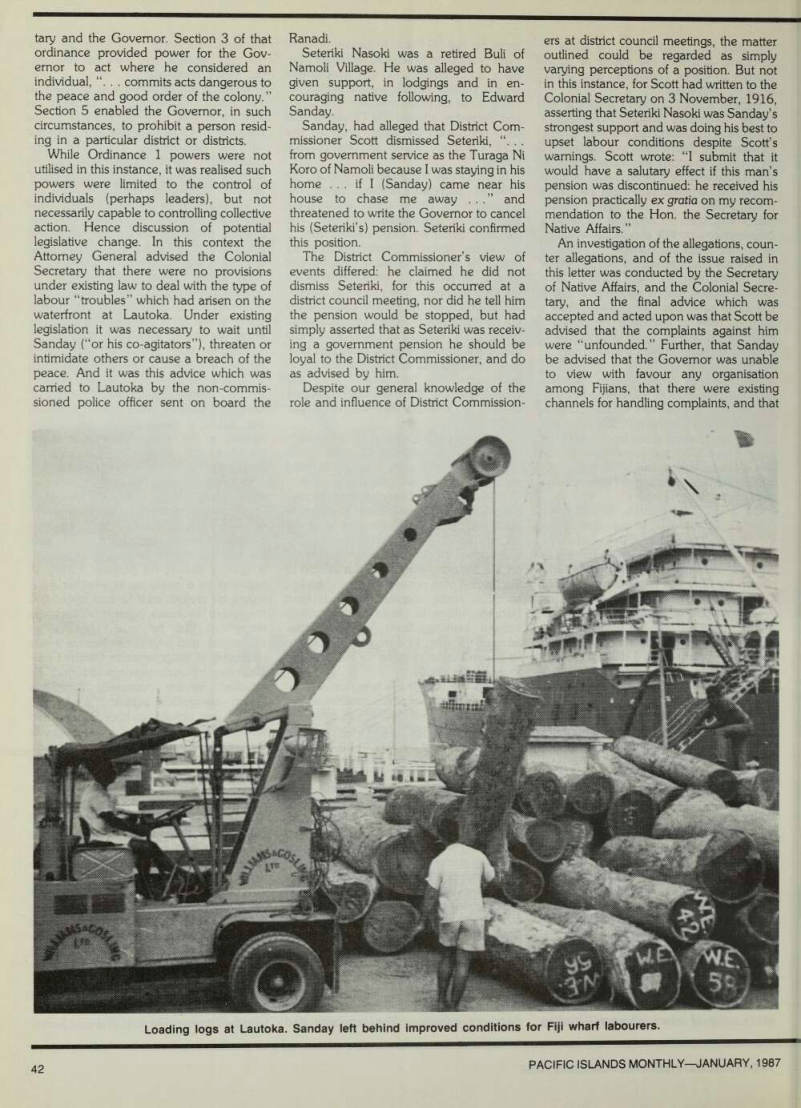
Loading logs at Lautoka. Sanday left behind improved conditions for Fiji wharf labourers.
the Governor believed that this was not the time for “fomenting dissatisfaction,” “de precate (d) any action which may lead to strikes and to disturbance,” and that the action taken by Sanday was “. . . danger ous to the peace and order of the colony. ”
Later, Seteriki was advised that his pension had been granted in the usual way, and there were not sufficient grounds to withdraw that pension.
Associated with these events is the notion of a union. The name Fiji Wharf Labourers Union has been referred to; Sanday has been named as and has claimed to be the organiser, and he had made contact with the Australian trade union movement. Demands and threats were made in mid-October (and the Ranadi with labourers and police was sent to Lautoka), and further troubles (the withdrawal of labour by the Solomon Islanders and the intervention of the District Commissioner) occurred in early November.
Sanday registered (and appears to have been motivated by) concern with the condition of work on the wharf, in terms of both exploitation and safe working . .
Black Slavery . . . carried on here at CSR Company’s and USS Company’s wharf,” . . toiling 12 hours . . ~” . . been several Fijian and Solomon boys killed or crippled for life.”
Sanday asserted that Fijians at Namoli asked him about the principles and found ations of a union to defend British rights, and had begged him to be organiser.
District Commissioner Scott’s interpreta tion is quite different, but the attempt to organise and cause disruption of work tasks is common to both views.
The reality or the unreality of the conditions of work, the validity or invalidity of positions at the time, need not be debated. It is clear that beliefs, either felt by the natives or articulated by Sanday, provided a basis for the actions. And disturbances and collective action occurred as a result.
The notion of a “union” subscription is implied in the context of a 10 shilling entrance fee payable to Sanday. His role as a “paid organiser” is implied in refer ences to his followers giving him four shillings per week “. . .to endeavour to get their pay raised”. Such monetary amounts were also a basis for allegations by District Commissioner Scott, that San day was “feathering his own nest”.
The reaction to “unionisation” included sending additional labour, sending police reinforcements, examining the possibility of deporting or restricting the movement of leaders, awaiting the “false” move or “threat” or “intimidation” by leaders, the examination of all existing legislative con trols, and the consideration of new legisla tion.
In the final context the recognition of a new dimension of labour problems the union is best illustrated by the com munications between CSR management and government, and the meeting and discussions between Hedstrom, H. M.
Scott, the Governor and the Attorney General.
Before concluding this discussion, which has highlighted the concept of “union” within the totality of actions of the period, it is interesting, if not imperative, to mention two other items.
First, Sanday’s membership of the AWU an his expressed horror at the possible association of his name with the IWW have been mentioned. In the same minute paper (dated October 20, 1916) in which the Colonial Secretary discusses Sanday’s union membership there is a reference stating that: “Mr Eva mentioned to me (the Colonial Secretary) that there is a Mr McMillan in Suva who is supposed to be an agent for the Australian Worker’s Union”.
McMillan, however, whilst he was en route to Sydney, carried documents of U.S. citizenship. Given such identification, the time period and Sanday’s gratuitous reference, it is possible that McMillan was a representative or member of the IWW rather than the AWU, and that his pre sence in Fiji is coincidental. Although the link is far too tenuous to suggest other than a need for further investigation, it is interesting to note the reference in lan Turner’s Sydneys Burning to a Tom McMillan organising for the IWW in West ern Australia in 1914.
Second, in his letter of November 11, 1916 Sanday, inter alia, warns of trouble which might take place, “. . .if the head office of CSR company in Sydney does not abide by our reasonable demands”. The lack of confidence in local management, the conviction that authority lay offshore was to be a continual feature of labour relations in the sugar industry, waterfront, and later other industries (oil, airlines, travel, etc.) in Fiji. Similar concern has also emerged in more sophisticated industrial relations systems where transnational corporations operate.
Reactions to the beginnings of labour troubles and union activity reflect the relationship between commercial interests and the colonial government, and the style and process of colonial government when under challenge.
Gillion assesses the relationship of the CSR company to the colonial government, in or about this period, in the following terms: . . . the role of the CSR company in the determination of the policy of the Fiji Government was undoubtedly an impor tant role, although it was not as great as popularly believed in Fiji today to have been. It is true that the company was directly or indirectly responsible for a