Bad news for the Nius
p. 55 · Read in the full issue
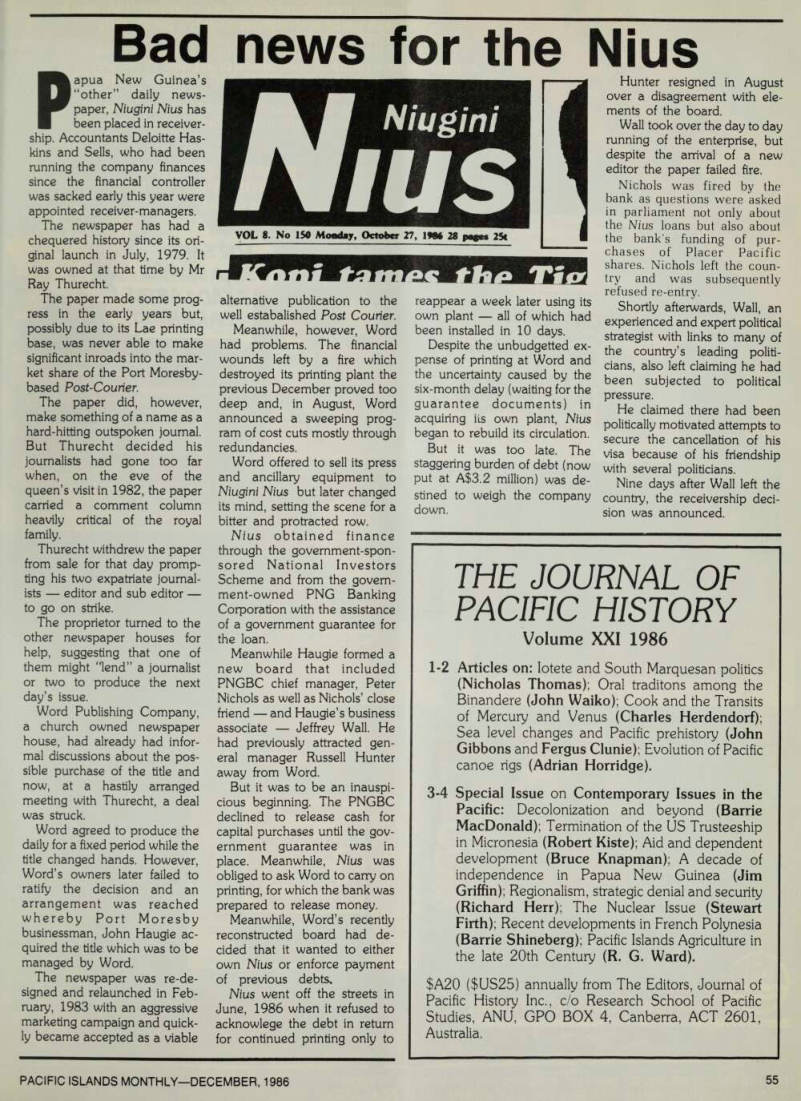
Papua New Guinea’s “other” daily news paper, Niugini Nius has been placed in receiver ship. Accountants Deloitte Has kins and Sells, who had been running the company finances since the financial controller was sacked early this year were appointed receiver-managers.
The newspaper has had a chequered history since its ori ginal launch in July, 1979. It was owned at that time by Mr Ray Thurecht.
The paper made some prog ress in the early years but, possibly due to its Lae printing base, was never able to make significant inroads into the mar ket share of the Port Moresby based Post-Courier.
The paper did, however, make something of a name as a hard-hitting outspoken journal.
But Thurecht decided his journalists had gone too far when, on the eve of the queen’s visit in 1982, the paper carried a comment column heavily critical of the royal family.
Thurecht withdrew the paper from sale for that day promp ting his two expatriate journal ists editor and sub editor to go on strike.
The proprietor turned to the other newspaper houses for help, suggesting that one of them might “lend” a journalist or two to produce the next day’s issue.
Word Publishing Company, a church owned newspaper house, had already had infor mal discussions about the pos sible purchase of the title and now, at a hastily arranged meeting with Thurecht, a deal was struck.
Word agreed to produce the daily for a fixed period while the title changed hands. However, Word’s owners later failed to ratify the decision and an arrangement was reached whereby Port Moresby businessman, John Haugie ac quired the title which was to be managed by Word.
The newspaper was re-de signed and relaunched in Feb ruary, 1983 with an aggressive marketing campaign and quick ly became accepted as a viable
alternative publication to the well estabalished Post Courier.
Meanwhile, however, Word had problems. The financial wounds left by a fire which destroyed its printing plant the previous December proved too deep and, in August, Word announced a sweeping prog ram of cost cuts mostly through redundancies.
Word offered to sell its press and ancillary equipment to Niugini Nius but later changed its mind, setting the scene for a bitter and protracted row.
Nius obtained finance through the government-spon sored National Investors Scheme and from the govern ment-owned PNG Banking Corporation with the assistance of a government guarantee for the loan.
Meanwhile Haugie formed a new board that included PNGBC chief manager, Peter Nichols as well as Nichols’ close friend and Haugie’s business associate Jeffrey Wall. He had previously attracted gen eral manager Russell Hunter away from Word.
But it was to be an inauspi cious beginning. The PNGBC declined to release cash for capital purchases until the gov ernment guarantee was in place. Meanwhile, Nius was obliged to ask Word to carry on printing, for which the bank was prepared to release money.
Meanwhile, Word’s recently reconstructed board had de cided that it wanted to either own Nius or enforce payment of previous debts, Nius went off the streets in June, 1986 when it refused to acknowlege the debt in return for continued printing only to
reappear a week later using its own plant all of which had been installed in 10 days.
Despite the unbudgetted ex pense of printing at Word and the uncertainty caused by the six-month delay (waiting for the guarantee documents) in acquiring its own plant, Nius began to rebuild its circulation.
But it was too late. The staggering burden of debt (now put at A 53.2 million) was de stined to weigh the company down.
Hunter resigned in August over a disagreement with ele ments of the board.
Wall took over the day to day running of the enterprise, but despite the arrival of a new editor the paper failed fire.
Nichols was fired by the bank as questions were asked in parliament not only about the Nius loans but also about the bank's funding of pur chases of Placer Pacific shares. Nichols left the coun try and was subsequently refused re-entry.
Shortly afterwards, Wall, an experienced and expert political strategist with links to many of the country’s leading politi cians, also left claiming he had been subjected to political pressure.
He claimed there had been politically motivated attempts to secure the cancellation of his visa because of his friendship with several politicians.
Nine days after Wall left the country, the receivership deci sion was announced.