New team for Henderson
p. 54 · Read in the full issue
Henderson
Henderson Island, Pit cairn’s uninhabited de pendency, will be the subject of a full scale bi-national study in February.
The scientific survey will be jointly sponsored by the USA’s Smithsonian Institute and Bri tain’s Royal Society.
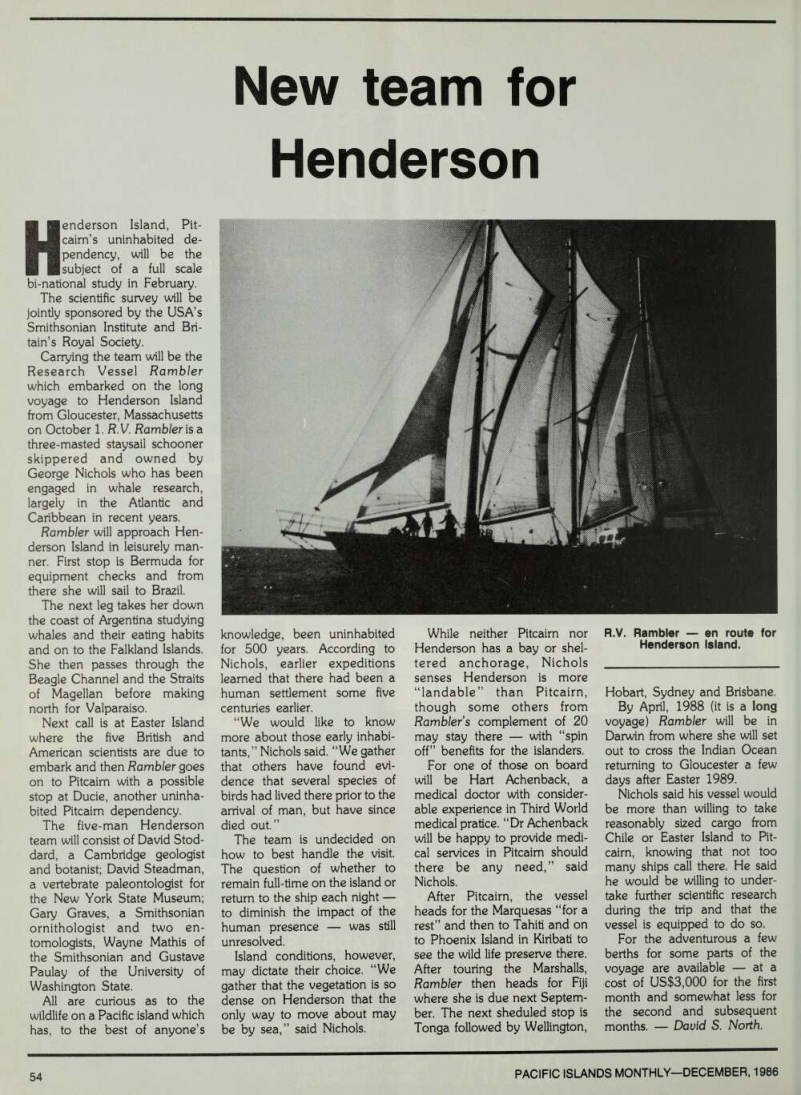
Carrying the team will be the Research Vessel Rambler which embarked on the long voyage to Henderson Island from Gloucester, Massachusetts on October 1. R.V. Rambler is a three-masted staysail schooner skippered and owned by George Nichols who has been engaged in whale research, largely in the Atlantic and Caribbean in recent years.
Rambler will approach Hen derson Island in leisurely man ner. First stop is Bermuda for equipment checks and from there she will sail to Brazil.
The next leg takes her down the coast of Argentina studying whales and their eating habits and on to the Falkland Islands.
She then passes through the Beagle Channel and the Straits of Magellan before making north for Valparaiso.
Next call is at Easter Island where the five British and American scientists are due to embark and then Rambler goes on to Pitcairn with a possible stop at Ducie, another uninha bited Pitcairn dependency.
The five-man Henderson team will consist of David Stod dard, a Cambridge geologist and botanist; David Steadman, a vertebrate paleontologist for the New York State Museum; Gary Graves, a Smithsonian ornithologist and two en tomologists, Wayne Mathis of the Smithsonian and Gustave Paulay of the University of Washington State.
All are curious as to the wildlife on a Pacific island which has, to the best of anyone’s
knowledge, been uninhabited for 500 years. According to Nichols, earlier expeditions learned that there had been a human settlement some five centuries earlier.
“We would like to know more about those early inhabi tants,” Nichols said. “We gather that others have found evi dence that several species of birds had lived there prior to the arrival of man, but have since died out.”
The team is undecided on how to best handle the visit.
The question of whether to remain full-time on the island or return to the ship each night to diminish the impact of the human presence was still unresolved.
Island conditions, however, may dictate their choice. “We gather that the vegetation is so dense on Henderson that the only way to move about may be by sea,” said Nichols.
While neither Pitcairn nor Henderson has a bay or shel tered anchorage, Nichols senses Henderson is more “landable” than Pitcairn, though some others from Rambler’s complement of 20 may stay there with “spin off” benefits for the islanders.
For one of those on board will be Hart Achenback, a medical doctor with consider able experience in Third World medical pratice. “Dr Achenback will be happy to provide medi cal services in Pitcairn should there be any need,” said Nichols.
After Pitcairn, the vessel heads for the Marquesas “for a rest” and then to Tahiti and on to Phoenix Island in Kiribati to see the wild life preserve there.
After touring the Marshalls, Rambler then heads for Fiji where she is due next Septem ber. The next sheduled stop is Tonga followed by Wellington,
Hobart, Sydney and Brisbane.
By April, 1988 (it is a long voyage) Rambler will be in Darwin from where she will set out to cross the Indian Ocean returning to Gloucester a few days after Easter 1989.
Nichols said his vessel would be more than willing to take reasonably sized cargo from Chile or Easter Island to Pit cairn, knowing that not too many ships call there. He said he would be willing to under take further scientific research during the trip and that the vessel is equipped to do so.
For the adventurous a few berths for some parts of the voyage are available at a cost of US$3,OOO for the first month and somewhat less for the second and subsequent
months.
David S. North.
R.V. Rambler - en route for Henderson Island.