Libya training
p. 16 · Read in the full issue
‘not a good idea’
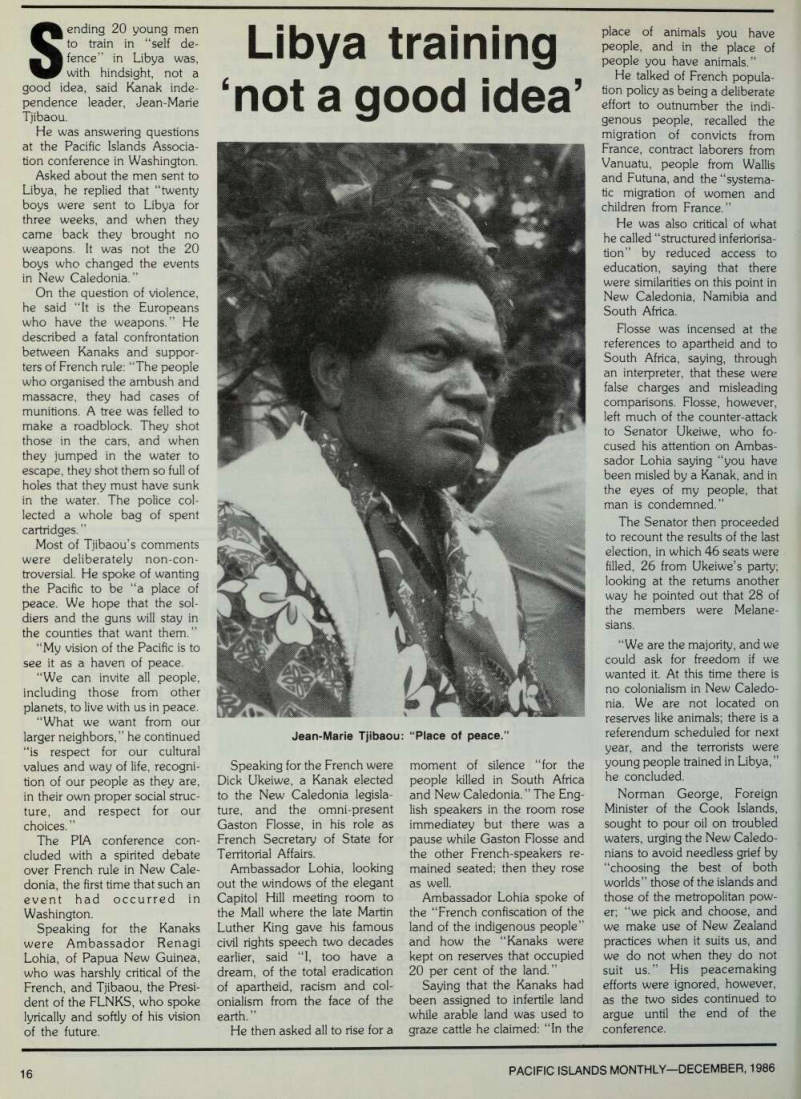
Sending 20 young men to train in “self de fence” in Libya was, with hindsight, not a good idea, said Kanak inde pendence leader, Jean-Marie Tjibaou.
He was answering questions at the Pacific Islands Associa tion conference in Washington.
Asked about the men sent to Libya, he replied that “twenty boys were sent to Libya for three weeks, and when they came back they brought no weapons. It was not the 20 boys who changed the events in New Caledonia.”
On the question of violence, he said “It is the Europeans who have the weapons.” He described a fatal confrontation between Kanaks and suppor ters of French rule: “The people who organised the ambush and massacre, they had cases of munitions. A tree was felled to make a roadblock. They shot those in the cars, and when they jumped in the water to escape, they shot them so full of holes that they must have sunk in the water. The police col lected a whole bag of spent cartridges.”
Most of Tjibaou’s comments were deliberately non-con troversial. He spoke of wanting the Pacific to be “a place of peace. We hope that the sol diers and the guns will stay in the counties that want them.”
“My vision of the Pacific is to see it as a haven of peace.
“We can invite all people, including those from other planets, to live with us in peace.
“What we want from our larger neighbors,” he continued “is respect for our cultural values and way of life, recogni tion of our people as they are, in their own proper social struc ture, and respect for our choices.”
The PIA conference con cluded with a spirited debate over French rule in New Cale donia, the first time that such an event had occurred in Washington.
Speaking for the Kanaks were Ambassador Renagi Lohia, of Papua New Guinea, who was harshly critical of the French, and Tjibaou, the Presi dent of the FLNKS, who spoke lyrically and softly of his vision of the future.
Speaking for the French were Dick Ukeiwe, a Kanak elected to the New Caledonia legisla ture, and the omni-present Gaston Flosse, in his role as French Secretary of State for Territorial Affairs.
Ambassador Lohia, looking out the windows of the elegant Capitol Hill meeting room to the Mall where the late Martin Luther King gave his famous civil rights speech two decades earlier, said “I, too have a dream, of the total eradication of apartheid, racism and col onialism from the face of the earth.”
He then asked all to rise for a
moment of silence “for the people killed in South Africa and New Caledonia. ” The Eng lish speakers in the room rose immediatey but there was a pause while Gaston Flosse and the other French-speakers re mained seated; then they rose as well.
Ambassador Lohia spoke of the “French confiscation of the land of the indigenous people” and how the “Kanaks were kept on reserves that occupied 20 per cent of the land.”
Saying that the Kanaks had been assigned to infertile land while arable land was used to graze cattle he claimed: “In the
place of animals you have people, and in the place of people you have animals.”
He talked of French popula tion policy as being a deliberate effort to outnumber the indi genous people, recalled the migration of convicts from France, contract laborers from Vanuatu, people from Wallis and Futuna, and the “systema tic migration of women and children from France.”
He was also critical of what he called “structured inferiorisa tion” by reduced access to education, saying that there were similarities on this point in New Caledonia, Namibia and South Africa.
Flosse was incensed at the references to apartheid and to South Africa, saying, through an interpreter, that these were false charges and misleading comparisons. Flosse, however, left much of the counter-attack to Senator Ukeiwe, who fo cused his attention on Ambas sador Lohia saying “you have been misled by a Kanak, and in the eyes of my people, that man is condemned.”
The Senator then proceeded to recount the results of the last election, in which 46 seats were filled, 26 from Ukeiwe’s party; looking at the returns another way he pointed out that 28 of the members were Melane sians.
“We are the majority, and we could ask for freedom if we wanted it. At this time there is no colonialism in New Caledo nia. We are not located on reserves like animals; there is a referendum scheduled for next year, and the terrorists were young people trained in Libya,” he concluded.
Norman George, Foreign Minister of the Cook Islands, sought to pour oil on troubled waters, urging the New Caledo nians to avoid needless grief by “choosing the best of both worlds” those of the islands and those of the metropolitan pow er; “we pick and choose, and we make use of New Zealand practices when it suits us, and we do not when they do not suit us.” His peacemaking efforts were ignored, however, as the two sides continued to argue until the end of the conference.
Jean-Marie Tjibaou: “Place of peace.”