in Washington
pp. 14-15 · Read in the full issue
Awful and worse in Washington talk show
The US officials were aw ful, but the French were worse, was a common American reaction to the South Pacific policy conference mounted in Washington by the Pacific Islands Association (PIA) and by Georgetown Univer sity’s Center for Strategic and International Studies (CSIS).
Entitled “Oceania at a Cros sroad: Strategic Considerations for the Western Alliance” the well-organised conference brought a series of important Pacific basin issues to the fore: tuna rights, nuclear issues, de velopment assistance and de colonisation. It also provided official Washington with a chance to hear, first-hand, half a dozen island leaders.
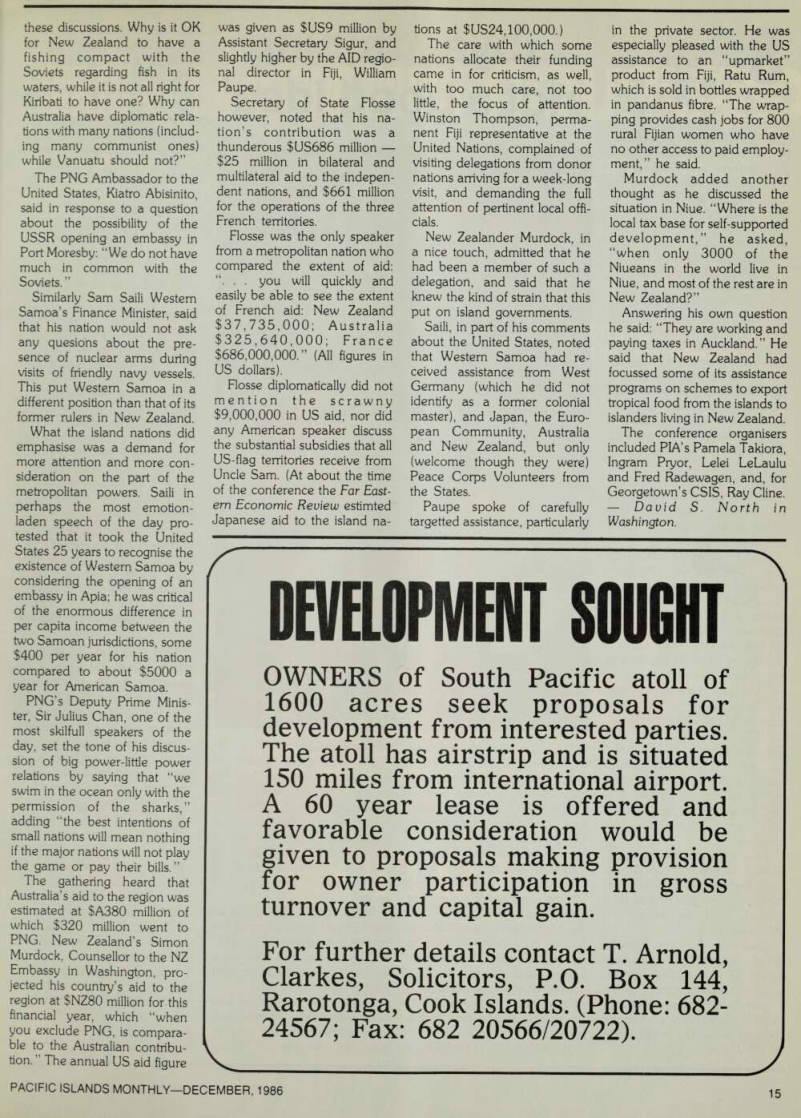
But neither official Washing ton nor the news media paid much attention. Dr. Gaston Sigur, the new Assistant Secre tary of State for East Asian and Pacific Affairs, made a bland and optimistic opening speech, and left the room; his deputy participated in the next panel, and then followed his boss back to the State Department.
But if the ranking Americans appeared somewhat insensi tive, the ranking Frenchmen were more so. The Ambassador to Washington, Emmanuel de Margerie, while speaking ele gant English, was stiff-necked in his defence of France’s nuclear policies.
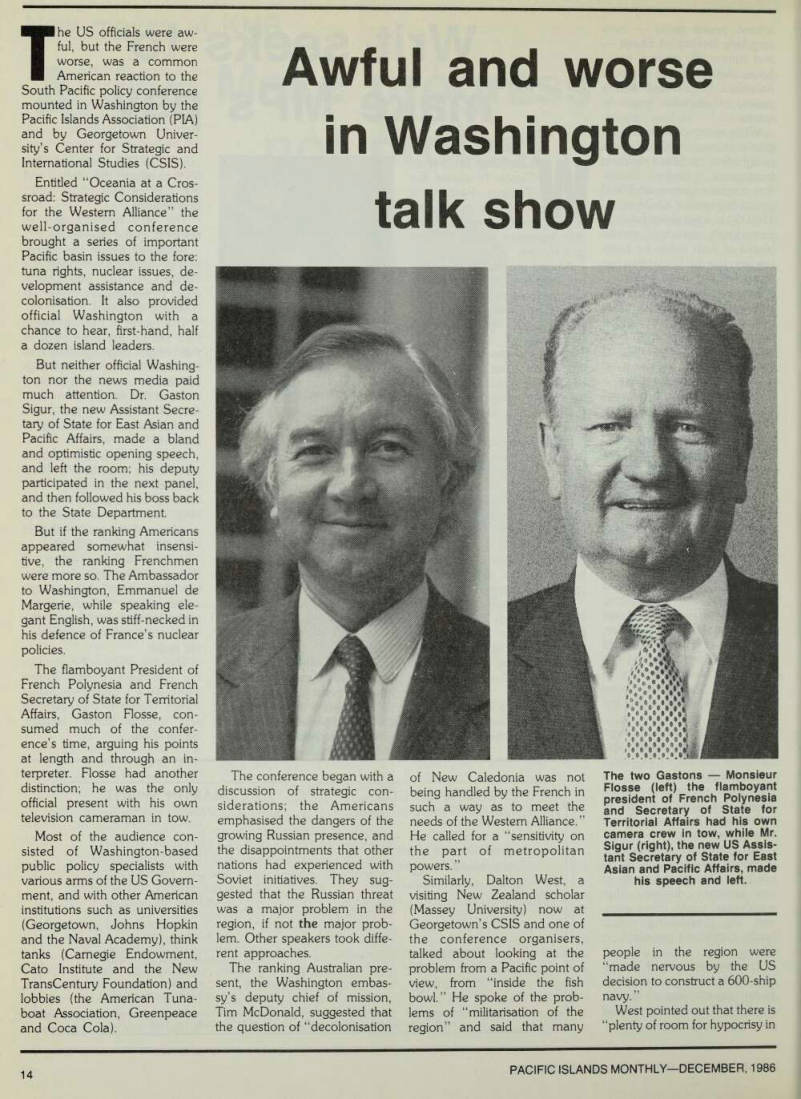
The flamboyant President of French Polynesia and French Secretary of State for Territorial Affairs, Gaston Flosse, con sumed much of the confer ence’s time, arguing his points at length and through an in terpreter. Flosse had another distinction; he was the only official present with his own television cameraman in tow.
Most of the audience con sisted of Washington-based public policy specialists with various arms of the US Govern ment, and with other American institutions such as universities (Georgetown, Johns Hopkin and the Naval Academy), think tanks (Carnegie Endowment, Cato Institute and the New Trans Century Foundation) and lobbies (the American Tuna boat Association, Greenpeace and Coca Cola).
The conference began with a discussion of strategic con siderations; the Americans emphasised the dangers of the growing Russian presence, and the disappointments that other nations had experienced with Soviet initiatives. They sug gested that the Russian threat was a major problem in the region, if not the major prob lem. Other speakers took diffe rent approaches.
The ranking Australian pre sent, the Washington embas sy’s deputy chief of mission, Tim McDonald, suggested that the question of “decolonisation
of New Caledonia was not being handled by the French in such a way as to meet the needs of the Western Alliance. ”
He called for a “sensitivity on the part of metropolitan powers.”
Similarly, Dalton West, a visiting New Zealand scholar (Massey University) now at Georgetown’s CSIS and one of the conference organisers, talked about looking at the problem from a Pacific point of view, from “inside the fish bowl.” He spoke of the prob lems of “militarisation of the region” and said that many
people in the region were “made nervous by the US decision to construct a 600-ship navy. ”
West pointed out that there is “plenty of room for hypocrisy in
The two Gastons - Monsieur Flosse (left) the flamboyant
president of French Polynesia
and Secretary of State for Territorial Affairs had his own camera crew in tow, while Mr.
Sigur (right), the new US Assis tant Secretary of State for East Asian and Pacific Affairs, made his speech and left.
these discussions. Why is it OK for New Zealand to have a fishing compact with the Soviets regarding fish in its waters, while it is not all right for Kiribati to have one? Why can Australia have diplomatic rela tions with many nations (includ ing many communist ones) while Vanuatu should not?”
The PNG Ambassador to the United States, Kiatro Abisinito, said in response to a question about the possibility of the USSR opening an embassy in Port Moresby: “We do not have much in common with the Soviets. ”
Similarly Sam Saili Western Samoa’s Finance Minister, said that his nation would not ask any quesions about the pre sence of nuclear arms during visits of friendly navy vessels.
This put Western Samoa in a different position than that of its former rulers in New Zealand.
What the island nations did emphasise was a demand for more attention and more con sideration on the part of the metropolitan powers. Saili in perhaps the most emotion laden speech of the day pro tested that it took the United States 25 years to recognise the existence of Western Samoa by considering the opening of an embassy in Apia; he was critical of the enormous difference in per capita income between the two Samoan jurisdictions, some $4OO per year for his nation compared to about $5OOO a year for American Samoa.
PNG’s Deputy Prime Minis ter, Sir Julius Chan, one of the most skilfull speakers of the day, set the tone of his discus sion of big power-little power relations by saying that “we swim in the ocean only with the permission of the sharks,” adding “the best intentions of small nations will mean nothing if the major nations will not play the game or pay their bills.”
The gathering heard that Australia’s aid to the region was estimated at SA3BO million of which $320 million went to PNG. New Zealand’s Simon Murdock, Counsellor to the NZ Embassy in Washington, pro jected his country’s aid to the region at SNZBO million for this financial year, which “when you exclude PNG, is compara ble to the Australian contribu tion. ” The annual US aid figure
was given as SUS 9 million by Assistant Secretary Sigur, and slightly higher by the AID regio nal director in Fiji, William Paupe.
Secretary of State Flosse however, noted that his na tion’s contribution was a thunderous SUS6B6 million $25 million in bilateral and multilateral aid to the indepen dent nations, and $661 million for the operations of the three French territories.
Flosse was the only speaker from a metropolitan nation who compared the extent of aid: “. . . you will quickly and easily be able to see the extent of French aid: New Zealand $37,735,000; Australia
$325,640,000; France
$686,000,000.” (All figures in US dollars).
Flosse diplomatically did not mention the scrawny $9,000,000 in US aid, nor did any American speaker discuss the substantial subsidies that all US-flag territories receive from Uncle Sam. (At about the time of the conference the Far East ern Economic Review estimted Japanese aid to the island na
tions at $U524,100,000.) The care with which some nations allocate their funding came in for criticism, as well, with too much care, not too little, the focus of attention.
Winston Thompson, perma nent Fiji representative at the United Nations, complained of visiting delegations from donor nations arriving for a week-long visit, and demanding the full attention of pertinent local offi cials.
New Zealander Murdock, in a nice touch, admitted that he had been a member of such a delegation, and said that he knew the kind of strain that this put on island governments.
Saili, in part of his comments about the United States, noted that Western Samoa had re ceived assistance from West Germany (which he did not identify as a former colonial master), and Japan, the Euro pean Community, Australia and New Zealand, but only (welcome though they were) Peace Corps Volunteers from the States.
Paupe spoke of carefully targetted assistance, particularly
in the private sector. He was especially pleased with the US assistance to an “upmarket” product from Fiji, Ratu Rum, which is sold in bottles wrapped in pandanus fibre. “The wrap ping provides cash jobs for 800 rural Fijian women who have no other access to paid employ ment,” he said.
Murdock added another thought as he discussed the situation in Niue. “Where is the local tax base for self-supported development,” he asked, “when only 3000 of the Niueans in the world live in Niue, and most of the rest are in New Zealand?”
Answering his own question he said: “They are working and paying taxes in Auckland.” He said that New Zealand had focussed some of its assistance programs on schemes to export tropical food from the islands to islanders living in New Zealand.
The conference organisers included PlA’s Pamela Takiora, Ingram Pryor, Lelei LeLaulu and Fred Radewagen, and, for Georgetown’s CSIS, Ray Cline.
David S. North in
Washington.