A tale of two islands
pp. 46-48 · Read in the full issue
There used to be a theory, supposedly endorsed by Albert Einstein, that everyone in the world had a twin, a double, living somewhere in the world. I don’t claim to subscribe to it, but I have seen evidence of places having doubles.
There is a village in Britain, Medford, that is as drab and uninspired as my hometown of the same name in Mas sachusetts. Parts of New York City eerily resemble the Black Hole of Calcutta.
At a party once, I was cor nered by an excitable Arab named Pierre Christophe, who insisted that my home at the time, Samoa, was the exact antipode of Mecca. The im plication, of course, was that if there were any Samoan Mos lems they were perfectly en titled to pray in any direction they wished.
This all brought to mind the
story of two islands, geographic doppelgangers if there ever were any.
They’re thousands of miles from each other and yet they’re alike in scores of ways, in shape, in topographical fea tures, active vulcanism, copious rainfall, archaelogical forma tions, native people, place names and in their relation to the others of the group: they are the yokels.
Samoans call Savaiians kuapaka (bumpkin); the pidgin version is F. 0.8. (Fresh Off the Boat).
When I was first dispatched by the Peace Corps to the Samoan Group, back in 1975,1 chose the westernmost island, the largest and most traditional, Savaii, on which to serve. It gave me my first teaching job, my first fluent, foreign lan guage, my first foreign culture, my first house, on the eastern most point of the island.
Ten years later, I am again teaching on the eastern side of a Polynesian island, the largest and most extreme of the group, with plenty of rainfall and trade winds. But my thatch roof has become tin and I’ve traded my foreign-speaking neighbours for equally baffling pidgin-spouting Portuguese.
I takes notes. And I’ve found that, just as I did ten years ago, I need a woollen blanket at night.
Well, even the Sahara gets cold then.
But the similarities of the islands are striking. In 1976, I visited an inland village on Savaii called Paia. I was told that nearby was a strange place called Le Ana (The Cave), where sa’a (Little People) lived.
A half mile or so inland through the jungle was an un prepossessing hole in the ground. Yet it was an opening to a lava tube as impressive as the famous Thurston Lava Tube at Kilauea. And Hawaii also has a Paia (Paia ha’a) near Ka’u. (there is a Ka’u or Ta’u in Samoa also. But I’ll only mention names common to both.) Of course the very names of
the islands Savaii and Hawaii are linguistically speaking, identical. No one knows just what the word means, and while some have speculated that it is Proto- Polynesian for “homeland”, no linguist will commit himself to this.
It has many versions throughout the Pacific: Hawaii, Havaiki, Avaiki and Savaii.
Since the letters S, J, and H are linked, 1 subscribe to the unsub stantiated but romantic notion that the name traces back to Java-lki, or Little Java, the Asian homeland of the Polyne sians.
But there are other, more convincing similarities in place names. The Vailoa (“Long Water”) on the south coast of Savaii is recalled in the Wailoa river and State Park at Hilo.
Both islands have a Vaitoloa in their northwest quadrants.
Cape Vaitoloa looks upon one
of the loveliest sunsets in the world, while Hawaii’s Waikoloa describes a pretty hill and a stream. Both mean “Duck Water. ” (In Polynesian T equals K and the Hawaiian W is pronounced V. Don’t ask me why).
Papa is a seacoast village and bay of particular beauty on the south coasts of both islands.
Hawaii’s sometimes snow-cap ped Mauna Loa recalls the two volcanic cones and one crater on Savaii, which are all called Mauga Loa. Other place names are identical, but geographically reversed, just as the islands themselves are the east or west extremities of their respective groups.
There is a Puapua on the east coast of Savaii, the west of Hawaii; Malae is found on the east coast of a aii, the west of Hawaii; Vaifou, too, is reversed and Waihou is on the west coast of Hawaii.
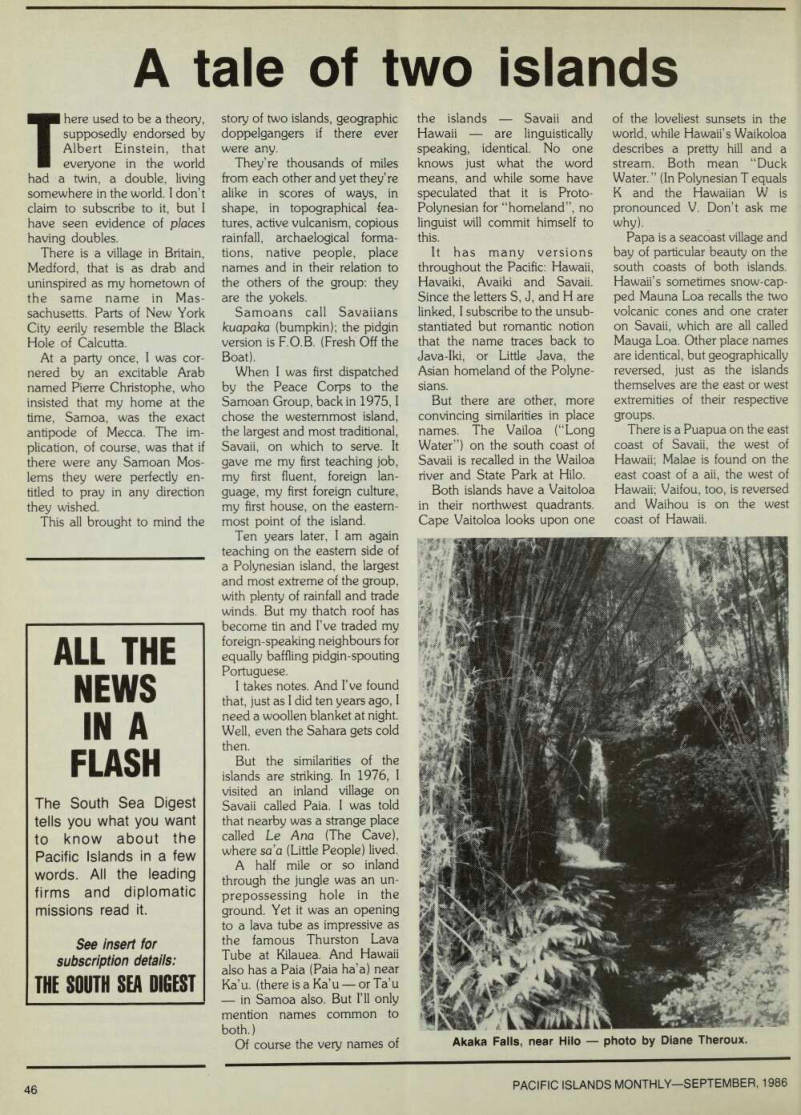
Akaka Falls, near Hilo photo by Diane Theroux.
One north-to-south switch is “Loincloth Bay”, each naming some forgotten battle, where a thin girdle was worn by the warriors: Fagamalo on Savaii and Hanamalo on Hawaii.
Another is Vaipouli, also on Savaii’s north coast. It becomes Hawaii’s southern Waipouli Bay. Hawaii’s Puna district, south of Hilo, recalls Savaii’s Mount Puna. Scores of other Samoan place names (Upolu, Tuasivi, Vaimea, Faga, Apia, just to name a few) were carried over the oceans along with dogs, chickens, coconuts, a lan guage and a culture.
Both islands were formed of volcanic activity, the lava field on Savaii as strange a moon scape as any of those on Hawaii. But because of the hundreds of inches of rainfall, the islands are lush, with thick timber forests. There is too wood on Savaii, “warrior’s wood”, like koa wood on Hawaii, valued for its strength as well as its reddish beauty.
Boar hunts can be arranged on either island. In some ways the islands are clones. Or so it seems.
But for perspective: Savaii is a mere 703 square miles, while Hawaii, at 4034 square miles deserves its name as the Big Island. Hawaii is 76 miles by 93 miles, nearly twice the size of all the other Hawaiian Islands combined. Savaii is but 45 miles by 26. There are also more than twice as many people on Hawaii: 110,000.
Savaiians number only about 50,000.
Recently, the Mayor of Hawaii, Dante Carpenter, refer red to the Big Island as the “sleeping giant of the Pacific.”
One would be hard put to find a more apt description. Its poten tial for tourist development, alternate energy production, agricultural benefits, as a play ground for astronomers, archaeologists and sociologists, has only recently been realised.
Experiments in the field of alternate energy include wind machines, burning biomass and geothermal energy: these actually are in production, though not nearly as much as they could and should be. Only the Kona side of the island is
beginning to flourish as a tourist haven.
They have not taken their rental cars and cash to the Hilo side, and that bothers the busi ness community. Part of the problem has been the island’s very name: everyone thinks that because he has been to the Hawaiian Islands he has seen
Hawaii, when he has only seen Waikiki and that island (Oahu, remember?).
The attempt to sell Hawaii as the Orchid Isle has met with only partial success. It has no distinction in the tourist’s or developer’s mind, in the way that Molokai does, for example.
Savaii’s problems are similar,
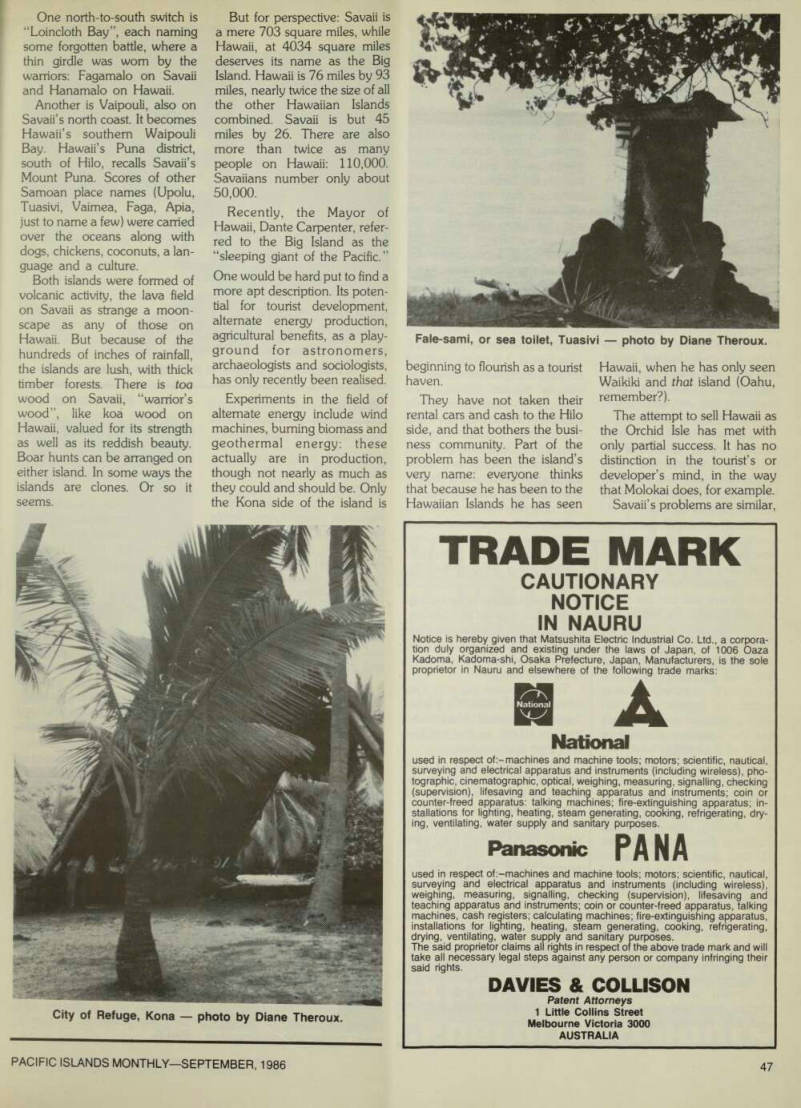
City of Refuge, Kona photo by Diane Theroux.
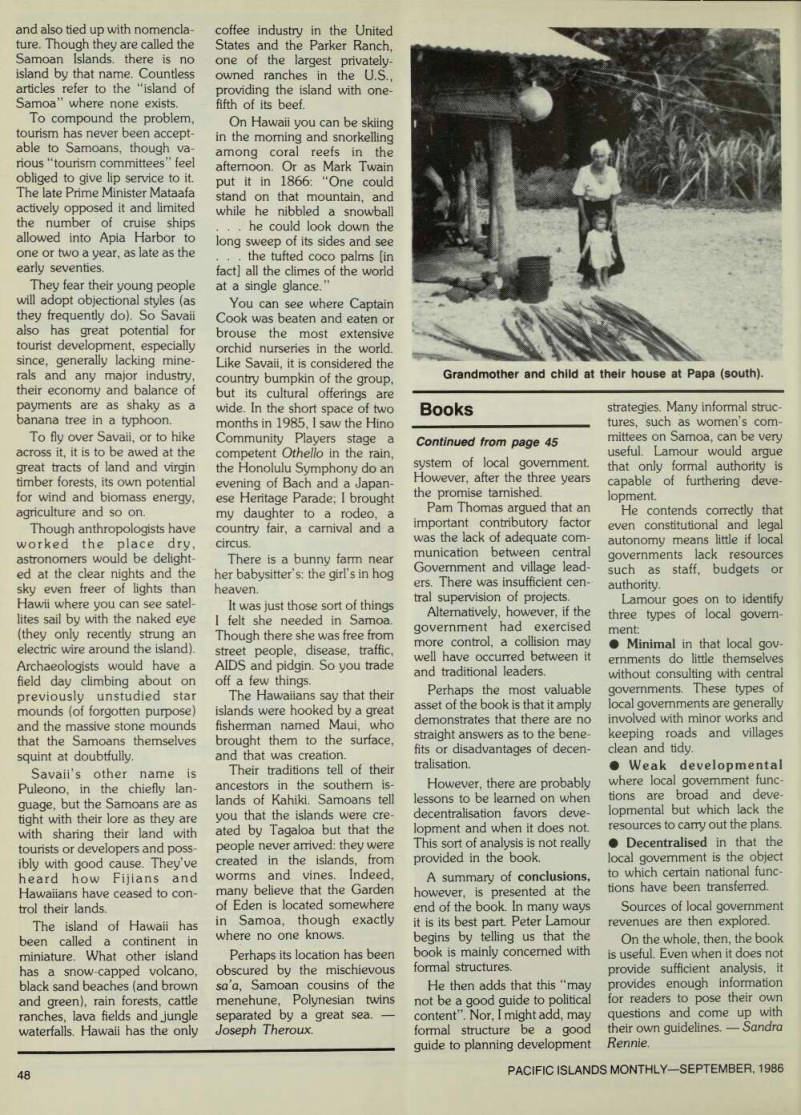
Fale-sami, or sea toilet, Tuasvi photo by Diane Theroux.
and also tied up with nomencla ture. Though they are called the Samoan Islands, there is no island by that name. Countless articles refer to the “island of Samoa” where none exists.
To compound the problem, tourism has never been accept able to Samoans, though va rious “tourism committees” feel obliged to give lip service to it.
The late Prime Minister Mataafa actively opposed it and limited the number of cruise ships allowed into Apia Harbor to one or two a year, as late as the early seventies.
They fear their young people will adopt objectional styles (as they frequently do). So Savaii also has great potential for tourist development, especially since, generally lacking mine rals and any major industry, their economy and balance of payments are as shaky as a banana tree in a typhoon.
To fly over Savaii, or to hike across it, it is to be awed at the great tracts of land and virgin timber forests, its own potential for wind and biomass energy, agriculture and so on.
Though anthropologists have worked the place dry, astronomers would be delight ed at the clear nights and the sky even freer of lights than Hawii where you can see satel lites sail by with the naked eye (they only recently strung an electric wire around the island).
Archaeologists would have a field day climbing about on previously unstudied star mounds (of forgotten purpose) and the massive stone mounds that the Samoans themselves squint at doubtfully.
Savaii’s other name is Puleono, in the chiefly lan guage, but the Samoans are as tight with their lore as they are with sharing their land with tourists or developers and poss ibly with good cause. They’ve heard how Fijians and Hawaiians have ceased to con trol their lands.
The island of Hawaii has been called a continent in miniature. What other island has a snow-capped volcano, black sand beaches (and brown and green), rain forests, cattle ranches, lava fields and jungle waterfalls. Hawaii has the only
coffee industry in the United States and the Parker Ranch, one of the largest privately owned ranches in the U.S., providing the island with one fifth of its beef.
On Hawaii you can be skiing in the morning and snorkelling among coral reefs in the afternoon. Or as Mark Twain put it in 1866: “One could stand on that mountain, and while he nibbled a snowball ... he could look down the long sweep of its sides and see ... the tufted coco palms [in fact] all the climes of the world at a single glance.”
You can see where Captain Cook was beaten and eaten or brouse the most extensive orchid nurseries in the world.
Like Savaii, it is considered the country bumpkin of the group, but its cultural offerings are wide. In the short space of two months in 1985,1 saw the Hino Community Players stage a competent Othello in the rain, the Honolulu Symphony do an evening of Bach and a Japan ese Heritage Parade; I brought my daughter to a rodeo, a country fair, a carnival and a circus.
There is a bunny farm near her babysitter’s: the girl’s in hog heaven.
It was just those sort of things I felt she needed in Samoa.
Though there she was free from street people, disease, traffic, AIDS and pidgin. So you trade off a few things.
The Hawaiians say that their islands were hooked by a great fisherman named Maui, who brought them to the surface, and that was creation.
Their traditions tell of their ancestors in the southern is lands of Kahiki. Samoans tell you that the islands were cre ated by Tagaloa but that the people never arrived: they were created in the islands, from worms and vines. Indeed, many believe that the Garden of Eden is located somewhere in Samoa, though exactly where no one knows.
Perhaps its location has been obscured by the mischievous sa’a, Samoan cousins of the menehune, Polynesian twins separated by a great sea.
Joseph Theroux.
Grandmother and child at their house at Papa (south).