Women stay in the background
p. 14 · Read in the full issue
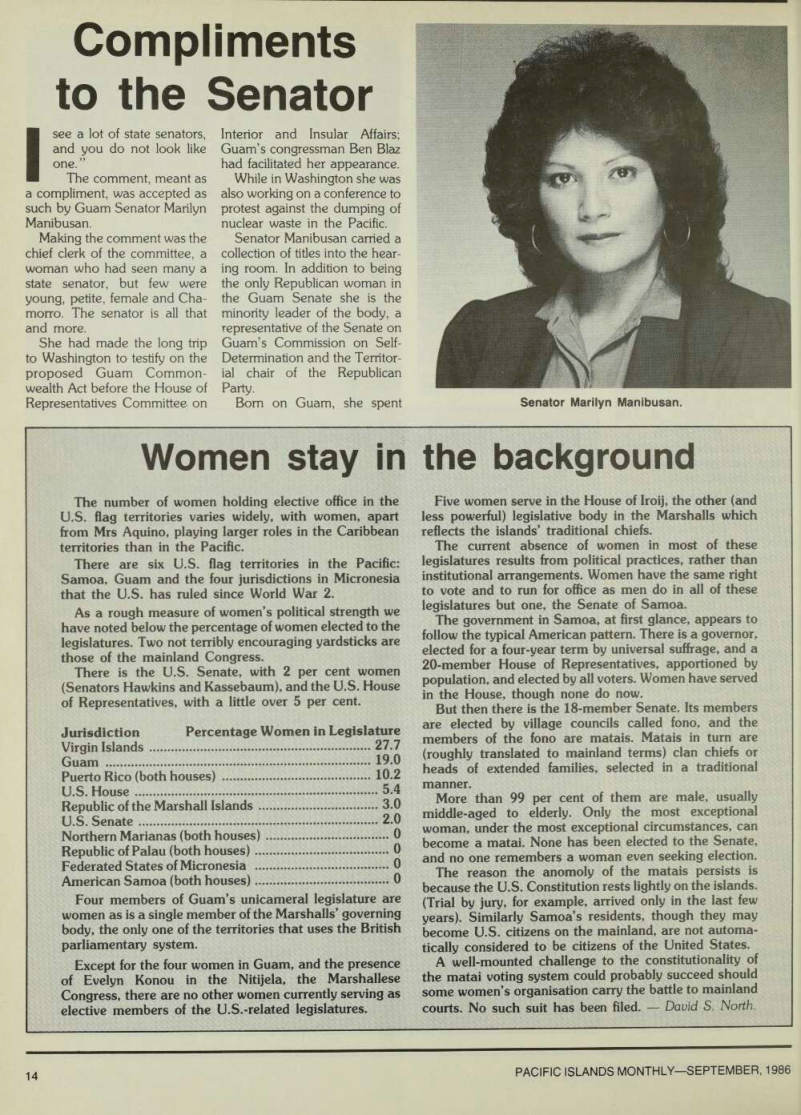
The number of women holding elective office in the U.S. flag territories varies widely, with women, apart from Mrs Aquino, playing larger roles in the Caribbean territories than in the Pacific.
There are six U.S. flag territories in the Pacific: Samoa, Guam and the four jurisdictions in Micronesia that the U.S. has ruled since World War 2.
As a rough measure of women’s political strength we have noted below the percentage of women elected to the legislatures. Two not terribly encouraging yardsticks are those of the mainland Congress.
There is the U.S. Senate, with 2 per cent women (Senators Hawkins and Kassebaum), and the U.S. House of Representatives, with a little over 5 per cent.
Jurisdiction Percentage Women in Legislature Virgin Islands 27.7 Guam 19.0 Puerto Rico (both houses) 10.2 U.S. House 5.4 Republic of the Marshall Islands 3.0 U.S. Senate 2.0 Northern Marianas (both houses) 0 Republic of Palau (both houses) 0 Federated States of Micronesia 0 American Samoa (both houses) 0 Four members of Guam’s unicameral legislature are women as is a single member of the Marshalls’ governing body, the only one of the territories that uses the British parliamentary system.
Except for the four women in Guam, and the presence of Evelyn Konou in the Nitijela, the Marshallese Congress, there are no other women currently serving as elective members of the U.S.-related legislatures.
Five women serve in the House of Iroij, the other (and less powerful) legislative body in the Marshalls which reflects the islands’ traditional chiefs.
The current absence of women in most of these legislatures results from political practices, rather than institutional arrangements. Women have the same right to vote and to run for office as men do in all of these legislatures but one, the Senate of Samoa.
The government in Samoa, at first glance, appears to follow the typical American pattern. There is a governor, elected for a four-year term by universal suffrage, and a 20-member House of Representatives, apportioned by population, and elected by all voters. Women have served in the House, though none do now.
But then there is the 18-member Senate. Its members are elected by village councils called fono, and the members of the fono are matais. Matais in turn are (roughly translated to mainland terms) clan chiefs or heads of extended families, selected in a traditional manner.
More than 99 per cent of them are male, usually middle-aged to elderly. Only the most exceptional woman, under the most exceptional circumstances, can become a matai. None has been elected to the Senate, and no one remembers a woman even seeking election.
The reason the anomoly of the matais persists is because the U.S. Constitution rests lightly on the islands. (Trial by jury, for example, arrived only in the last few years). Similarly Samoa’s residents, though they may become U.S. citizens on the mainland, are not automa tically considered to be citizens of the United States.
A well-mounted challenge to the constitutionality of the matai voting system could probably succeed should some women’s organisation carry the battle to mainland
courts. No such suit has been filed.
David S. North.