Compliments
pp. 14-16 · Read in the full issue

to the Senator
I see a lot of state senators, and you do not look like one.”
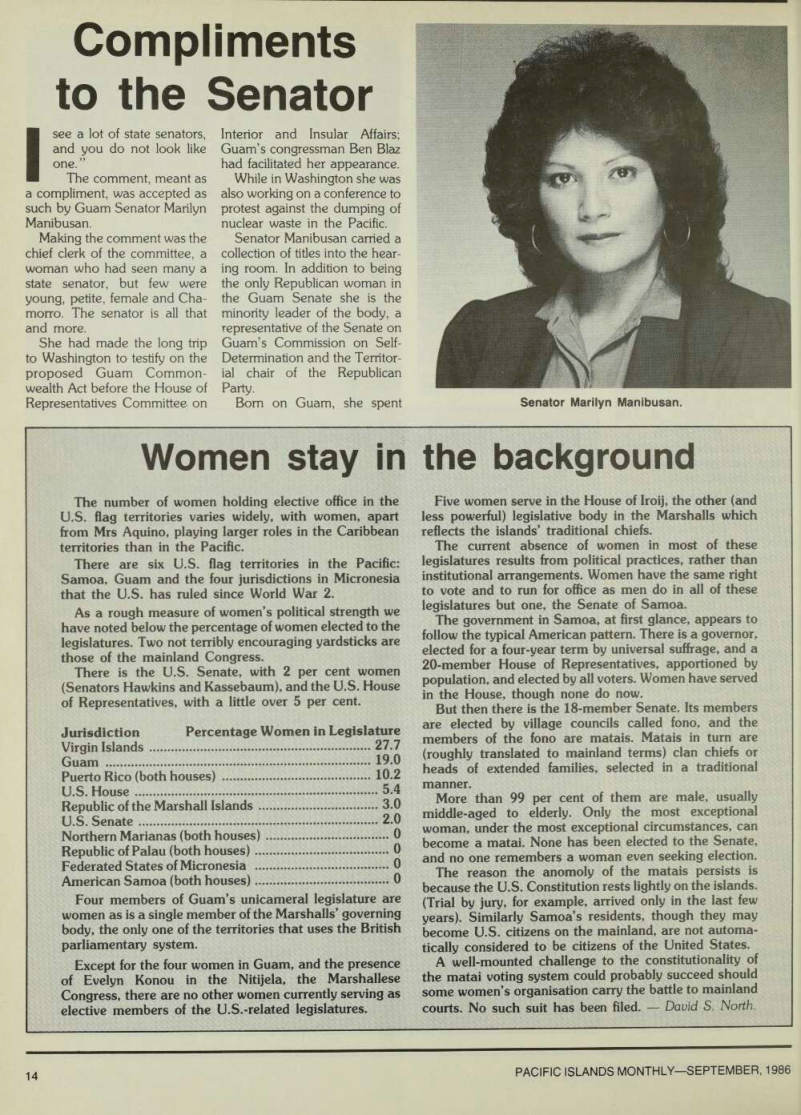
The comment, meant as a compliment, was accepted as such by Guam Senator Marilyn Manibusan.
Making the comment was the chief clerk of the committee, a woman who had seen many a state senator, but few were young, petite, female and Cha morro. The senator is all that and more.
She had made the long trip to Washington to testify on the proposed Guam Common wealth Act before the House of Representatives Committee on
Interior and Insular Affairs; Guam’s congressman Ben Blaz had facilitated her appearance.
While in Washington she was also working on a conference to protest against the dumping of nuclear waste in the Pacific.
Senator Manibusan carried a collection of titles into the hear ing room. In addition to being the only Republican woman in the Guam Senate she is the minority leader of the body, a representative of the Senate on Guam’s Commission on Self- Determination and the Territor ial chair of the Republican Party.
Bom on Guam, she spent
Senator Marilyn Manibusan.
several years in San Francisco, going to college and securing a paralegal’s certificate. Marilyn Manibusan returned to Guam in 1978, married, had a child, went into several businesses and became concerned about Guam’s relations with the main land.
“I first was involved in politics when I fought the proposed constitutional referendum; it did not solve our problems and was defeated. ”
In 1982 she was elected to the Senate, was re-elected two years later and this year has turned aside suggestions she seek the Lt. Governorship and instead is seeking another term in the Senate. She points out she is the only woman ever elected to the Guam Senate while using her maiden name.
While other women have been elected to the Guam Senate in the past and to legislative bodies in American Samoa, Palau and the Northern Marianas, there currently are only five women serving in elective positions in U.S. -affili ated legislatures in the Pacific.
The other three Guam Sena tors are Elizabeth Perez Arriola, Herminia Duenas (Pepero) Dierking and Pilar C. Lujan; all three are seeking re-election and all three are Democrats.
Further, all three secured their bachelor’s degrees on the mainland (it seems to be a pattern) and two of them (Senators Arriola and Dierking) earned master’s degrees there as well. All three spent part of their lives teaching in church or public schools.
Senator Arriola, who is in her second two-year term, has served on the Territorial Board of Education and the Board of Regents of the University of Guam and is currently a mem ber of the Diocesan Board of Education.
She is chair of the Senate’s Committee on Youth, Senior Citizens, Cultural Affairs and Human Resources.
Senator Lujan’s early career was devoted to education, moving up from a teacher’s job to that of assistant principal of one school and principal of another.
She was Associate Superin tendent for Curriculum and In-
struction at the time of her retirement from the Guam school system. She subse quently became chair of the first elected Board of Education.
She has'been active in the promotion of the Chamorro language, was an instructor in the language at the University of Guam and served as chair of the Chamorro Language Com mission for several years. She, too, is in her second term in the Senate.
Senator Dierking is the
newest female member of the Senate, being elected for the first time in 1984. With her academic degrees in business administration she taught that subject at the University of Guam, rising to become chair of the Accounting Department.
She also ran her own account ing firm, HERMCO, Inc.
Senator Dierking’s campaign literature is interesting because about a quarter of the space is devoted to a list of her relatives,
living and dead, all of whom have Chamorro names (Castro, Duenas, Guzman, etc).
This presumably is a way to emphasise her family connect ions while continuing to use the (somewhat less Chamorro) name of her husband. Senator Manibusan’s decision to run on her maiden name may, in part, relate to the fact her own name sounds more like an island one than that of her spouse, Mr Colbert.
The fifth woman serving in an elective American flag legis lature is Evelyn Konou, a mem ber of the Nitijela of the Repub lic of the Marshall Islands. She is a member of the Opposition Party.
Five women serve in the House of Iroij, the 12-member body in the Marshalls which passes on traditional matters such as titles and land claims but which can not override the political decisions of the Nitijela.
The members of this body are not elected by the voters generally, they are persons with chiefly rank, that of Iroijaplap; when more than one such person lives in a Council of Iroij district (usually an atoll) those holding the rank choose a member of the group to sit on the Council.
Rotation in office is advo cated (but not mandated) in article 111 of the Constitution of the Marshall Islands. The Con stitution is very clear, however, one can not sit in both the Nitijela and the Council of Iroij; if a member of the Council is elected to the Nitijela that mem ber can appoint a deputy to serve on the Council and this is why two of the women sit on the Council. one woman, Neilang Loeak, sits in her own right while two others have been appointed by male members. Amata Kabua, the President of the Marshalls, is also a chief and has appointed his cousin, Atama Zedkaia, to represent him in the Council of Iroij.
Similarly, his uncle, Kabua Kabua, has appointed Niemata Makamura to sit for him. There are two other women on the Council, Limelang Jawin and Likbar Anni, but how they were
named is not clear.
David S.
North.
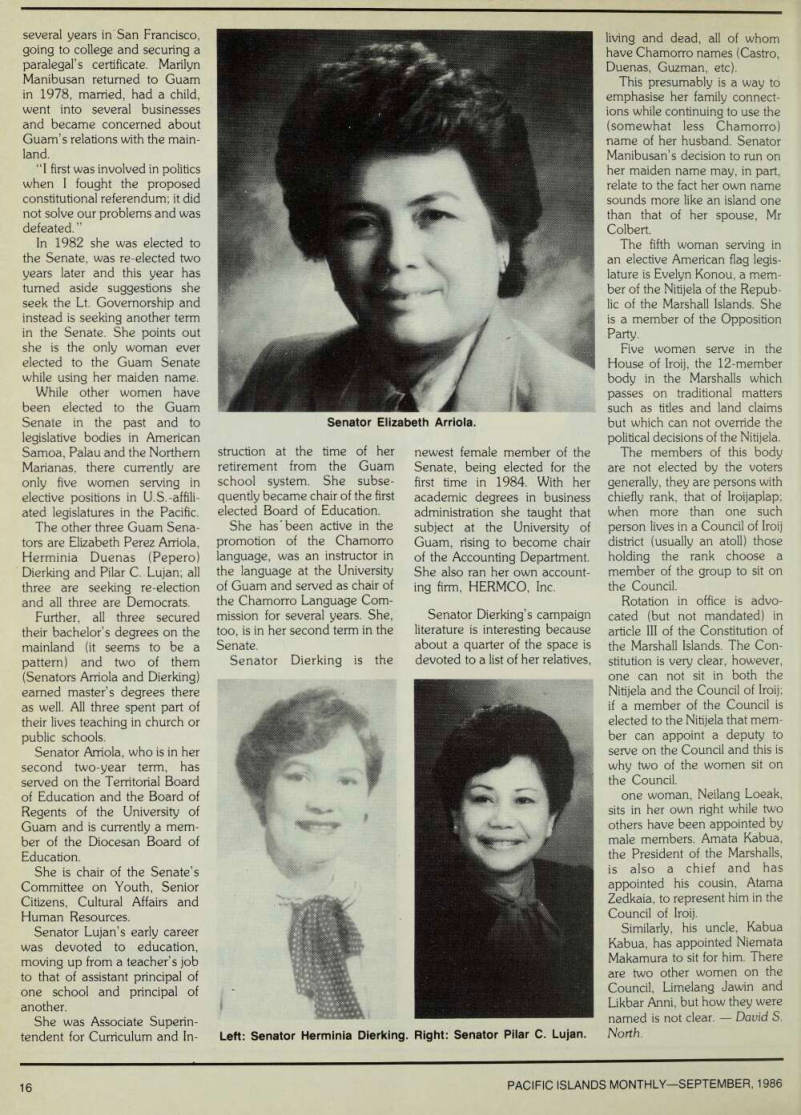
Senator Elizabeth Arriola
Left: Senator Herminia Dierking. Right: Senator Pilar C. Lujan