Ratu Mara plays
pp. 20-22 · Read in the full issue
the Russian card
You are perhaps now thinking, here we go again the Russians are coming, the Russians are com ing. The Russians aren’t com ing, they’re here.
Thus Admiral Ronald R.J.
Hays, US Commander in Chief (Pacific) at a recent press con ference.
The admiral was addressing himself to the build-up of Rus sian naval forces in the Pacific, and indicated that, so far at least, the US was well placed to contain any immediate threat.
Doubtless, that’s true.
On the diplomatic and com mercial fronts, however, the US is less well placed.
The rot, from a Washington viewpoint, began with the sig ning of the Kiribati-Soviet fishing agreement.
It continues as Vanuatu seems ever more likely to con clude an agreement giving the Soviets shore facilities.
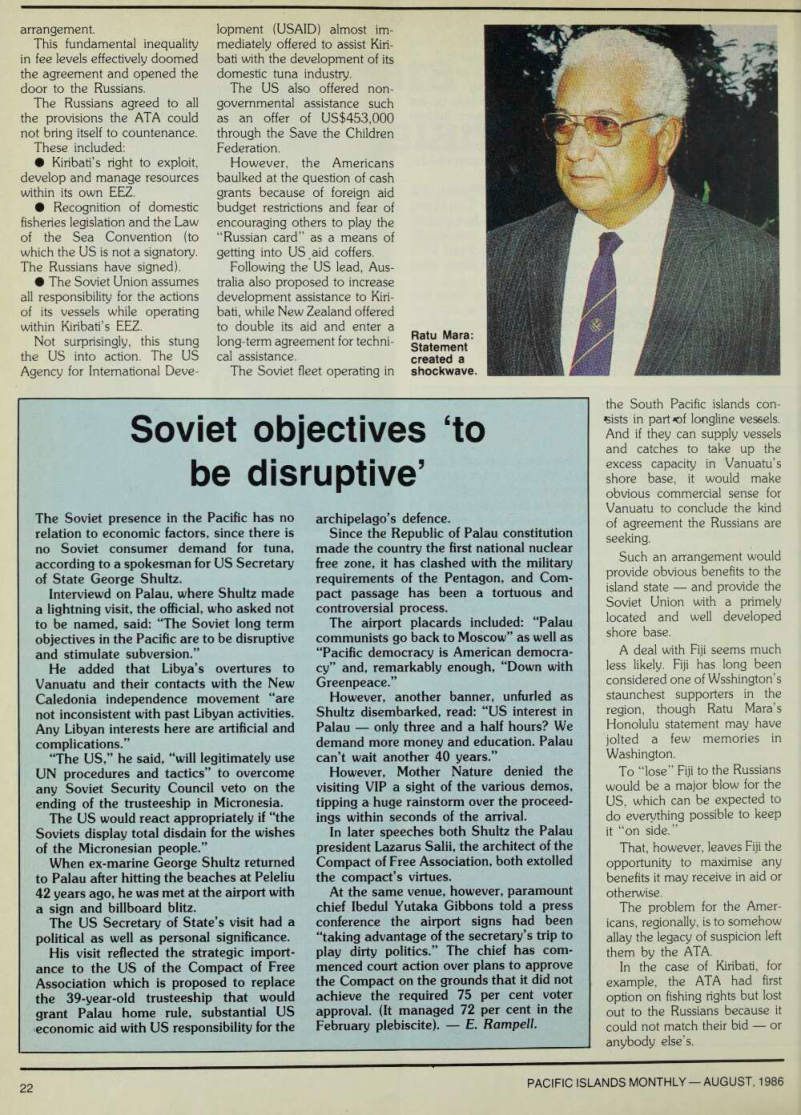
It looked like running riot when Fiji’s Ratu Mara told a Honolulu press conference that he might consider a similar agreement, although this was later toned down by his foreign affairs secretary.
Nevertheless, the point was not lost on the Russians.
There is further potential for erosion of US prestige with the Soviets giving possibly their strongest hint yet (see box) that they might use their veto against the US when the Micronesian question comes before the UN Security Council.
Ratu Mara told reporters dur ing a Honolulu visit that Fiji was now interested in pursuing a fisheries agreement with the Soviet Union so long as the price was right.
He also, in an apparent about face on previous policy, said the Soviet fleet might be able to negotiate shore facilities.
His remarks sent a shock wave throughout the region,
with the Americans, the Austra lians and the New Zealanders particularly nonplussed.
For when US Secretary of State George Shultz visited Fiji last year, the host prime minis ter was critical of the Kiribati agreement.
However, a spokesman for the Russian embassy in Can berra told PIM that no formal reply had been received from Fiji to the Russian invitation to negotiate a bilateral fishing agreement.
And Fiji’s secretary for fore ign affairs, a few days after his prime minister’s surprise state ment, was able to defuse the situation by stressing that the Soviet offer of co-operation in several economic areas was only one of many under con sideration by Fiji.
A spokesman at the US embassy in Suva told PIM that, in the light of this, no reply to Ratu Mara’s statement was deemed necessary.
The prime minister’s re marks, however, may reflect a degree of frustration on US aid negotiations and the sugar quota.
Fiji is due to become the first South Pacific island nation to negotiate a bilateral deve lopment aid agreement with the US.
However, progress has been slow with- the wording of the document taking some time to work out.
Ratu Mara’s well-timed state ment could reasonably be ex pected to have the effect of hurrying along the aid deal with a possible reassessment of the sugar quota.
The bilateral aid talks are also reflected in Fijian support for the US efforts to negotiate a unique multilateral fishery agreement with the island states, though some of the participants are known to have become frustrated at the slow progress.
Vanuatu, meanwhile, was evaluating proposals put to them by the Soviets for fishery access with shore facilities.
Fr Lini’s government, how ever, is keeping its options open by taking a close interest in the progress of the multilateral fishery talks with the US.
Vanuatu currently has an underused tuna processing plant.
More detailed negotiations with the Russians are expected.
Ratu Mara’s remarks fol lowed a meeting of the Stan ding Committee of the Pacific Island Conference in Honolulu.
Chaired by the Fiji prime minis ter, the committee consists of the presidents of FSM and Kiribati, the prime ministers of Papua New Guinea and the
Cook Islands, the governors of Guam and Hawaii and the president of Congress of New Caledonia.
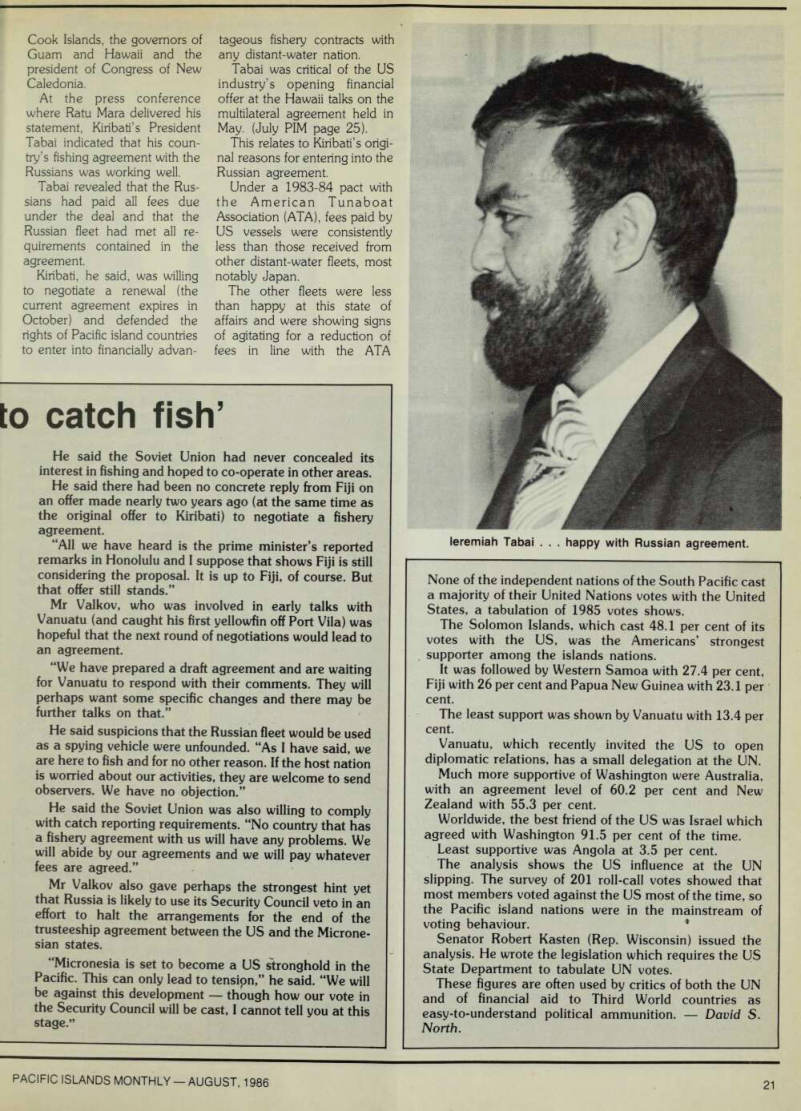
At the press conference where Ratu Mara delivered his statement, Kiribati’s President Tabai indicated that his coun try’s fishing agreement with the Russians was working well.
Tabai revealed that the Rus sians had paid all fees due under the deal and that the Russian fleet had met all re quirements contained in the agreement.
Kiribati, he said, was willing to negotiate a renewal (the current agreement expires in October) and defended the rights of Pacific island countries to enter into financially advan
tageous fishery contracts with any distant-water nation.
Tabai was critical of the US industry’s opening financial offer at the Hawaii talks on the multilateral agreement held in May. (July PIM page 25).
This relates to Kiribati’s origi nal reasons for entering into the Russian agreement.
Under a 1983-84 pact with the American Tunaboat Association (ATA), fees paid by US vessels were consistently less than those received from other distant-water fleets, most notably Japan.
The other fleets were less than happy at this state of affairs and were showing signs of agitating for a reduction of fees in line with the ATA
None of the independent nations of the South Pacific cast a majority of their United Nations votes with the United States, a tabulation of 1985 votes shows.
The Solomon Islands, which cast 48.1 per cent of its votes with the US, was the Americans’ strongest supporter among the islands nations.
It was followed by Western Samoa with 27.4 per cent, Fiji with 26 per cent and Papua New Guinea with 23.1 per cent.
The least support was shown by Vanuatu with 13.4 per cent.
Vanuatu, which recently invited the US to open diplomatic relations, has a small delegation at the UN.
Much more supportive of Washington were Australia, with an agreement level of 60.2 per cent and New Zealand with 55.3 per cent.
Worldwide, the best friend of the US was Israel which agreed with Washington 91.5 per cent of the time.
Least supportive was Angola at 3.5 per cent.
The analysis shows the US influence at the UN slipping. The survey of 201 roll-call votes showed that most members voted against the US most of the time, so the Pacific island nations were in the mainstream of voting behaviour. * Senator Robert Hasten (Rep. Wisconsin) issued the analysis. He wrote the legislation which requires the US State Department to tabulate UN votes.
These figures are often used by critics of both the UN and of financial aid to Third World countries as easy-to-understand political ammunition. David S.
North.
leremiah Tabai ... happy with Russian agreement.
arrangement.
This fundamental inequality in fee levels effectively doomed the agreement and opened the door to the Russians.
The Russians agreed to all the provisions the ATA could not bring itself to countenance.
These included; • Kiribati’s right to exploit, develop and manage resources within its own FEZ. • Recognition of domestic fisheries legislation and the Law of the Sea Convention (to which the US is not a signatory.
The Russians have signed). • The Soviet Union assumes all responsibility for the actions of its vessels while operating within Kiribati’s FEZ.
Not surprisingly, this stung the US into action. The US Agency for International Deve
lopment (USAID) almost im mediately offered to assist Kiri bati with the development of its domestic tuna industry.
The US also offered non governmental assistance such as an offer of U 55453,000 through the Save the Children Federation.
However, the Americans baulked at the question of cash grants because of foreign aid budget restrictions and fear of encouraging others to play the “Russian card” as a means of getting into US aid coffers.
Following the US lead, Aus tralia also proposed to increase development assistance to Kiri bati, while New Zealand offered to double its aid and enter a long-term agreement for techni cal assistance.
The Soviet fleet operating in
the South Pacific islands con sists in part of longline vessels.
And if they can supply vessels and catches to take up the excess capacity in Vanuatu’s shore base, it would make obvious commercial sense for Vanuatu to conclude the kind of agreement the Russians are seeking.
Such an arrangement would provide obvious benefits to the island state and provide the Soviet Union with a primely located and well developed shore base.
A deal with Fiji seems much less likely. Fiji has long been considered one of Wsshington’s staunchest supporters in the region, though Ratu Mara’s Honolulu statement may have jolted a few memories in Washington.
To “lose” Fiji to the Russians would be a major blow for the US, which can be expected to do everything possible to keep it “on side.”
That, however, leaves Fiji the opportunity to maximise any benefits it may receive in aid or otherwise.
The problem for the Amer icans, regionally, is to somehow allay the legacy of suspicion left them by the ATA.
In the case of Kiribati, for example, the ATA had first option on fishing rights but lost out to the Russians because it could not match their bid or anybody else’s.
Ratu Mara: Statement created a shockwave.