believe in ourselves’
pp. 18-19 · Read in the full issue
‘Now we can believe in ourselves’
With next year’s June general election looming and not even a year at the helm of Papua New Guinea politics behind him, Paias Wingti says his government has already notched up some signi ficant achievements.
The Wingti-Chan coalition has now entered what seems likely to be its most difficult period with economic activity slowing, corruption and law and order issues still high on the agenda and the general stability of the coalition in question.
Wingti agrees that the time between now and the election will be difficult.
“Our most important achievement,” he said, “is in giving our people a sense of confidence in their country.
“The other achievements you can monitor and measure in monetary terms, but I think the excitement of giving them
The run up to an election is a crucial time for any government. But for PNG prime minister Paias Wingti, in office for less than a year with a widespread coalition to hold together, the bur den is especially heavy. DENIS REINHARDT found him on the campaign trail, not at all dismayed by the task ahead.
confidence in themselves and that Papua New Guineans can do things is the major achievememt of this govern ment,” Wingti told PIM in a wide ranging interview.
Wingti, who served as his predecessor’s deputy before resigning early last year and then challenging Michael So mare, is convinced that his is a ministry that will deliver the goods for his countrymen.
“We have a better ministry and the most experienced men who have been in govern
ment,” he said. “For instance, in Sir Julius Chan we not only have a former prime minister but a world-recognised finance minister.
“And there are many others too, like mines minister, John Kaputin. ”
A revival in community confi dence is also behind the break in the cycle of public violence, argues the 35-year-old prime minister possibly the world’s youngest democratically elected leader.
“We have controlled the law
and order situation. It has be come stable because it comes back to people’s self confi dence,” he said.
“In the past, people were frustrated. They were frustrated because the people at the time gave the impression that they knew the answers to the prob lems and the people were wait ing for government leaders to solve them.
“Whereas this time, I said: ‘Look, each one of you Papua New Guineans must stand on your own feet and you must solve all your own problems by yourselves and no one else can do it for you.’ That has gone across very well.”
Economic management is a harder, more enduring task, however.
“When we came into office, there was little liquid cash in the banking system, and because of that, interest rates were very high and rising.
“It was 17 per cent for ordinary lending and, for short terms, it went as high as 27 per cent and (even) the banks were rushing for the quick money.
“So when we took office we took a hand in that and clear directions were given to the banks on which sectors they could lend to in accordance with government priorities.”
According to Wingti, the re sults are evident.
“Now you see a situation where interest rates are down to 12 per cent and that’s a big achievement,” he argues.
But it is not something that has been gained without strong resistance from the banks who say the fixing of rates by gov ernment decree has altered the risk factors and may force them to make losses.
Wingti also claims early suc cess in reducing taxation.
“The previous government was going to increase taxes on basic foodstuffs for our people.
We decided not to increase those taxes.”
Similarly, bureaucratic re strictions on licences for PMV (public transport) operators have been lifted.
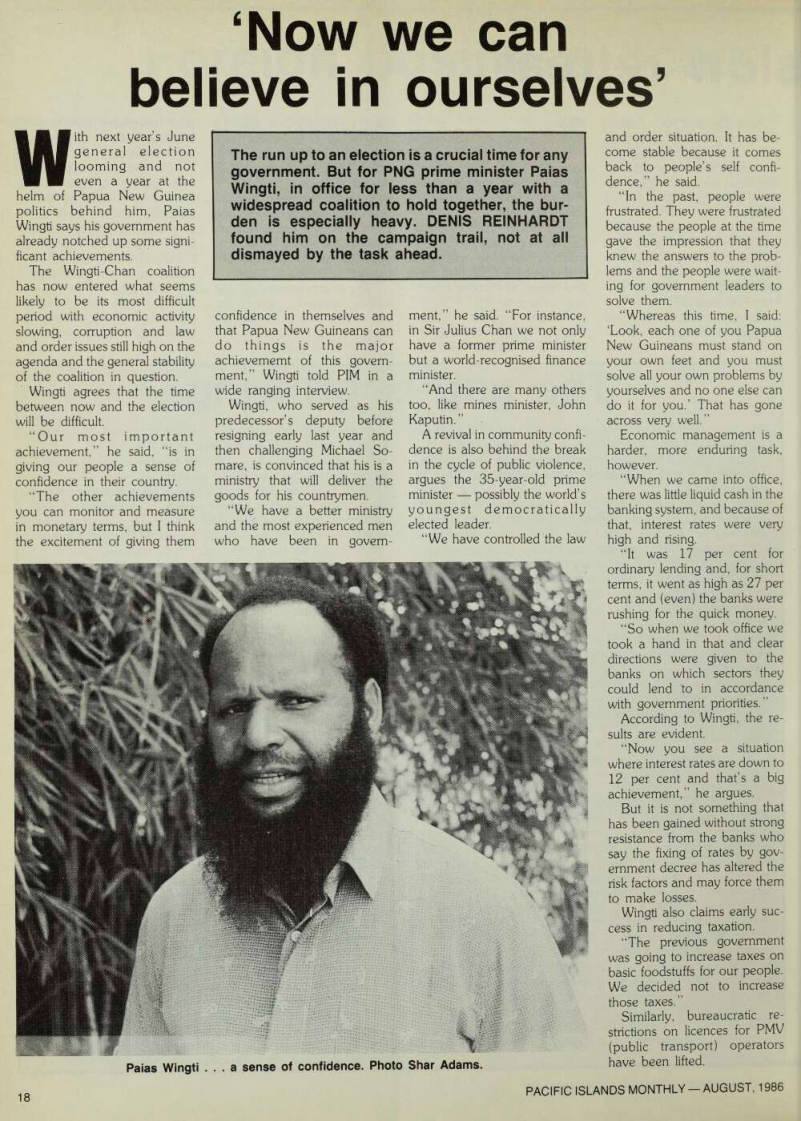
Paias Wingti ... a sense of confidence. Photo Shar Adams.
The approach we have taken is that the people know how to spend money much better than the government. So why should we collect money from people when they can spend it more efficiently.”
With Wingti’s government already subject to a bout of whisperings about corruption, which has become a hallmark of public life in Port Moresby, Wingti, whose own public stan ding remains unimpeached, maintains that his government “has tackled corruption in a much more forceful manner.”
“People feel the difference now in Port Moresby,” he said.
“Because in the past you had the prime minister going for long lunches with business friends I’m not saying I haven’t got any business friends I am saying that his govern ment was run on an ad hoc basis. ”
It is a theme which the ascetic Wingti likes to pursue.
‘ I here was no senousness in cabinet whereas now individual ministers are encouraged to perform.
“I don’t interfere with their portfolios or go over their heads in matters in their ministries.
“My office is to act as a co-ordination (centre). Now that people have seen the changes, there is a feeling in the public service that we are get ting somewhere and we have inspired people.”
Wingti is coy about what may become his other great achieve ment the balancing of rela tions with Indonesia by persuading Jakarta to accept the role of the United Nations High Commissioner for Re fugees in the border camps housing an estimated 10,000 Irian Jayans who have taken refuge on PNG soil.
“Our relations with Indonesia are very vital and we realise this fact. The only area of concern has been the border,” Wingti explained cautiously.
but now I can say there are better relations with Indonesia where therq is respect and understanding. ”
But this rapprochement which has brought about meet ings between both countries’ defence chiefs will not extend to joint military patrols against the Free Papua Movement or OPM which is seeking independence for Irian Jaya.
“The OPM is a declining force which does not cause any major threat to the stability of this country.”
The long term future of Papua New Guinea may be guaranteed by decisions the Wingti government takes, be fore the general elections, on the huge gold and possible oil reserves in PNG.
The recently announced Placer Pacific Limited float, the largest company launch in Au stralasian history, has indicated the revenue to come from the Porgera and Misima gold de;posits.
Equally important is the oil drilling program in the South ern Highlands around Tari.
Wingti has been told private ly that the latest well being drilled at lagifu south of Tari may prove up the greatest oil discovery anywhere in the world in the last decade.
If it does, PNG could see its current budget revenue doubled within ten years.
Wingti is likely to have to make landmark decisions on both gold and oil before the election. He emphasises that the predicted huge revenues must be spent wisely.
“We will be redirecting the revenue towards the rural areas of Papua New Guinea where 85 per cent of our people live.
“Because those resources are non-renewable and will be come exhausted, then if we direct those resources into agri culture that would make this economy become a very strong economy. ”
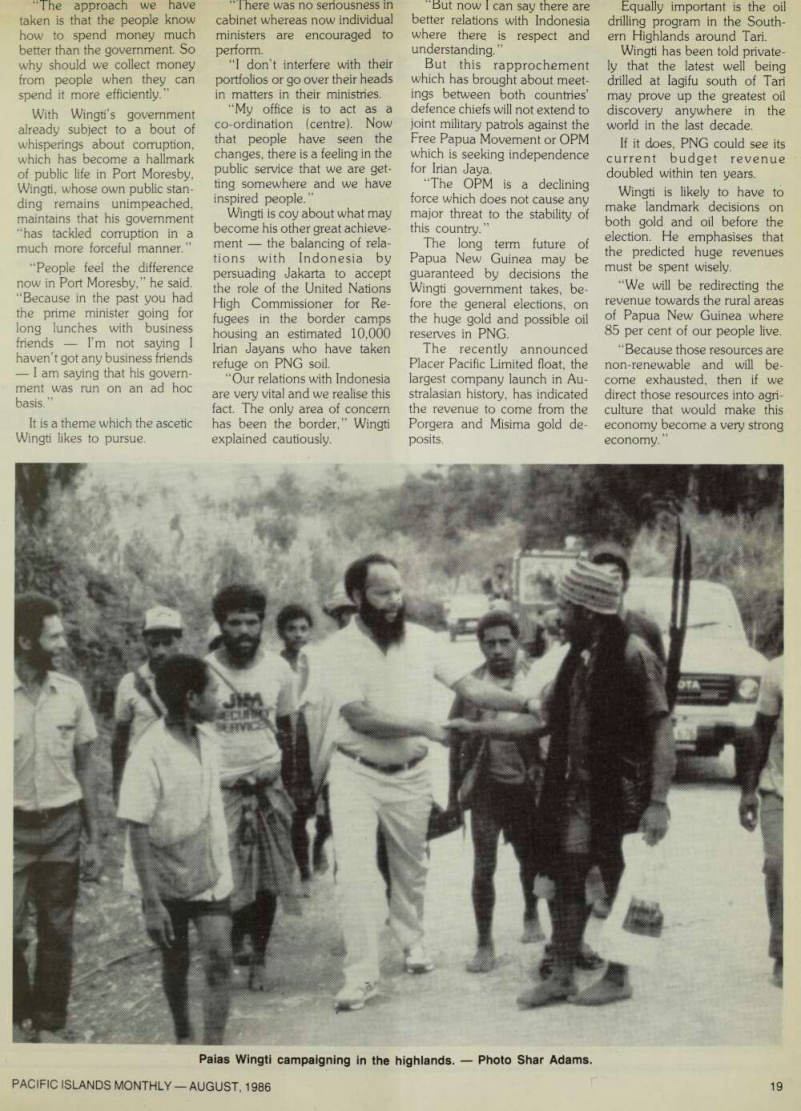
Paias Wingti campaigning in the highlands. Photo Shar Adams.