Foreign business beats a slow reteat
pp. 16-17 · Read in the full issue
Racial attitudes in the Fiji business community are highlighted in the results of a survey carried out by Hawaii-based researchers.
A cross section of the coun try’s entrepreneurs were sur veyed in a program organised by the East-West Centre’s Paci fic Island Development Program.
The results, contained in a report by John Bailey, contri bute to a hard hitting critique of indigenous Fijian business con ditions.
Bailey found that, in general, the workforce was largely un tapped, with great potential in the rural areas.
His report, “Indigenous Busi ness in Fiji,” is heavily critical of several groups.
Fijians, in particular, he claims, are finding it increasing ly difficult to find employment.
“Many of the major locally owned companies continue to
employ a majority of Indian labour, and one must question the impartiality of their selection policies as equal opportunity employers.
“Such recruitment policies do little to encourage Fijian applicants, and this situation is aggravated by the fact that few of these jobs are advertised.
“Word of mouth and perso nal contacts are a dominant feature of job-seeking in Fiji,” he claims.
Bailey estimates that there is one small firm for every 40 people in Fiji, which ratio cor responds with similar figures for the UK and Australia.
But “although the private business sector is composed predominently of sole traders and partnerships, in reality it is dominated by a few large com panies that generate the large sales turnover.”
These are the Carpenters
Group, Burns Philp, Central Manufacturing and Western Mining with the locally-owned Punja’s and R.B. Patel’s.
In 1981, says Bailey, an estimated 12,200 Fijians were employed in the private sector.
“Although they represented one third of the total number employed in the private sector, the great majority were em ployed only as semi-skilled or unskilled labour.
“Only 2,040 Fijians held senior salaried positions, a mere 17 per cent of all Fijians em ployed.”
The past 10 years, in particu lar, has seen the gradual ad vance of locally-owned enter prise at the expense of the traditionally dominant foreign owned companies.
Foreign capital, says Bailey, is in retreat despite the incentives offered by the gov ernment.
“During the past 15 years
foreign investment has drifted away from the Pacific islands for four main reasons: • The independence of many nations, which encour aged a return of land to traditio nal landholders and govern ments; • Falling commodity prices; • A management succession problem among many small foreign-owned concerns and • A search for economies of scale.
“This dramatic disengage ment and retreat from the Paci fic is apparent in such examples as the withdrawal of the US multinational Brewer Corpora tion from the Solomon Islands, the sale of Burns Philp retail properties in Fiji, the rationalisa tion that created Industrial Marine Engineering Ltd (IMEL), with the loss of 100 jobs and the complete withdra wal of Barclays Bank from Fiji and the Pacific in 1985.”
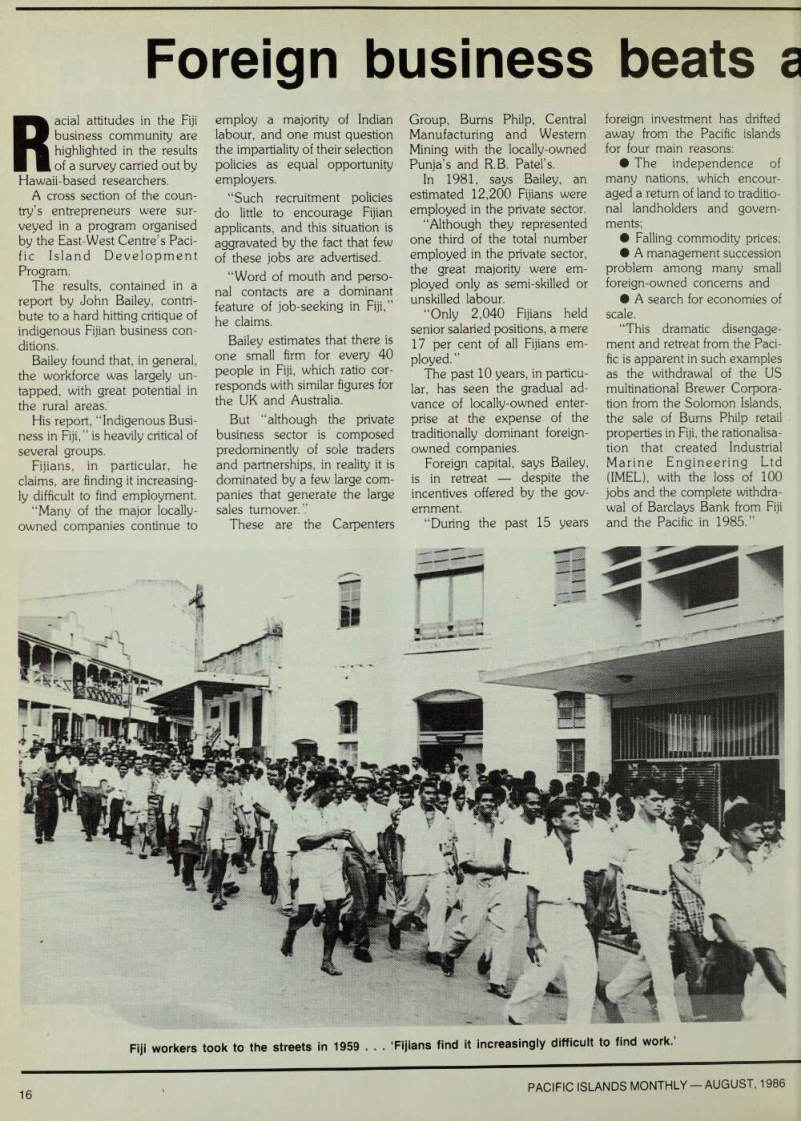
Fiji workers took to the streets in 1959 ... ‘Fijians find it increasingly difficult to find work.’
Australian and New Zealand investors are also going back home or are re-appraising their overseas investments with new emphasis on the ASEAN na tions, Southeast Asia and North America.
Bailey also notes that many foreign-owned businesses in Fiji feel discriminated against in having limited access to the local capital market (see also May PIM page 27).
Foreign investors also see themselves as facing unfair wage competition, reports
Bailey.
“Foreign-owned companies with relatively enlightened per sonnel policies are an obvious target for trade union activities; thus wage levels and costs are forced upwards.”
He estimates that foreign em ployers pay up to three times as much as their local counterparts and especially cites the food processing and paper conver sion industries.
“These figures,” states Bailey, “reflect not only the exploitative attitude of many
local employers but also the total failure of the trade union movement to involve them selves with employees of locally owned companies.”
He also expresses concern over the rapid growth of the
predominantly Indian-owned
local private sector, which now appears to dominate the market.
“The more entrenched the Indian business community be comes as a market leader, the harder it will be for Fijians to gain a market share and com
pete effectively against such well-established, experienced entrepreneurs.
“The discriminatory recruit ment policies of many Indian employers is reflected in the relatively few numbers of Fi jians that they employ, particu larly at supervisory or senior management levels.: N.P. “If Fijians are to take advantage of the buoyancy in the locally owned private sector, then all businesses in Fiji should be come equal opportunity em ployers. ”