Power plant
p. 12 · Read in the full issue
fall-out leaves islands in debt
An electric power fiasco has put the Republic of Palau among the ranks of the Third World debtor nations.
The fall-out from the power project has seen Carlos Salii, brother of President Lazarus Salii, under investigation by the judiciary for allegedly accepting a $1.5 million bribe while he was speaker of the House of Delegates.
And the House was even considering impeaching the president, alleging bribery and power peddling.
Present Speaker of the House, Santos Olikong said: “IPSECO is breaking my heart.
It was supposed to be self paying, but instead it costs Palau 15 cents per second.
“As of September 1985, the cost of the project and interest payments has skyrocketed to $35 million.”
This is a staggering debt for the tiny Western Pacific island state of 15,000. It is almost double the government’s annual budget.
IPSECO International Power Systems Ltd is a British company which, in May 1983, entered into a contract with Palau to construct a badly needed power plant and fuel farm.
Company president, Mr Gor don Mochrie, was reported as assuring the OEK Palau’s National Congress that the entire project would be self financing through the sale of electricity and fuel.
Instead, IPSECO has entered the language as a term implying fiscal misfortune. The deal has plunged the fledgling republic into debt of economic night mare proportions.
Conspiracy theories abound as a small island state is thrown into debt by an ambitious power plan that failed spectacularly. E. Rampell in Palau tells the story of a financial fiasco.
Funding for the project came via London’s National Westminster Bank and the loans were guaranteed by a multinational consortium of banks including: Morgan Gren fell of London, Orion Bank of Canada, the Bank of Scotland, the Bank of Tokyo and Morgan Guaranty Trust of New York.
In April last year Palau de faulted on its foreign debt. In December the banks sued the tiny republic in a New York court for over $35 million.
The plot then thickened when IPSECO declared bank ruptcy in London.
Mochrie, meanwhile, had be come a creditor of his former company, putting in a claim for 29,615 pounds.
In June, Palau struck back, suing IPSECO in the Supreme Court in Koror, claiming $750,000 for non-delivery and non-installation of the power plant’s fifth generator, although the company had been paid in full for the diesel engine.
A representative of the British manufacturer, Crossley En gines, was interviewed in Palau in June when he claimed that his company had not been paid for the four generators installed at the plant.
Palau had already paid IPSE CO for the generators and Crossley were now seeking payment from that company, said the representative.
Assistant attorney general Eric Basse said that Palau has filed a claim with IPSECO’s
London liquidator, chartered accountants, Cork Gully, in addition to its law suit in Koror.
Basse threatened to seize IPSECO’s assets if the claim goes unpaid.
Meanwhile, conspiracy theories are rife in Palau, the only Pacific Island state to have lost a president to an assassin in recent times.
Leaders such as Olikong speculate that IPSECO is part of a plot to force Palau to enter into the proposed Compact of Free Association with the Un ited States.
Palau has been US-adminis tered since 1947 as part of a UN Trusteeship. In three plebis cites since 1983, Palau has failed to overturn the nuclear free provisions if its constitution, which made it the world’s first nuclear-free nation.
The conspiracy theory hypothesises that by bankrup ting Palau, the emerging nation will have to accept the compact along with US military and strategic nuclear interests in the Pacific in exchange for Amer ican aid.
Furthermore, the IPSECO plant would provide any future US military base at Babeldoab the largest island in Mic ronesia with a ready made power source and fuel storage facility.
And the fact that there has been a mysterious dearth of news coverage of IPSECO in the regional press is fuelling
suspicions of behind-the-scenes skulduggery.
IPSECO has a plant in the Marshalls and had been trying to sell power projects through out the South Pacific.
While debate rages, the fiscal fiasco continues along with periodic power shortages and a crippling foreign debt burden for a power project that has yet to light a single lamp for the people of Palau.
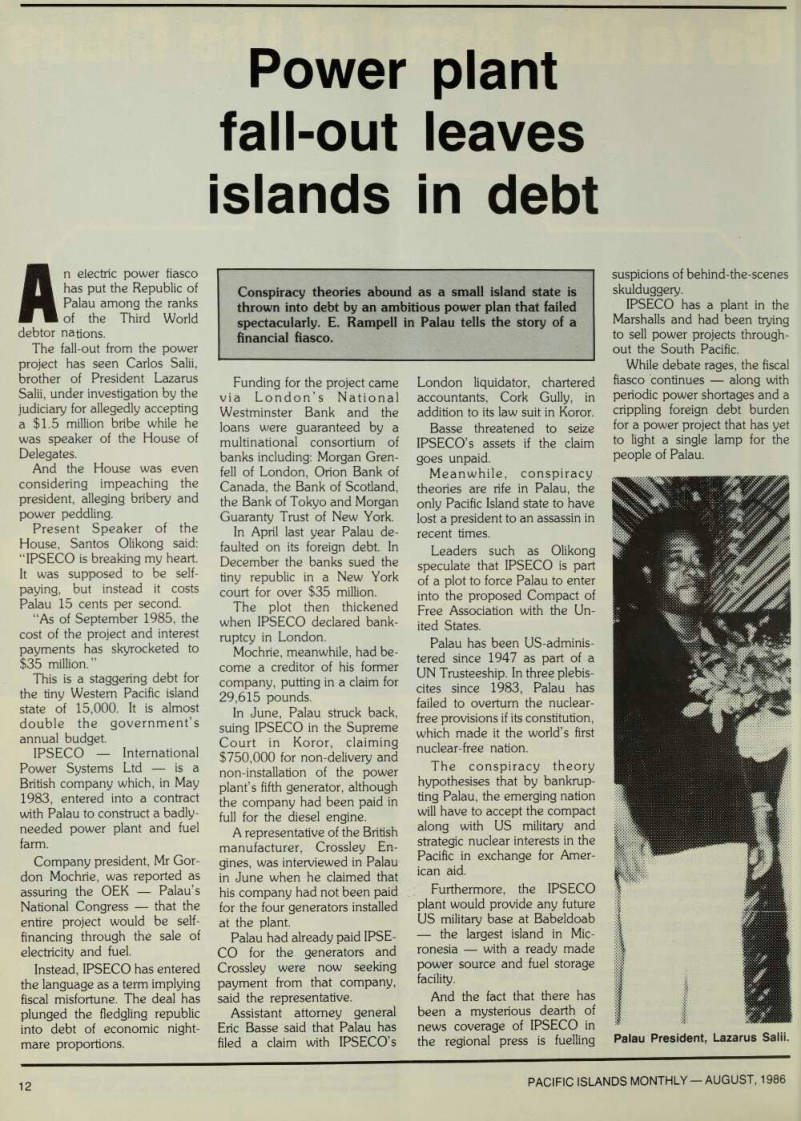
Palau President, Lazarus Salii.